Series: Hard Questions, Holy Answers — Post 41
Introduction — When Faith Looks for Proof
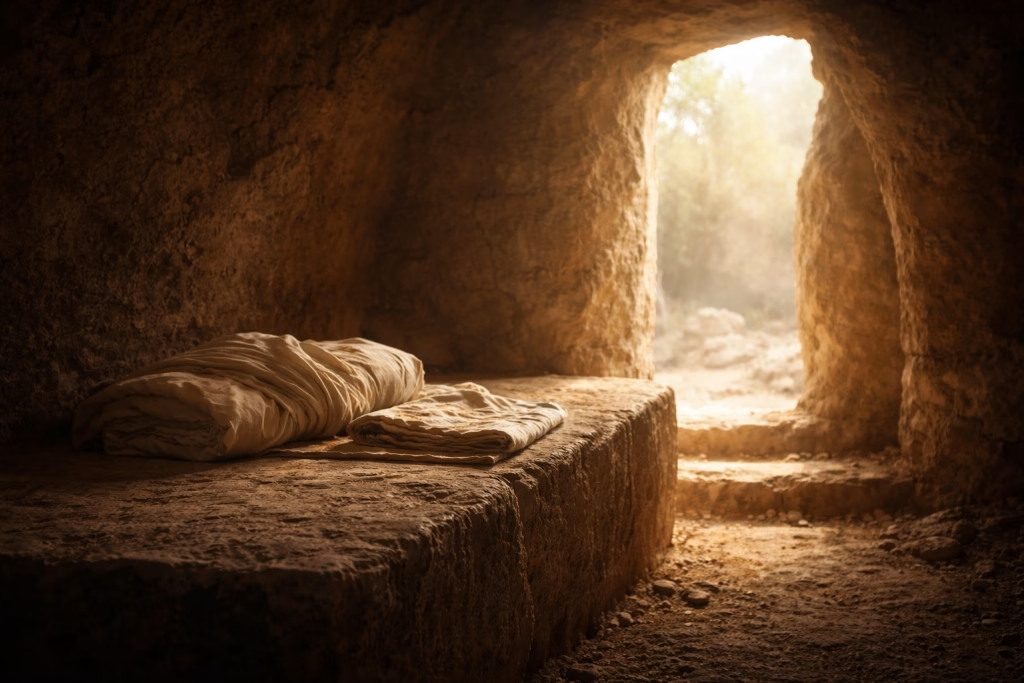
Many are coming to see the Shroud of Turin in my city this week.
Having been raised in a Catholic family, I grew up watching people venerate relics, objects believed to be connected to Christ. Over the years, I have seen the Shroud presented and treated in the same way.
Many claim it is the burial cloth of the Lord Jesus, even pointing to it as evidence of the resurrection.
But we must ask a more important question:
What does the New Testament say?
Even if it were real, what would it change?
For the believer, truth is not established by tradition, emotion, or appearance, but by the Word of God.
What Does the Bible Actually Say?
The burial of Jesus is not left to speculation. Scripture gives us clear and specific detail.
“Then took they the body of Jesus, and wound it in linen clothes with the spices…” John 19:40 (KJV)
“…and seeth the linen clothes lie,
And the napkin, that was about his head, not lying with the linen clothes, but wrapped together in a place by itself.” John 20:6–7 (KJV)
The details are important.
The Holy Ghost makes a point to tell us:
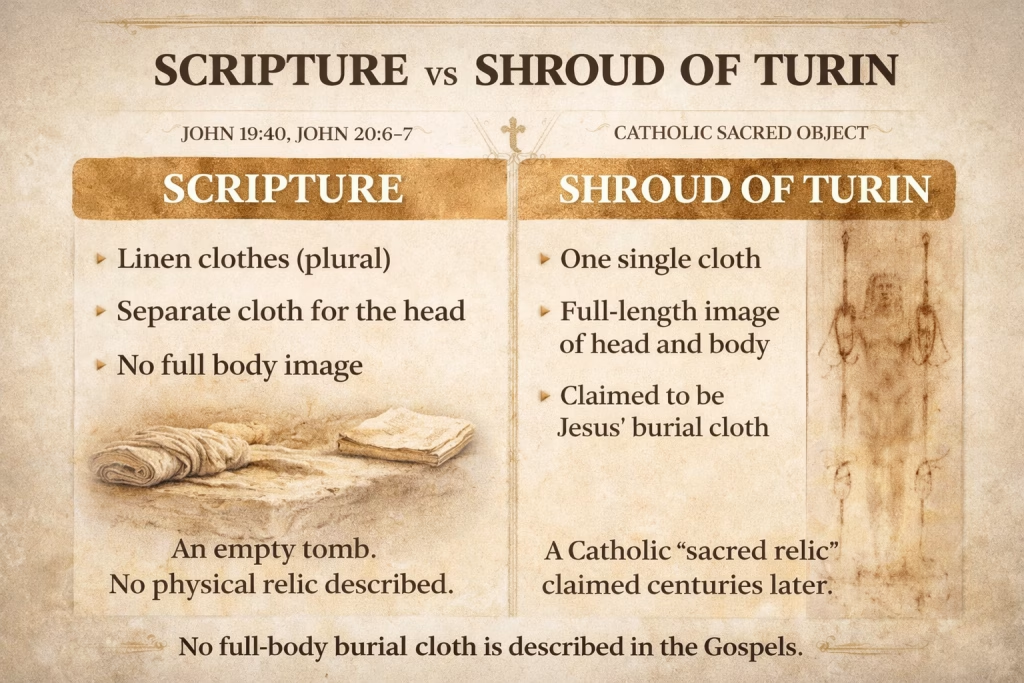
- There were linen clothes (plural)
- There was a separate napkin for the head
- They were arranged distinctly in the tomb
The Shroud of Turin, however, presents something entirely different:
- A single, continuous cloth
- A full-body image from head to toe
Far from being a small discrepancy it is a direct contradiction of the biblical record.
A Missing History
If the Shroud were truly the burial cloth of Christ, we would expect:
- Early church recognition
- Apostolic testimony
- Continuous historical record
Instead, what do we find?
The Shroud appears clearly in history around the 1300s, over a thousand years after the resurrection. Even more telling, some church leaders at the time openly questioned its authenticity. That alone should give pause and suspicion that truth emerges late and uncertain.
What is of God is established from the beginning.
The Rise of Relics
The Shroud does not stand alone. It belongs to a broader pattern.
Throughout medieval religion, there was an explosion of claimed relics:
- fragments of the cross
- bones of saints
- garments and objects tied to Christ
This created a system where people began to look for:
- physical contact
- sacred objects
- visible tokens of holiness
But the New Testament moves in the opposite direction. The early Church did not gather relics, they proclaimed a risen Lord. And they did not preserve objects they preached the gospel.
Would It Even Last?
From a practical standpoint, the claim raises another issue. Linen is fragile.
Over time, it:
- decays
- tears
- deteriorates with handling and exposure
For a cloth to survive nearly 2,000 years would require extraordinary preservation and even then, it would demand clear, unbroken historical evidence.
The Shroud does not have that.
The Greater Concern — Where Does Faith Rest?
This is where the matter becomes spiritual, not just historical. The danger is not merely believing something questionable. The danger is what it does to the heart.
Relics subtly shift the focus:
- from Christ Himself → to objects about Christ
- from the living Word → to physical evidence
- from faith → to sight
But the Lord Jesus said:
“Blessed are they that have not seen, and yet have believed.” John 20:29 (KJV)
The power of the gospel is not found in artifacts, it is found in a Person.
Christ Left No Relic Behind
There is a reason no burial cloth was preserved and handed down. Because there was no need, the tomb was empty. The grave clothes were left behind, not as relics to be honored, but as silent witnesses that death had been defeated.
The message of the apostles was never:
“Come see the cloth.”
It was always:
“He is risen.”
Final Word — The Living Christ, Not a Dead Relic
The Shroud of Turin may stir curiosity. It may even appear convincing to some. But it is not the foundation of our faith. Christ is. And He is not a figure impressed upon fabric. He is the risen Son of God, seated at the right hand of the Father, reigning now. We do not need a relic to prove Him.
We have:
- the Scriptures
- the Spirit
- the living reality of Christ within
Let others chase after objects, the believer looks to the throne.
Overcomer’s Checkpoint
Are you seeking reassurance through something you can see…or standing firmly on the Word of God? Faith that depends on evidence will always look for more, but faith rooted in Christ rests in what God has already said.
Well done! Off subject but not really:. Something spiritual to be discerned.
In the same chapter about the napkin John 20:7
See
John 20:11-12
But Mary stood without at the sepulchre weeping: and as she wept, she stooped down, and looked into the sepulchre,
And seeth two angels in white sitting, the one at the head, and the other at the feet, where the body of Jesus had lain.
This👆is a Picture of this👇
Exodus 25:20-19-21
And the cherubims shall stretch forth their wings on high, covering the mercy seat with their wings, and their faces shall look one to another; toward the mercy seat shall the faces of the cherubims be.
And make one cherub on the one end, and the other cherub on the other end: even of the mercy seat shall ye make the cherubims on the two ends thereof.
And thou shalt put the mercy seat above upon the ark; and in the ark thou shalt put the testimony that I shall give thee.
Don’t mean to distract from your message, but I found this to be beautiful.
Enjoy your writing of truth.
In Christ, Carl
Carl,
Thank you for sharing this. I have heard this observation before, and it is indeed a beautiful picture to consider.
In John 20:11–12, Mary looks into the tomb and sees two angels, “the one at the head, and the other at the feet, where the body of Jesus had lain.” It is certainly interesting that this mirrors the two cherubim positioned at either end of the mercy seat in Exodus 25.
Whether John intended us to see a direct allusion or not, there is no question that Christ Himself is the fulfillment of everything the mercy seat represented. The blood sprinkled upon the mercy seat pointed forward to the blood of Christ, and the place where God’s justice and mercy met under the Old Covenant finds its ultimate fulfillment at the cross and in the resurrection.
The thought that the place where Jesus’ body had rested was marked by two angels, much like the cherubim overshadowing the mercy seat, is a wonderful meditation on the finished work of Christ.
Thank you for sharing the insight and for your encouragement.
In Christ,
Rick