(When Revelation Gives Way to Reconstruction — Post 17)
One of the striking things about the New Testament is something most readers never notice.
The apostles rarely retell the stories of Jesus’ earthly ministry.
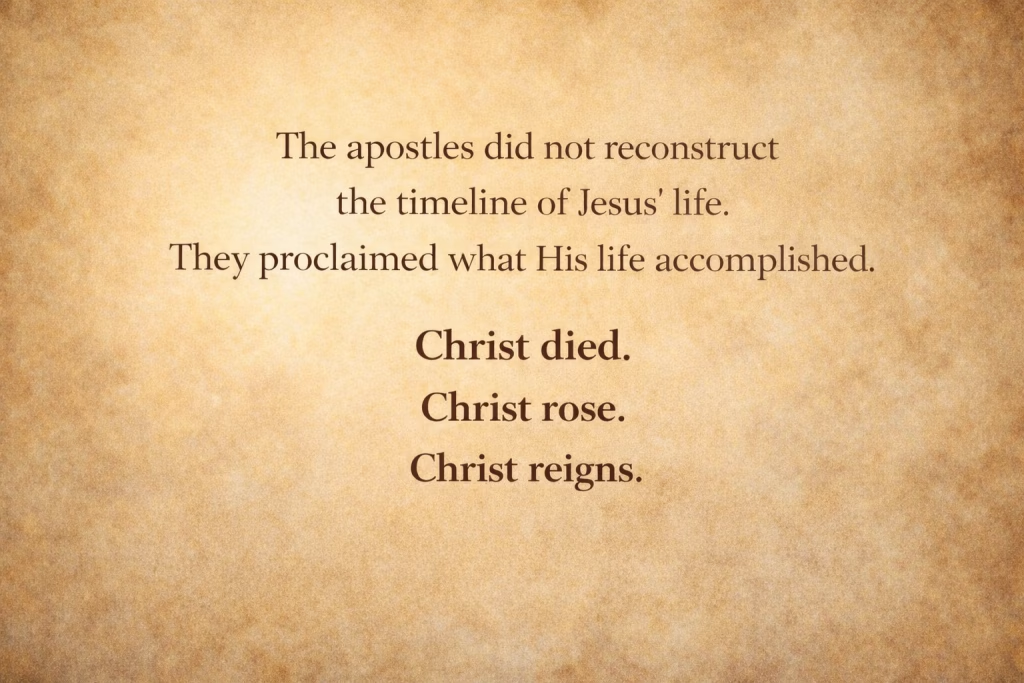
They do not reconstruct His timeline nor did they harmonize the Gospels. They did not attempt to arrange events chronologically. Instead, they proclaim what those events accomplished.
This becomes obvious the moment we move from the Gospels into Acts and the Epistles. The Gospels give us narrative and the apostles gave us interpretation.
Consider Peter’s preaching in Acts. He does not walk through the details of Jesus’ ministry in Galilee Nor did he copiously explain the sequence of miracles. He didn’t even reconstruct the Sermon on the Mount like we see so much of today.
Instead he declares the meaning of the central events:
“Him, being delivered by the determinate counsel and foreknowledge of God, ye have taken… whom God hath raised up.” (Acts 2:23–24)
The apostles preached death, resurrection, and exaltation. They assumed the story was known. Their task was not to repeat the narrative but to announce the reality the narrative produced.
Paul does the same thing.
In 1 Corinthians 15 he summarizes the Gospel in a few lines:
“Christ died for our sins…
he was buried…
he rose again the third day.” (1 Cor 15:3-4)
No timeline or harmonization or reconstruction. Because apostolic preaching was never about re-telling the story, it was about declaring what the story accomplished and walking in it.
The Gospels reveal who Christ is, the apostles proclaimed what His work meant and they demonstrated the power of a godly, Christ-centered and Christ-yielded life.
When interpretation drifts away from that apostolic focus, something subtle happens: believers begin studying the events of Christ’s life without standing in the authority those events established.
The apostles did not want the Church merely informed about Jesus, they wanted the Church established in His finished work. And the apostles did not interpret Scripture by reconstructing timelines or writing systematic theology volumes, they interpreted it by proclaiming the finished work and present reign of Christ and walking in it.
“For I determined not to know any thing among you, save Jesus Christ, and him crucified.” 1 Corinthians 2:2
Overcomer’s Checkpoint
Apostolic teaching was never meant to leave believers merely informed about Jesus. It was meant to establish them in His finished work and present authority.
Take a moment to ask yourself:
1️⃣ Do I see myself walking in the authority of Christ, or merely reading about historical figures who once did?
2️⃣ When I study Scripture, do I primarily analyze events — or do I ask what those events accomplished and what they now mean for my life?
3️⃣ Has my Bible study produced greater clarity about Christ’s present reign, or has it mostly filled my mind with information about the past?
The apostles did not preach so that believers would admire what Christ once did, they preached so that believers would stand in what Christ accomplished and walk in the authority of His reign.
The apostles did not leave the Church with a puzzle to reconstruct, but with a victory to proclaim and a Kingdom to walk in under the authority of the risen Christ.