Why Living by Christ Does Not Mean Abandoning God’s Righteous Standard
Introduction — When Words Trigger Concern
Recently, a reader responded to an article of mine with a concern that is worth addressing carefully.
He had spent decades in a movement shaped by the teachings of Witness Lee, and when he read the phrase “beyond morality,” it raised a red flag. And honestly—that reaction makes sense.
There is a version of that language that leads to error. There are teachings that speak of “Christ as life” while quietly drifting away from the authority of Scripture and the reality of obedience. So the concern is not foolish. But the conclusion does not follow, because the New Testament does not call us to abandon righteousness.
It reveals something far deeper:
Righteousness is no longer something we produce—it is something fulfilled in us through Christ.
The Real Issue — Not Whether Righteousness Matters, But Where It Comes From
Let’s be clear from the outset, God has not lowered His standard.
The law still reflects His nature:
- holy
- just
- good
But the question is not: 👉 Should the believer live righteously?
The question is: 👉 How does that righteousness come?
The old covenant answer was: Man must obey.
The New Testament answer is: Christ is our life—and our righteousness.
“Christ… is made unto us… righteousness.” (1 Corinthians 1:30)
The Failure of Moral Effort
Most Christians—even sincere ones—default to this:
- trying harder
- being more disciplined
- measuring progress by behavior
But Scripture exposes the limitation of that approach.
“For what the law could not do, in that it was weak through the flesh…” (Romans 8:3)
The law was not weak in itself. 👉 It was weak because of us.
No amount of effort can produce what God requires. That’s why even “good” morality—if it comes from self—is still insufficient.
What the New Testament Actually Reveals
The gospel does not strengthen moral effort.
It replaces the source.
“I am crucified with Christ: nevertheless I live; yet not I, but Christ liveth in me…” (Galatians 2:20)
This is not poetic language, this is the foundation of the Christian life.
The believer is not called to:
- imitate Christ externally
but to:
- live by Christ internally
And this is how righteousness is fulfilled:
“That the righteousness of the law might be fulfilled in us, who walk not after the flesh, but after the Spirit.” (Romans 8:4)
Notice carefully:
👉 The law is not discarded
👉 It is fulfilled
But not by human effort, by the Spirit.
Two Dangerous Errors
This is where many go wrong—on both sides.
1. The Error of Moral Christianity
This view says:
- Obey the commandments
- Try to live right
- Measure your standing by performance
It sounds safe.
It sounds serious.
But it quietly shifts the Christian life back onto man as the source.
The result is:
- burden
- inconsistency
- introspection
- either pride or discouragement
2. The Error of Lawless “Spirituality”
On the other side, some react against moral effort and say:
- “Just live by Christ”
- “Don’t focus on commandments”
But this becomes:
- vague
- detached from Scripture
- sometimes permissive
This is not freedom.
This is confusion.
The Truth — Christ as Life Produces Real Righteousness
The New Testament does not offer a middle compromise.
It reveals a higher reality:
Christ Himself is both the life and the righteousness of the believer.
“Without me ye can do nothing.” (John 15:5)
When Christ is truly the source:
- obedience is real
- righteousness is genuine
- fruit is produced
Not forced, not performed, but lived.
The Deeper Pattern — Life, Not Law
From the beginning, the issue has never been:
👉 morality vs immorality
It has always been:
👉 life vs independence
In Eden, the choice was:
- the tree of the knowledge of good and evil
- the tree of life
Even “good” can be independent of God and that is the root problem.
The Test — How Do You Know the Difference?
This is where discernment becomes practical.
Ask:
- Does this teaching anchor me in Scripture?
- Does it make Christ central—not just language about Him?
- Does it produce real obedience—not just ideas?
- Does it remove self as the source?
If Christ is truly the source: 👉 righteousness will follow.
Conclusion — Not Less Than Righteousness, But More
To move beyond morality does not mean:
- abandoning God’s law
- lowering the standard
- excusing sin
It means this:
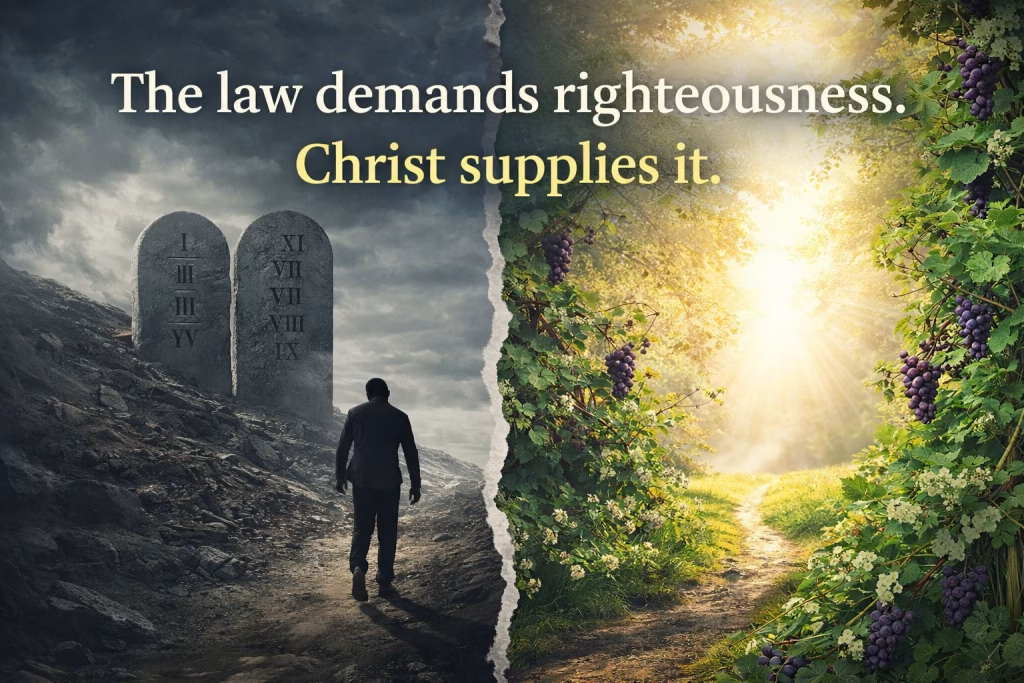
Righteousness is no longer demanded from us—it is supplied in us through Christ.
The law pointed to it.
Christ fulfills it.
And the believer lives in it.
Overcomer’s Checkpoint
- Am I trying to produce righteousness… or receiving it in Christ?
- Do I measure my walk by effort… or by dependence?
- Is Christ truly my life—or just my example?
“For me to live is Christ.” (Philippians 1:21)
Greetings, Rick.
I’m acquainted with the reader you mention, and he encouraged me to share my thoughts on this article of yours.
I myself spent very nearly a decade within a group of churches known as The Lord’s Recovery (The Local Churches), which was founded by Witness Lee and remains fervently dedicated to preserving and disseminating his teachings.
I wanted to express my gratitude that you would be willing to speak on this matter. This concept of going “beyond morality” is certainly one which has burdened me for many years, and I too am quick to raise my brow whenever such language is used due to how it has often been applied within the churches of The Lord’s Recovery.
I greatly appreciate your presentation of the distinction between receiving righteousness through faith in Christ and attempting to produce righteousness through human effort. Likewise, I appreciate your exhortation that one must not veer into vague or spiritually detached ideas that invoke “living by Christ” while quietly abandoning the reality of obedience and scriptural grounding.
It is my understanding that a believer should endeavor to live righteously, for the Christian life is indeed an endeavor—a race to be run. There is a righteousness that saves—the righteousness of Christ—and there is also a righteousness lived out in believers, one that requires conscious effort while remaining rooted in our union with the Lord. As such, I would say that the New Testament answer is this: Christ is our life and our righteousness, and those who believe are called to obedience.
I agree with your exhortation which warns of defaulting to simply trying harder and being more disciplined, particularly when it replaces a genuine, intimate, and daily relationship with Christ. As believers, we are called to bear fruit, to discipline ourselves, to learn from the scriptures, and to learn to discern between good and evil, though there must be a solid foundation underneath it all. Much like how one must balance relationships with academic pursuits or career obligations, I believe the Christian life must likewise be balanced between earnest endeavor and an ongoing, tenderly nurtured relationship with God.
As believers, we are invited to experience the reality of “Christ in us,” the presence of God strengthening us from within. He is the Helper who dwells within us and marks us as God’s own. At the same time, the Apostle Paul explicitly exhorts believers to be imitators of Christ—those who do as Christ did. Christ Himself set forth the example of righteous living, both in what He taught and commanded and in the very way He lived His life. Indeed, Christ taught that we must be born again, and He instructed us to love God and neighbor alike. The final message He left to His apostles was this: “Therefore go and make disciples of all nations, baptizing them in the name of the Father and of the Son and of the Holy Spirit, and teaching them to obey everything I have commanded you. And surely I am with you always, to the very end of the age.”
As you mention, there is always the risk of living the Christian life in an unbalanced manner. What should be an earnest desire to grow in discernment, self-control, and maturity can devolve into legalism, perfectionism, and unhealthy expectations. Likewise, what should be inward spiritual reflection and communion with the Holy Spirit—who guides and empowers believers—can become surface-level spirituality that is vague, shallow, detached from scripture, and even harmful.
As such, there are absolutely two dichotomies presented in the scriptures: morality/immorality and communion/independence. Both of these are dichotomies that God’s people must wrestle with, for disobedience and immorality resulted in the breaking of communion with our God. In the same vein, it is the restoration of communion through Christ that allows us to once more wrestle earnestly with morality and immorality—not for the sake of securing salvation, but because of the very freedom which salvation grants us.
As one dear pastor from my youth put it, “The freedom that Jesus gives is not freedom to do as you want, it is freedom to do as you ought.” Likewise, I believe this thought to be in complete harmony with your own: If Christ is truly the source, righteousness will follow.
We must endeavor to live out the righteousness that comes freely from Christ, for we are invited not only to partake of his righteousness, but to show it.
We may gauge our maturity and spiritual well-being by the obedience, discipline, and earnestness we exercise while depending upon Christ as our foundation, for we are not called merely to stand on the foundation, but to build properly upon it.
We must take Christ both as our life and our example day by day as we walk with the Lord, for Christ is not merely within us for our own experience, but rather the world will know we are the sons of God when we walk as he walked.
Thank you again, Rick, for speaking on this matter and for the opportunity to engage in dialogue on such a fascinating subject. I sincerely appreciate your willingness to address these issues thoughtfully, and I would be glad to hear any further thoughts you may have when you are able.
Hello Javier,
Thank you for taking the time to write such a thoughtful and gracious response. I especially appreciate hearing from someone who spent many years within The Lord’s Recovery and has firsthand experience with how some of these concepts are taught and applied in practice.
I was encouraged by your comment because it is evident that you understood the main concern of the article. My intention was not to diminish obedience, righteousness, self-control, or spiritual maturity. Rather, it was to address the tendency I have observed in some circles to speak of “living by Christ” in ways that become detached from practical obedience, moral responsibility, and the clear commands of Scripture.
I particularly appreciated your statement that Christ is both our life and our righteousness, and that those who believe are called to obedience. I believe that captures an important New Testament balance. The Lord does not save us merely to leave us unchanged. The same grace that justifies also teaches, transforms, and bears fruit.
At the same time, if I were to gently interact with one aspect of your comment, it would be regarding the idea of gauging our spiritual well-being by our obedience, discipline, and earnestness. I understand the point you are making, and I certainly agree that these things matter. Yet I have also seen many sincere believers become discouraged because they begin measuring themselves rather than looking unto Christ.
One of the great lessons I continue to learn is that fruit is a wonderful witness to life, but it makes a poor foundation for assurance. The healthiest believers I have known were often the least impressed with their own progress and the most occupied with Christ Himself.
That is why I believe the order is so important. We do not look at our fruit to find Christ; we look to Christ, and fruit follows. We do not find peace by measuring our maturity; we find peace in Him, and maturity grows as we abide in Him.
I suspect we would agree that both ditches are dangerous. On one side lies legalism, where the Christian life becomes a constant examination of personal performance. On the other side lies a vague spirituality that speaks much of Christ as life while neglecting obedience altogether. Neither reflects the balance of the New Testament.
As you so well stated, if Christ is truly the source, righteousness will follow.
Thank you again for your thoughtful contribution to the discussion. Comments like yours help elevate the conversation and encourage believers to think carefully about these important matters.
Grace and peace,
Rick