Flesh and Spirit: Why Christian Zionism Can’t See the Kingdom — Post 3
“They are not all Israel, which are of Israel.”
— Romans 9:6, KJV
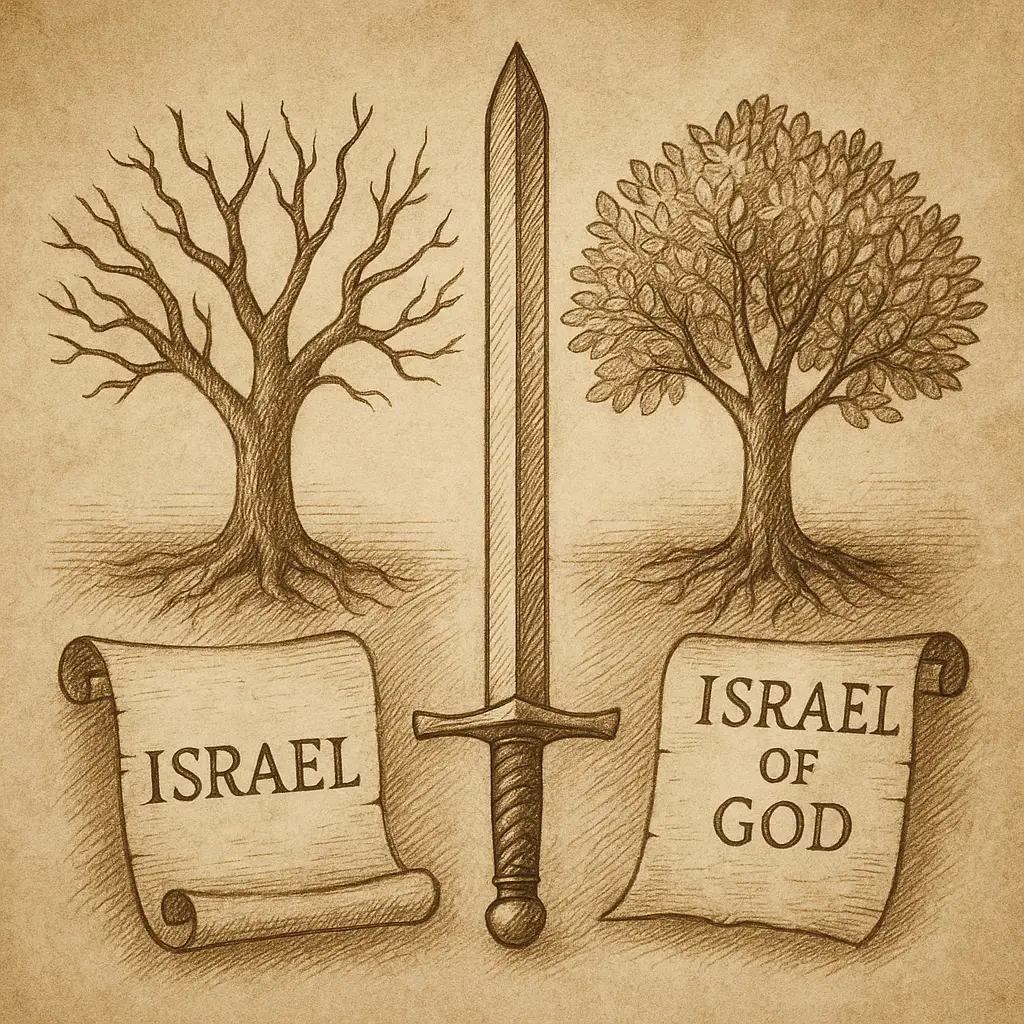
Christian Zionism depends on a simple but deadly assumption:
That “Israel” always means the same thing in the Bible — specifically, ethnic Jews descended from Abraham through Jacob.
But Paul, writing under the inspiration of the Holy Ghost, cuts that assumption down in a single phrase:
“They are not all Israel, which are of Israel.”
In other words, there is an Israel within Israel, a distinction between natural lineage and covenant identity. And this distinction is not a technicality — it is the interpretive key to understanding the entire arc of redemptive history.
Not All Israel
Romans 9–11 is often misused by Christian Zionists to argue that God still has a separate, national plan for ethnic Israel. But they rarely stop to ask: What does Paul mean by “Israel”?
Let’s examine the first verses of Romans 9:
“I could wish that myself were accursed from Christ for my brethren, my kinsmen according to the flesh…”
— Romans 9:3
Paul is burdened for his ethnic brethren, those of Israel after the flesh.
“Who are Israelites; to whom pertaineth the adoption, and the glory, and the covenants…”
— Romans 9:4
This nation had glorious privileges. But then comes the dividing line:
“Not as though the word of God hath taken none effect. For they are not all Israel, which are of Israel.”
— Romans 9:6
If we miss this, we’ll misread the whole chapter. Paul is not affirming ethnic Israel’s unbroken covenantal role. He’s reframing the definition of Israel to center in faith, not flesh.
Children of Promise vs. Children of the Flesh
Paul continues:
“Neither, because they are the seed of Abraham, are they all children: but, In Isaac shall thy seed be called.”
— Romans 9:7
Ishmael was also Abraham’s seed. But the covenant went through Isaac — the child of promise.
“They which are the children of the flesh, these are not the children of God: but the children of the promise are counted for the seed.”
— Romans 9:8
This is covenantal surgery. The Word of God here divides between biological descent and spiritual inheritance. God’s people are not defined by bloodline, but by belief.
And Paul doesn’t stop with Isaac. He brings in Jacob and Esau — same mother, same father, same womb — and still one is chosen, the other not. Why?
“That the purpose of God according to election might stand, not of works, but of him that calleth.”
— Romans 9:11
Who Then Is Israel?
If only some of ethnic Israel are actually Israel in God’s sight, then who is?
Who carries forward the promises? Who inherits the covenants?
The answer unfolds across the New Testament:
- Galatians 3:7 — “They which are of faith, the same are the children of Abraham.”
- Galatians 3:29 — “If ye be Christ’s, then are ye Abraham’s seed, and heirs according to the promise.”
- Romans 2:28–29 — “He is not a Jew, which is one outwardly… but he is a Jew, which is one inwardly.”
- Philippians 3:3 — “We are the circumcision, which worship God in the spirit.”
This is the new covenant Israel — the spiritual people of God, made up of both Jew and Gentile, gathered into one body in Christ.
God Has Not Failed — But Many Have Misunderstood
When Paul says, “Not as though the word of God hath taken none effect…” (Rom. 9:6), he’s addressing the objection many Christian Zionists raise: “But didn’t God promise Abraham?”
Yes — but the promise was always about Christ.
“Now to Abraham and his seed were the promises made… to thy seed, which is Christ.”
— Galatians 3:16
The promise is fulfilled in Him — not in a political entity, not in a strip of land, and not in a genealogical tree.
From Root to Remnant
Romans 11 continues Paul’s thought: there is a remnant of Israel — those who believe, and are therefore part of the olive tree.
But what of unbelieving Jews?
“They also, if they abide not still in unbelief, shall be graffed in…”
— Romans 11:23
The condition for inclusion is faith — not ancestry.
And the warning for the Church?
“Boast not… be not highminded, but fear.” (Rom. 11:18,20)
This isn’t about supremacy. It’s about unity in Christ.
Why Christian Zionism Rebuilds What God Tore Down
By insisting that modern Jews still possess covenantal favor apart from faith, Christian Zionism:
- Denies the sufficiency of Christ
- Divides what God has made one
- Preaches two peoples, two plans, and two destinies
- Turns the focus from the heavenly kingdom to an earthly agenda
But Christ came to fulfill — not perpetuate — the old system.
“For He is our peace, who hath made both one, and hath broken down the middle wall of partition between us.”
— Ephesians 2:14
There is one people, one Seed, one promise — and that is enough.
Next: The Land or the Lord?
Untangling the Promise of Inheritance