True Apostolic Discipleship — Post 6 of 48
Section II: The Cross and the Covenant
God does not lead His children to the throne by avoiding the cross, but by forming the life of the Lamb within them.
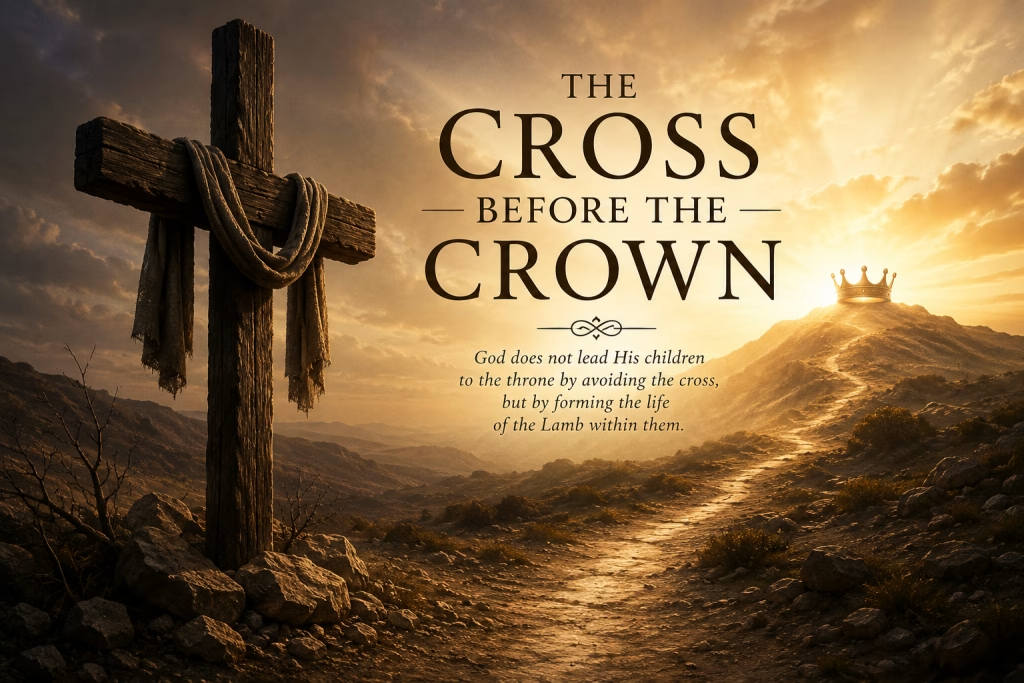
Every disciple begins by following Christ, but few understand where He is leading.
At first, we see His power. We hear His words. We experience His mercy. We rejoice that our sins are forgiven and that eternal life has been given to us freely. We begin to imagine what God may do through our lives.
Then the road narrows.
The Lord begins to touch the very things we assumed He would strengthen—our independence, our ambitions, our confidence in ourselves, our need to be understood, and our desire to control the outcome.
We expected Him to improve the old life.
He came to bring it to the cross.
This is where many believers become confused. They received Christ expecting victory, yet they encounter weakness. They prayed for usefulness, yet God permits obscurity. They asked for spiritual authority, yet He first teaches them submission. They desired the crown, but the Lord begins speaking to them about the cross.
There is no contradiction in this.
The cross is not a detour from the purpose of God.
It is the way into it.
Peter Wanted the Kingdom Without the Cross
When Jesus began to show His disciples that He must go to Jerusalem, suffer, be killed, and rise again, Peter could not accept it.
“Then Peter took him, and began to rebuke him, saying, Be it far from thee, Lord: this shall not be unto thee.” — Matthew 16:22
Peter believed Jesus was the Christ. He expected the kingdom. He could imagine the throne.
But he could not reconcile the throne with the cross.
In Peter’s mind, suffering contradicted Messiahship. The Christ should conquer, not be rejected. He should reign, not be crucified. Peter loved the Lord, but his understanding of God’s purpose was still governed by natural reasoning.
Jesus answered him with startling severity:
“Get thee behind me, Satan: thou art an offence unto me: for thou savourest not the things that be of God, but those that be of men.” — Matthew 16:23
Peter was not knowingly serving Satan. He was speaking from human affection and natural wisdom. Yet the suggestion that Christ could receive the kingdom without the cross came from the same spirit that had tempted Jesus in the wilderness.
Satan offered Him the kingdoms of the world without Calvary.
Peter, without realizing it, was suggesting the same path.
The temptation was not merely to abandon God’s purpose. It was to obtain the promised glory by avoiding God’s appointed way. That temptation remains with us.
We want:
- resurrection power without fellowship in His sufferings.
- authority without submission.
- fruitfulness without pruning.
- spiritual stature without hidden years.
- the crown without the cross.
But Jesus never offered such a discipleship.
The Cross Is Not Merely What Jesus Endured
Many believers understand the cross only as the place where Jesus died for them.
That is gloriously true. Christ bore our sins, suffered judgment in our place, and reconciled us to God through His blood. Nothing can be added to His finished work.
But Jesus also presented the cross as the pathway of every disciple.
“Then said Jesus unto his disciples, If any man will come after me, let him deny himself, and take up his cross, and follow me.” — Matthew 16:24
The cross of the disciple is not an additional sacrifice for sin. Christ alone accomplished redemption.
Our cross is the practical application of His death to the rule of self.
Jesus did not merely say, “Admire My cross.”
He said, “Take up yours.”
To deny self is not the same as denying ourselves certain comforts. A person may give up food, possessions, sleep, marriage, leisure, or worldly success and still remain thoroughly self-governed.
Self-denial may become another ground for pride.
To deny self is to renounce self as the governing center of life. It means that my will is no longer final.
My feelings are no longer lord, my understanding is no longer the measure of truth, my reputation is no longer the treasure that must be protected at all costs and my life is no longer my own possession.
The cross brings us under the government of another.
The Cross Exposes What Religious Activity Can Hide
Religious service can conceal the strength of the natural man.
A person may preach, teach, lead, pray publicly, give generously, endure hardship, and gather followers while still being governed by ambition, insecurity, jealousy, and the need for recognition.
Gift can operate where character remains immature.
Knowledge can increase while self remains enthroned.
Ministry can become the place where the old man finds religious expression.
The cross brings hidden motives into the light.
- Why must I be seen?
- Why must my opinion prevail?
- Why am I disturbed when another is honored?
- Why do I become defensive when corrected?
- Why must God work according to my timetable?
- Why do I call it spiritual conviction when it may simply be wounded pride?
These questions are not comfortable, but they are merciful. God is not exposing us because He despises us. He is exposing what cannot inherit His kingdom.
Paul understood this principle:
“Always bearing about in the body the dying of the Lord Jesus, that the life also of Jesus might be made manifest in our body.” — 2 Corinthians 4:10
The dying and the manifestation belong together. Where the cross is working, the life of Jesus is being revealed. The purpose is not death for death’s sake. God is not interested in producing lifeless, crushed, passive people. He is removing the obstruction so that the life of His Son may be seen.
The cross is never God’s final word.
Resurrection is.
Joseph Received the Dream Before the Pit
Joseph saw the crown before he understood the cross.
God gave him dreams of rule, but the path to their fulfillment led through betrayal, slavery, false accusation, and prison.
The dream was from God and so was the formation.
Joseph may initially have imagined that the dream revealed what others would someday recognize in him. In time, he learned that the dream concerned what God intended to make of him. Before Joseph could govern Egypt, he had to be delivered from the need to govern his own journey.
- He could not control his brothers.
- He could not prevent the pit.
- He could not determine the terms of his service in Potiphar’s house.
- He could not defend himself against false accusation.
- He could not open the prison door.
Every place stripped away another layer of self-reliance. Yet God was not absent from the pit, the house, or the prison. The Lord was forming a man who could carry authority without being destroyed by it. When the crown finally came, Joseph no longer used power to vindicate himself. He used it to preserve life.
That is the work of the cross. Natural man wants authority in order to prove himself.
The formed man receives authority in order to serve God’s purpose.
David Was Anointed Long Before He Was Enthroned
David’s anointing did not immediately place him on the throne.
It placed him on the road toward it.
Samuel poured oil upon David, but Saul remained king. David defeated Goliath, yet soon found himself hunted in the wilderness. The man chosen by God had opportunities to seize what God had promised, but he refused to establish the kingdom by the strength of his own hand.
When Saul entered the cave, David’s men believed providence had delivered his enemy to him.
David could have ended the delay in a moment.
But he would not take through the flesh what God had promised by the Spirit.
“The LORD forbid that I should do this thing unto my master, the LORD’S anointed, to stretch forth mine hand against him.” — 1 Samuel 24:6
David was learning that the throne belonged to God.
The promise was God’s, the timing was God’s and the way was God’s.
The wilderness was not proof that the anointing had failed. It was the place where the anointed man was being prepared to carry the kingdom. A crown taken prematurely would have ruined David.
The cross prepared him to receive it.
The Cross Deals With Our Right to Be Right
One of the deepest workings of the cross concerns our demand to be vindicated.
We may endure inconvenience more easily than misunderstanding. We may survive hardship more easily than false accusation. Something in us insists that the record must be corrected, motives must be explained, and others must finally admit that we were right.
There are times when truth must be spoken and error must be confronted. The cross does not require dishonesty or silence in the face of evil.
But it does deal with the inward demand that our name be cleared before we can rest.
Jesus:
“When he was reviled, reviled not again; when he suffered, he threatened not; but committed himself to him that judgeth righteously.” — 1 Peter 2:23
He did not deny the truth and He entrusted Himself to the Father.
That is the difference.
The flesh must control how others see us. The cross releases our reputation into God’s hands. The flesh says, “I cannot have peace until everyone understands.”
Faith says, “The Father knows.”
This is not weakness. It is one of the deepest forms of spiritual strength.
Not Every Difficulty Is a Cross
We should also be careful not to call every hardship “the cross.” Some suffering comes from our own foolishness, some comes from sin while other suffering comes because we refuse counsel, neglect responsibility, or persist in harmful patterns.
The cross is not a spiritual name for every unpleasant consequence, nor is it something we manufacture for ourselves.
Jesus did not tell His disciples to create suffering. He told them to follow Him.
The cross is found in the path of obedience. It appears when the will of God conflicts with the rule of self. It is present when faithfulness costs us something we would naturally preserve. It is present when we must choose truth over approval, forgiveness over bitterness, purity over appetite, patience over control, obedience over convenience, and Christ over self-protection.
The cross is not merely pain.
It is the surrender of self-rule in obedience to God.
The Cross Is Daily
Jesus said:
“If any man will come after me, let him deny himself, and take up his cross daily, and follow me.” — Luke 9:23
There are great moments of surrender in the Christian life, but the cross is usually worked into us through ordinary days.
- It appears in the conversation where we choose not to defend ourselves harshly.
- It appears when we forgive before feelings have caught up.
- It appears when we remain faithful in obscurity.
- It appears when we obey without applause.
- It appears when we listen instead of insisting upon being heard.
- It appears when we receive correction without immediately building a defense.
- It appears when another person’s needs interrupt our carefully arranged plans.
- It appears when we surrender our timetable to God.
These moments may seem small, but they reveal who is governing the life. The great declarations of consecration are tested in daily relationships. A person may speak passionately about dying to self while remaining impatient, controlling, touchy, and unwilling to yield at home.
The cross is not proved by our vocabulary.
It is revealed in our walk.
The Cross and the Covenant Belong Together
Post 5 established that discipleship rests upon God’s covenant faithfulness rather than our unstable promises. That foundation is necessary because the cross will shake everything in which we have placed false confidence.
Without covenant assurance, the dealings of God can feel like rejection. When our strength fails, we may think He has abandoned us. When a door closes, we may assume the promise has been withdrawn. When correction comes, we may hear condemnation rather than the voice of a Father.
But covenant teaches us that God is committed to finishing what He began. Therefore, we can be broken without being destroyed. We can be corrected without fleeing. We can be humbled without losing hope.
The cross does not mean the covenant has failed, it means the covenant is working deeply. God has not pledged Himself to preserve the reign of self. He has pledged Himself to conform us to the image of His Son.
“For whom he did foreknow, he also did predestinate to be conformed to the image of his Son.” — Romans 8:29
That conformity includes the pattern of the Lamb. The One who reigns is the One who was slain.
The throne of God is not occupied by self-exalting power, but by holy, sacrificial love.
The Lamb Is the Pattern of the Overcomer
Revelation does not separate overcoming from the Lamb.
The overcomers conquer because of His blood, His testimony, and a life no longer held as their own.
“And they overcame him by the blood of the Lamb, and by the word of their testimony; and they loved not their lives unto the death.” — Revelation 12:11
They overcome first by what Christ has done. Then by the testimony of what He has made real within them. And finally by refusing to preserve self at the cost of faithfulness.
This is not a glorification of death. It is freedom from the enemy’s greatest leverage.
Satan controls men through fear—fear of loss, rejection, suffering, obscurity, and death. The disciple whose life has been surrendered to Christ cannot be governed in the same way.
The life of the Lamb has been formed within him. He does not overcome by becoming louder, harder, or more aggressive than the enemy. He overcomes by standing in the victory of Christ and refusing to abandon obedience.
The cross produces this kind of overcomer.
The Crown Is Not Self-Exaltation
When Scripture speaks of reigning with Christ, the flesh may imagine spiritual status, superiority, or reward for personal greatness.
But the crown belongs to the life of Christ. God is not preparing the old man for promotion. He is forming a people who can share the government of the Son because they have learned the nature of the Son.
Christ’s authority is not separate from His character.
- He is the Lion who conquered as the Lamb.
- He possesses all power, yet gives Himself.
- He rules, yet serves.
- He is exalted, yet forever bears the marks of sacrifice.
The cross prepares us for the crown by forming in us the kind of life that can be trusted with authority.
Without the cross:
- authority feeds pride.
- gifting becomes self-promotion.
- revelation becomes superiority.
- leadership becomes control.
- the language of overcoming becomes another way for the flesh to seek prominence.
God will not crown what He has sentenced to death. The crown belongs to Christ and to those in whom His life has been formed.
The Joy Set Before Him
Jesus did not endure the cross because suffering itself was good.
He endured because of what lay beyond it.
“Looking unto Jesus the author and finisher of our faith; who for the joy that was set before him endured the cross, despising the shame.” — Hebrews 12:2
The cross was terrible, the shame was real.
But it was not final.
Beyond the cross stood resurrection, ascension, a redeemed people, and the fulfillment of the Father’s purpose.
The disciple also learns to look beyond the immediate pain.
He may not understand every dealing of God while passing through it. Joseph did not understand the prison while he was inside it. David did not know how long the wilderness would last. Peter could not yet imagine how his failure would prepare him to strengthen his brethren.
But the Father knew.
The cross does not ask us to call darkness light or pain pleasant, it asks us to trust that God is able to bring resurrection life out of every death to which He faithfully leads us.
Following the Lamb
The call of discipleship is not merely to believe that Jesus died. It is to follow the One who died and rose again. He leads us into places where self cannot survive as lord.
He teaches us to release our rights, our reputation, our timing, our ambitions, and even our understanding into the hands of the Father.
This path is costly, but it is also liberating.
The cross delivers us from the exhausting task of preserving ourselves. We no longer have to force the promise, manufacture the ministry, defend the image, control the outcome, or secure the crown.
We follow Christ, the Father handles the resurrection.
The crown will come in God’s way and time. But it will rest only upon the life that has passed through the cross.
“If we suffer, we shall also reign with him.” — 2 Timothy 2:12
There is no crown without the cross, but neither is there a cross without resurrection.
The disciple who follows the Lamb is not walking toward defeat, he is walking through death into the life that cannot be conquered.
Not every wound is holy, and not every hardship comes from God. Yet when suffering is received under the Father’s hand, it can become a school in which endurance, compassion, discernment, and the life of Christ are formed within us.
Thank you for your obedience to our Lord. This was so helpful to me and very timely. May God continue to reach His people through this ministry.
Blessings, Sandy
Thank you, Sandra. Your encouragement means a great deal. My prayer is simply that Christ would be exalted and His people would be strengthened through His Word. May the Lord continue to lead both of us deeper into His life and likeness. Thank you for taking the time to write. Blessings, Rick