Flesh and Spirit: Why Christian Zionism Can’t See the Kingdom — Post 14
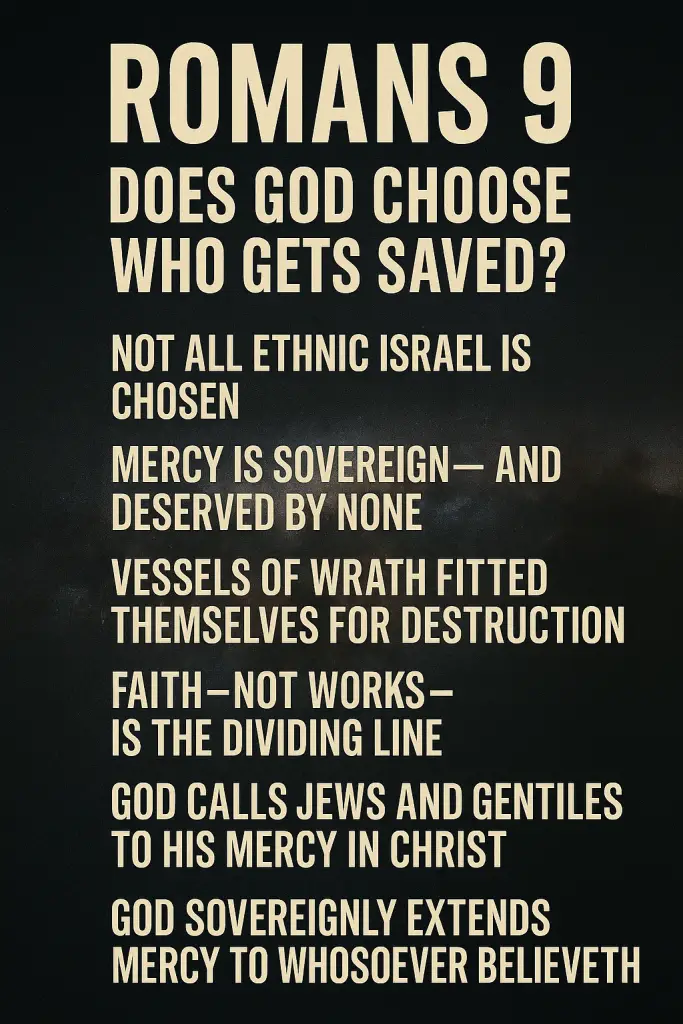
Many believers are unsettled by Romans 9. Calvinists cite it to teach that God predestined some people to eternal life and others to eternal damnation—before they were born—based on His own mysterious will alone. But is that what Paul is really teaching?
Let’s walk through this chapter together, in context, and with spiritual discernment.
Paul’s Burden: Israel’s Rejection of Christ
Paul begins not with abstract theology, but with heartbreak.
I say the truth in Christ, I lie not, my conscience also bearing me witness in the Holy Ghost, That I have great heaviness and continual sorrow in my heart. (Romans 9:1–2)
Why? Because his fellow Israelites, to whom pertained the covenants and promises, had largely rejected their Messiah.
Paul is wrestling with a question: If God made promises to Israel, and most of them have rejected Christ, has God’s Word failed? (v.6). That is the backdrop of this chapter—not individual salvation per se, but how God’s plan has always involved a narrowing down to the faithful remnant through whom His purposes would continue.
Not All Israel Is Israel
Paul immediately reframes the issue:
They are not all Israel, which are of Israel. (Romans 9:6)
That is, physical descent from Abraham does not guarantee participation in the covenant blessings. God has always chosen through spiritual criteria, not merely ethnic lineage.
Paul gives two examples:
- Isaac, not Ishmael — Though both sons of Abraham, God chose Isaac to carry the promise (v.7–9).
- Jacob, not Esau — Before either had done good or evil, God declared the older would serve the younger (v.10–12). This was not about personal salvation, but about God’s sovereign election of which line would bear the covenant.
“Jacob Have I Loved, Esau Have I Hated”
This troubling verse (v.13) is a quote from Malachi 1:2–3—written over a thousand years after Jacob and Esau were born. There, God is referring to nations (Israel and Edom), not individual destinies. Esau’s “rejection” was not an arbitrary damnation but a sovereign passing-over of his descendants in the outworking of redemptive history.
Is God Unrighteous?
Paul anticipates the objection:
What shall we say then? Is there unrighteousness with God? God forbid. (v.14)
He points to Moses:
I will have mercy on whom I will have mercy… (v.15)
Mercy is not something we can demand. If it were owed, it would not be mercy. God’s mercy is sovereign, but not random. He bestows it on those who come by faith—and He is never obligated to extend it to the proud or unbelieving.
Pharaoh: A Hardened Example
For the scripture saith unto Pharaoh, Even for this same purpose have I raised thee up… (v.17)
God raised Pharaoh to demonstrate His power—but Scripture shows Pharaoh hardened his heart first (Exodus 8:15), and only then did God confirm that hardness. God doesn’t arbitrarily create rebels to destroy them—He confirms their choices for His purposes.
Vessels of Wrath vs. Vessels of Mercy
Paul says:
“What if God, willing to shew his wrath, and to make his power known, endured with much longsuffering the vessels of wrath fitted to destruction:” (v.22)
“Fitted to destruction” here is in the passive voice—they prepared themselves. God endured them with longsuffering. By contrast, vessels of mercy are those He prepared beforehand—those who believe in Christ and are formed by grace.
Who Are These Vessels?
Paul answers:
“Even us, whom he hath called, not of the Jews only, but also of the Gentiles?” (v.24)
This is the key. God’s plan was to bring in the Gentiles and call out a remnant of believing Jews. This is not about unconditional individual election to heaven or hell. It’s about God’s sovereign right to include whosoever will believe in His Son—Jew or Gentile.
Conclusion: Mercy Is Found in Christ
Romans 9 is not a dark mystery about arbitrary damnation. It is a majestic revelation of God’s mercy—His sovereign right to extend grace not to a bloodline or law-keepers, but to those who believe.
Paul sums it up in Romans 9:30–32:
What shall we say then? That the Gentiles, which followed not after righteousness, have attained to righteousness… But Israel, which followed after the law… hath not attained… Wherefore? Because they sought it not by faith…
Faith is the dividing line—not lineage, works, or predestination.
Overcomer’s Checkpoint
- Do you believe God’s mercy is greater than man’s rebellion?
- Are you trusting in Christ, the true Seed through whom all God’s promises are fulfilled?
- Do you see that the “election” in Romans 9 is about God’s covenant purpose—not random favoritism?
Let the truth set you free. God is not arbitrary—He is just, merciful, and sovereign. And His arms are open to whosoever believeth.