Giants in the Land: Volume 1 (War for Possession) — Post 12 of 33
Part II — The Wilderness Where Sons are Proven
When the Law Pretends to Be Holiness
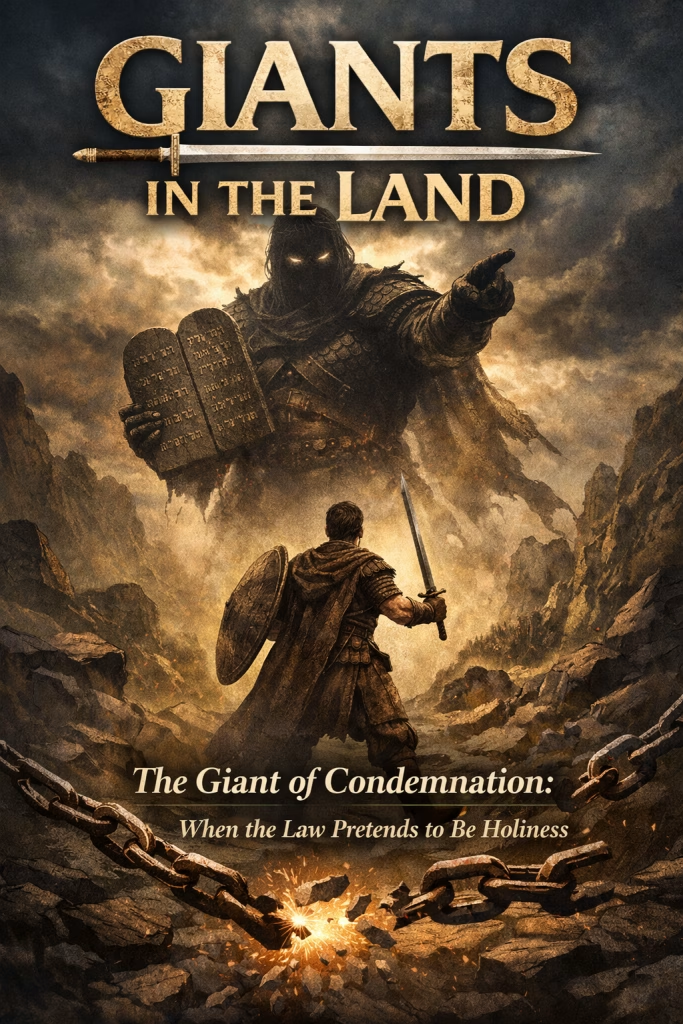
One of the most crippling giants believers face today does not roar — it whispers. It does not assault the body — it assaults the conscience. Its strategy is subtle: to persuade the saint that he is unworthy to fight, unworthy to inherit, unworthy to reign, and perhaps unworthy to be saved at all. Scripture calls this giant condemnation, and it is one of the devil’s oldest weapons.
Condemnation is the law pretending to be holiness. It masquerades as conviction, humility, and self-examination, but its fruit is always the same — despair, paralysis, and distance from Christ. It convinces the believer that God wants less from him because he has failed, when in truth God intends to give him more because he has made him a son.
“There is therefore now no condemnation to them which are in Christ Jesus…”
(Romans 8:1)
That sentence is not a comfort text — it is a war declaration. Paul is cutting off a giant’s head.
The Wilderness of Self-Accusation
Condemnation thrives in the wilderness, not Canaan. Israel did not doubt deliverance — they doubted possession. Many Christians do the same. They believe God has forgiven their past, but they doubt He would ever entrust them with inheritance, authority, or rest.
Condemnation tells them Egypt was a miracle, but Canaan is unreasonable.
This is where the psychology of warfare begins. The ten spies did not say the land was not good — they said we are not able.
(Num. 13:31)
Condemnation always begins with a shrinking of identity.
The Accuser’s Strategy
Revelation unmasks Satan plainly:
“…the accuser of our brethren…”
(Rev. 12:10)
Satan does not merely tempt to sin — he accuses after sin. Temptation seeks participation; accusation seeks despair. One lures; the other imprisons. His aim is not merely disobedience, but inactivity — that the saint would be too ashamed to fight.
If Satan cannot kill a believer, he will try to convince him he has no right to reign.
Condemnation vs. Conviction
Condemnation attacks the person.
Conviction addresses the action.
Condemnation says: you are unclean — depart.
Conviction says: this is unclean — come to Christ.
Condemnation drives away.
Conviction draws near.
Condemnation leads to despair.
Conviction leads to repentance.
Condemnation ends in silence.
Conviction ends in praise.
This distinction is not academic — it is deliverance.
Hell Is Not for Sinners — But for Those Who Reject Christ
This sentence has broken more chains than people realize. It reorders the gospel. Hell is not populated by those who sinned — for all have sinned (Rom. 3:23) — but by those who rejected Christ, the spotless Lamb who bore the sins of many.
Once the soul sees this difference, the giant of condemnation loses most of its power. Christ removes sin, satisfies wrath, and secures righteousness — not in part, but fully. The believer’s assurance rests not upon improved performance, but upon a perfect substitute.
The Yoke Broken
Nahum describes deliverance in martial terms:
“I will break his yoke from off thee, and will burst thy bonds in sunder.”
(Nahum 1:13)
Sin wounds the soul; condemnation imprisons it. The giant of condemnation binds the saint with shame, fear, and unbelieving introspection. Christ breaks the yoke, bursts the bonds, and commands the prisoner to fight.
Condemnation’s goal is to prevent warfare. Christ’s goal is to produce sons who conquer.
Overcomer’s Checkpoint
OVERCOMER’S CHECKPOINT
Question:
Is the voice that speaks to my soul drawing me to Christ or driving me from Him?
Condemnation shrinks the saint.
Conviction enlarges him.
One produces despair.
The other produces repentance.
One keeps men in the wilderness.
The other trains them for war.
Jesus came to provide the hope of salvation that requires us being forgiven from violating the Ten Commandments. The elect are no longer under this condemnation but under grace and faith. The love of God is given to Gods elect that fulfills the intent of the law. Gods love becomes our works for it is God who works in us both to will and to to His good pleasure. Love is the fulfillment of the Ten Commandments. Anyone not in Christ is still under the law, Christ did not abolish the law but fulfilled it with his Fathers love. The Ten Commandments are holy, just and good but humanity isn’t. These Ten Commandments are what the world breaks when the sin and the wages of sin is death. Jesus took this death sentence upon himself and paid with his own life the wages we earned for ourselves. After this it is a denial of Christ to go back to trying to be justified by the Ten Commandments. All the world is guilty of breaking the Ten Commandments and are sinners sentenced to death but even these have and unknown hope of the millennium or second resurrection.
Thank you, Lee. I appreciate your thoughtful comments. I agree that salvation is entirely by God’s grace through faith, and that it is God who works in His children both to will and to do of His good pleasure (Phil. 2:13). I would simply add that Christ fulfilled not only the moral requirements of the Law but the entire Law and the Prophets, bringing all of God’s redemptive purpose to its fulfillment in Himself. Those who are in Christ are no longer under the condemnation of the Law, but now walk by the Spirit in the liberty of the new covenant. Thank you again for taking the time to share your thoughts.