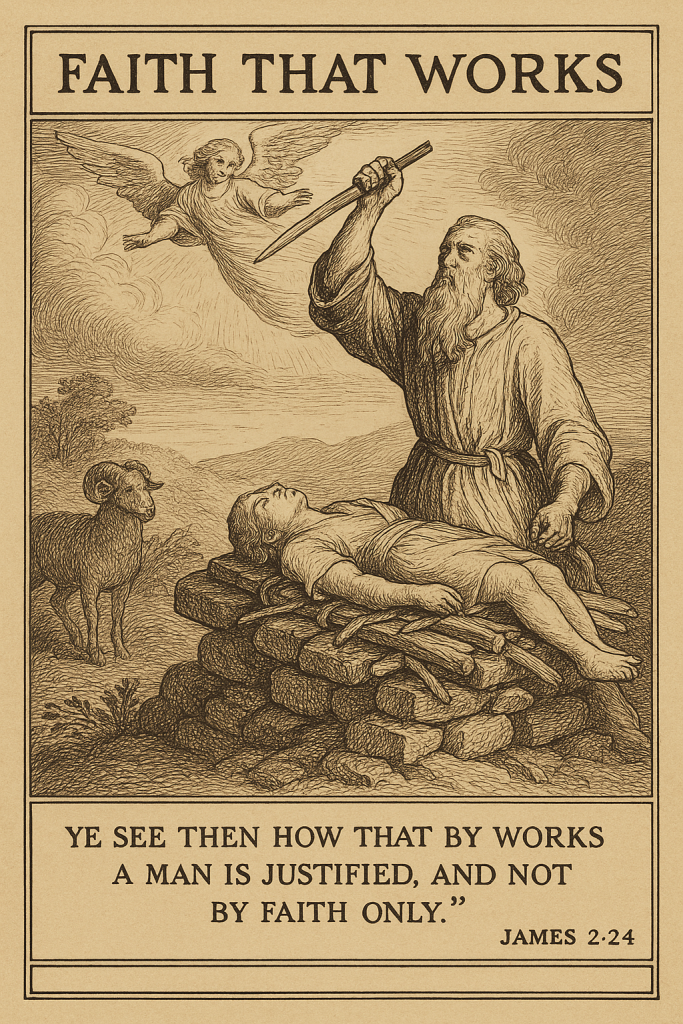
There’s a growing trend—subtle yet dangerous—in modern teaching where obedience is being substituted for faith as the condition for salvation. While obedience is certainly the fruit of true faith, it was never the root. This twisting of terms shifts the gospel from grace to works, from rest to effort. And it must be exposed.
This article addresses a common confusion surrounding James 2 and Romans 3, and helps us hold fast to the truth that we are saved by grace through faith, with works flowing as the evidence—not the requirement—of new birth.
Obedience: The Fruit, Not the Root
A friend recently wrote:
“It seems to me that Paul (a friend, not Paul the apostle) is simply replacing the word ‘works’ with the word ‘obedience’ and thus subtly sliding in works as necessary to salvation, when good works are the evidence of having been saved.”
That insight is exactly right. Many confuse the obedience that flows from salvation with the obedience required to earn salvation—a confusion Paul forcefully refutes in Galatians:
“Are ye so foolish? having begun in the Spirit, are ye now made perfect by the flesh?” (Galatians 3:3)
The Red Sea: A Picture of Receiving Christ
At the beginning of our walk with God, we are not called to perform—we are called to flee Egypt and follow the Deliverer. The crossing of the Red Sea beautifully pictures salvation: Israel was delivered by faith in God’s power, not by their own ability. Only after deliverance did God bring them into a walk of obedience in the wilderness.
Likewise, salvation is not attained by works but leads to a life of obedience:
“Believe on the Lord Jesus Christ, and thou shalt be saved…” (Acts 16:31)
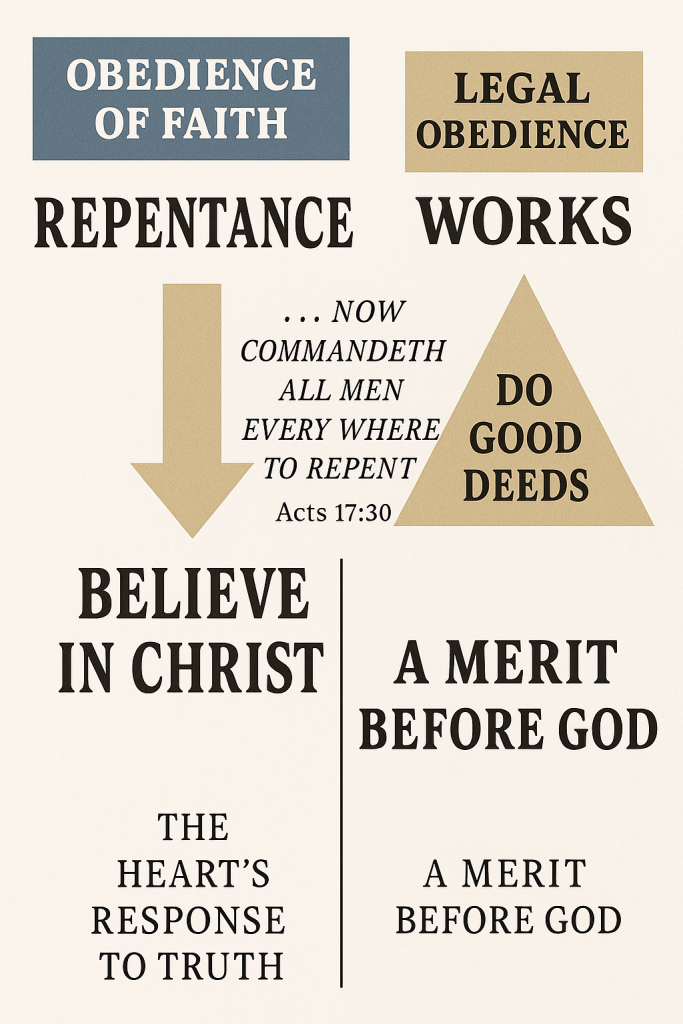
Obedience Begins with Repentance — But Not Legal Obedience
Some may rightly point out that fleeing Egypt was itself an act of obedience. That’s true — but it wasn’t the legal obedience of law-keeping. It was the obedience of faith, the surrender of the will to God’s call to turn and follow Him. As Acts 17:30 declares:
“And the times of this ignorance God winked at; but now commandeth all men every where to repent.”
Repentance is not a work that earns salvation. It is the first yielding of a heart awakened by grace. Like the Israelites leaving Egypt, the sinner who turns to Christ does so because they want to flee bondage and follow the Deliverer. That is obedience — not the kind that earns salvation, but the kind that flows from believing the truth and turning from lies.
Paul vs. James? Or Law vs. Life?
At first glance, Paul and James seem at odds:
“Therefore we conclude that a man is justified by faith without the deeds of the law.” (Romans 3:28)
“Ye see then how that by works a man is justified, and not by faith only.” (James 2:24)
But context solves the tension. Paul is addressing legalistic works done to earn salvation. James is addressing the evidence of saving faith—the fruit that must naturally appear if faith is real.
James 2 Explained — Faith That Acts
“But wilt thou know, O vain man, that faith without works is dead? Was not Abraham our father justified by works, when he had offered Isaac his son upon the altar?” (James 2:20–21)
Abraham was declared righteous long before Isaac was offered (Genesis 15:6). But James appeals to Abraham’s later obedience to show that living faith always produces action. That’s why James says:
“Seest thou how faith wrought with his works, and by works was faith made perfect?” (James 2:22)
His faith matured and was proven genuine by obedience.
“Declared Righteous” — Not “Made Righteous”
“Ye see then how that by works a man is justified, and not by faith only.” (James 2:24)
God sees faith the moment it is born in the heart (e.g. The thief on the cross). But people cannot. We declare someone righteous only after we see the fruit. That’s why we examine ourselves and others by the evidence of new life:
“Examine yourselves, whether ye be in the faith…” (2 Corinthians 13:5)
Paul and James Are Not Enemies—They’re Allies
Paul is concerned with dead works being used to impress God without faith.
James is concerned with dead faith that produces no works and only deceives.
Both would agree: No change, no Christ.
Jesus Himself taught:
“By their fruits ye shall know them.” (Matthew 7:20)
Final Word: Don’t Confuse the Root and the Fruit
Salvation is not earned by obedience. But it is always proven by obedience.
As Spurgeon warned in the sermon “The Curse and the Curse for Us,” those who trust in their own obedience are under the curse—because they are relying on self-righteousness rather than the righteousness of Christ.
So yes, run from Egypt. Cross the Red Sea. Trust the blood of the Lamb. Then walk with Him, and let the world see the fruit.
Word for the Overcomer
Don’t confuse the fruit of salvation with its foundation. Obedience is not the way into the kingdom—it’s the walk of those who already belong there. Christ alone is the door. But those who’ve passed through it will walk the narrow path He laid down.