Post 2 of The Torch of the Testimony Review
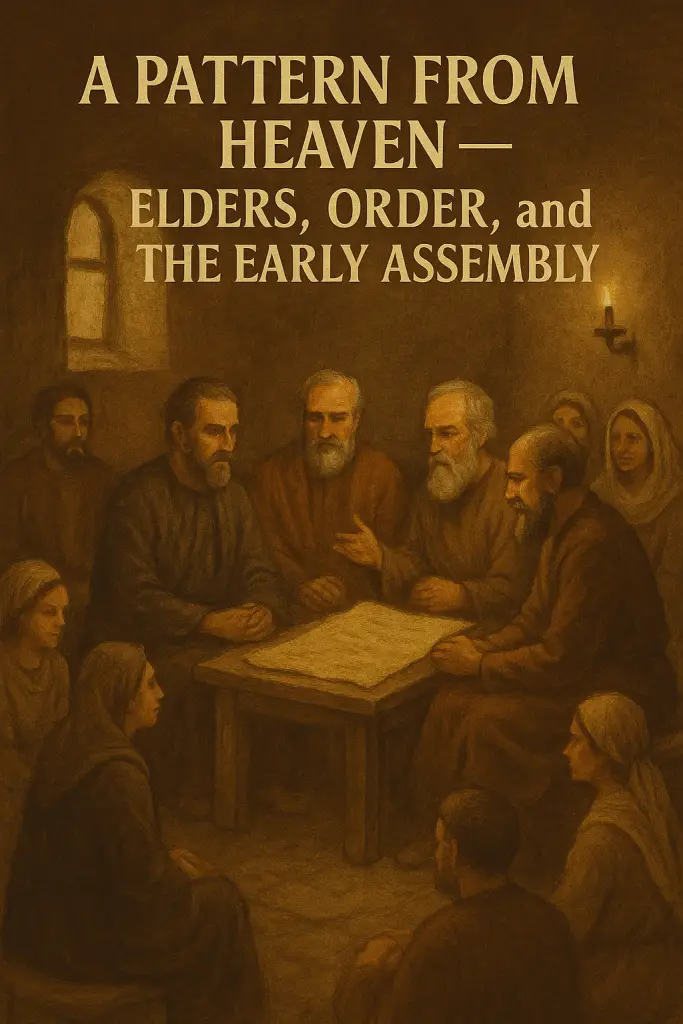
The second chapter of The Torch of the Testimony introduces a theme essential to understanding God’s mind for the Church: divine order. Not hierarchy. Not control. But Spirit-governed structure — a pattern revealed from heaven and lived out among the earliest believers.
John W. Kennedy opens this chapter by contrasting two approaches to Church order:
- One that is imposed from above by ecclesiastical machinery,
- And one that arises naturally from the life of the Spirit in the gathered body.
He identifies the true New Testament pattern as that which is born from within — from Christ the Head, manifesting His government through spiritually mature men known as elders.
The Office that Wasn’t an Office
The first thing that strikes the reader is how unbureaucratic the early Church was. There was no professional clergy. There were no robes, rituals, or elaborate ranks. Instead, spiritual men were raised up organically in each city or assembly, and they were simply known as elders — or “presbyters” (Greek: presbuteros).
Kennedy emphasizes that these men:
- Were not appointed by popular vote or religious ceremony
- Did not rule as overlords
- Were known by their maturity, godly character, and spiritual influence
- Shepherded the flock willingly and by example, not by force (1 Peter 5:2–3)
This is a far cry from today’s clerical systems. These elders weren’t priests, pastors, bishops, or executives. They were older brothers in the faith, spiritually seasoned and respected by the congregation because their lives proved them worthy of imitation.
Why Plurality Matters
A crucial point Kennedy draws out is that elders were always plural. The New Testament knows nothing of a “pastor” as the single spiritual head of a local church. In every example — from Jerusalem to Ephesus to Philippi — elders functioned together.
This plurality reflects something deeper: Christ is the only Head of the Church (Col. 1:18). No single man is to take His place. When elders serve in plurality, they protect the body from personality cults, abuse, and authoritarianism. Together, they seek the mind of the Lord, not merely their own wisdom.
Spiritual Government, Not Political Structure
Kennedy warns that the Church quickly drifted from this model. As persecution decreased and societal acceptance increased, external structures replaced inward guidance. Elders became officials. Bishops became regional rulers. Eventually, the Church took on the Roman Empire’s administrative form — complete with hierarchy, power centers, and politics.
But in the early days, the government of the Church was as spiritual as its birth. The apostles didn’t appoint men based on ambition or popularity. They discerned through prayer and the laying on of hands those who already had the Holy Ghost’s evident calling and character.
This was not democratic. It was not dictatorial. It was spiritual.
Scriptural Witness
The following passages ground Kennedy’s insight:
- Acts 14:23 — “And when they had ordained them elders in every church…”
- Titus 1:5 — “Ordain elders in every city, as I had appointed thee.”
- 1 Timothy 3:1–7 and Titus 1:6–9 give character qualifications — not professional skills.
- 1 Peter 5:1–3 warns against “lording over” God’s heritage.
There is no mention of a dominant “pastor” figure. The authority was relational and spiritual, not positional.
Typology: Elders as Judges in the Gates
In the Old Testament, the elders of Israel sat in the city gates — places of wisdom, justice, and spiritual oversight. This pattern foreshadowed the role of elders in the New Testament Church: not as rulers on thrones, but as watchmen at the gates, safeguarding the spiritual integrity of the community.
They represented both authority and humility — upholding God’s standard while walking among the people.
Application for Today
In our day, the Church is again faced with the choice: Will we follow the Spirit’s pattern, or man’s invention? The overcomer must discern between what is biblical and what is merely traditional. A true fellowship will reflect the early Church’s model:
- Christ as Head
- Plurality of elders
- Governance by maturity, not personality
- A body where every member ministers
Kennedy’s work challenges us to repent of man-made systems and return to heaven’s blueprint.
Overcomer’s Checkpoint
- Do I expect one man to lead the whole church — or do I recognize Christ as the Head?
- Are the elders in my fellowship spiritually mature or merely organizational?
- Am I developing the kind of character that could shepherd others if called?