Post 1 of The Torch of the Testimony Review
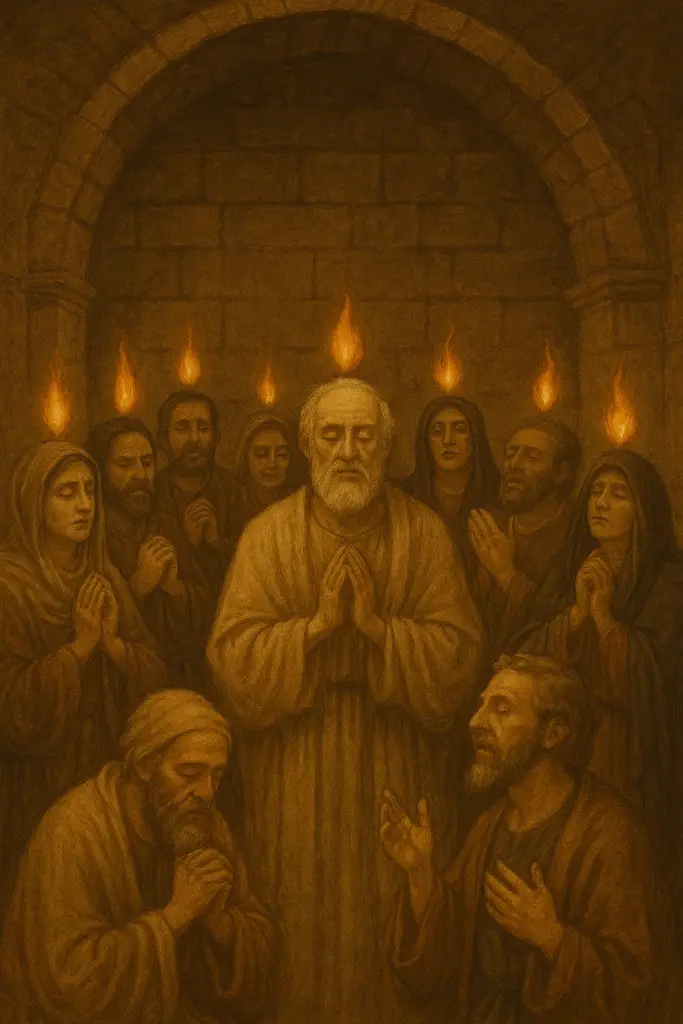
The first chapter of The Torch of the Testimony by John W. Kennedy lays a crucial cornerstone: the true Church of Jesus Christ did not begin with institutions, clergy, or hierarchy. It began with the coming of the Holy Ghost — with fire from heaven. If we are to understand Church history rightly, we must start not with Constantine, councils, or cathedrals, but with an Upper Room in Jerusalem where 120 ordinary believers were filled with extraordinary power.
Kennedy opens by showing that the Church was birthed through Israel — but not by clinging to Israel’s form. The synagogue, not the temple, formed the immediate context for the early believers. While the temple was still standing in Jerusalem, the spiritual bridge between the Old Covenant and the New was found in the synagogue — a gathering centered not on sacrifice, but on the Word. There, Scriptures were read, elders governed by wisdom, and community functioned organically. Christ Himself ministered in synagogues, and so did Paul and the apostles.
But something happened that made the synagogue insufficient.
A Divine Break with Tradition
The same Spirit that once moved in the synagogue now demanded something more. The veil in the temple was rent. Christ, the living Word, had come. And He would not fit into the framework of dead religion — not even one with Scriptural roots. The early Church began within Jewish life, but it could not remain there. Stephen’s bold sermon in Acts 7 — exposing the obsolescence of temple worship and proclaiming that “the most High dwelleth not in temples made with hands” — marked a turning point. His stoning ignited a persecution that scattered believers but also scattered the flame.
The fire of Pentecost moved outward. New assemblies formed not by expansion of the synagogue system, but by spiritual explosion — believers gathering in homes, breaking bread, praying, being taught by the apostles. No priesthood but Christ. No veil but boldness. No need for temple sacrifices, for the Lamb had already died and risen.
The Pattern of Simplicity and Power
Kennedy emphasizes that this new pattern wasn’t organizational, but spiritual. Elders emerged not by vote or clerical appointment, but by spiritual maturity and evident character. The believers continued “steadfastly in the apostles’ doctrine and fellowship, and in breaking of bread, and in prayers” (Acts 2:42). That is the living model. Not hierarchical control, but shared life. Not tradition handed down by man, but truth revealed by the Spirit.
This was not a weak beginning. It was a fiery one. The Church was born of power — a people filled with the Holy Ghost, preaching boldly, living sacrificially, and turning the world upside down.
Typological Insight: Synagogue to Church
The synagogue, in a sense, served as a type — a transitional vessel between the shadow of the law and the light of grace. It preserved the Word, emphasized teaching, and modeled local governance through elders. But the New Testament Church was the spiritual substance to which the synagogue pointed. Christ Himself is the center now. He is the Word made flesh, the fulfillment of every scroll read aloud in those synagogues.
Where the synagogue housed the Scriptures, the Church became the pillar and ground of truth (1 Tim. 3:15). Where the synagogue administered law and community order, the Church became the spiritual household of God — neither Jew nor Greek, male nor female, bond nor free (Gal. 3:28).
A Warning for the Modern Church
Just as the early Church had to break free from the constraints of tradition, so must we. The Spirit will not dwell where man’s order dominates God’s voice. History repeats this pattern: where new life is birthed, it eventually faces the temptation to calcify into tradition. But the true Church is always a living thing — led by the Spirit, centered on Christ, and grounded in the Word.
Kennedy puts it this way:
“The beginning of the Church is not to be found in organization, but in the coming of the Holy Spirit.”
We must beware of trying to organize what only the Spirit can birth. The Church did not begin with institutional recognition but with heavenly power. And that is how it must continue.
Overcomer’s Checkpoint
- Have I mistaken religious tradition for spiritual life?
- Am I part of a fellowship where Christ is truly the Head — or where man governs in His place?
- Am I willing to leave the “synagogue” when the Spirit moves on?