
Dispensationalism and Christian Zionism have profoundly influenced the modern church, especially regarding the teaching that Jesus Christ does not presently sit on the throne of David. This perspective, however, contradicts the clear scriptural teaching that Christ’s reign on David’s throne is active, spiritual, and ongoing.
Did God Fulfill His Promises to Israel in the Old Testament?
Joshua 21:43-45 states explicitly that God fulfilled all promises to Israel regarding land:
“Thus the Lord gave to Israel all the land that he swore to give to their fathers… Not one word of all the good promises that the Lord had made to the house of Israel had failed; all came to pass.”
Dispensationalists counter by pointing to promises like the eternal throne of David (2 Samuel 7:16, Ezekiel 36-37), which they believe require future fulfillment. However, scripture consistently moves from natural to spiritual fulfillment:
- 1 Corinthians 15:45-46: “First the natural, then the spiritual.” Scripture does not suggest a return to natural after spiritual fulfillment.
Christ’s Spiritual Kingship
Peter explicitly connects David’s throne to Jesus’ resurrection and ascension (Acts 2:29-36), affirming Christ’s current reign from heaven. Jesus Himself clearly declared:
“My kingdom is not of this world.” (John 18:36)
Why would Christ regress to an earthly throne, inferior to His current heavenly reign?

The Thousand-Year Reign: Symbolic or Literal?
The “thousand-year reign” from Revelation 20 is best understood symbolically as a complete, divinely-appointed period, not a literal 1,000-year countdown:
- Psalm 50:10: God owns cattle on “a thousand hills”—clearly symbolic for “all.”
- 2 Peter 3:8: A thousand years are as one day to God, emphasizing symbolic completeness.
Thus, the millennium represents Christ’s current reign from resurrection onward, fulfilling David’s throne spiritually. See The Thousand Years: A Symbolic Reign of Christ
Jesus Reigning Now
Several New Testament passages confirm Christ’s present kingship:
- Acts 2:29-36: Jesus sits now on David’s throne, exalted at God’s right hand.
- Luke 1:32-33: Gabriel announces Jesus’ eternal reign over the house of Jacob, fulfilled spiritually.
- Hebrews 1:3: After Christ’s atonement, He sat at God’s right hand, affirming His completed work and present reign.
The Binding of Satan: A Present Reality
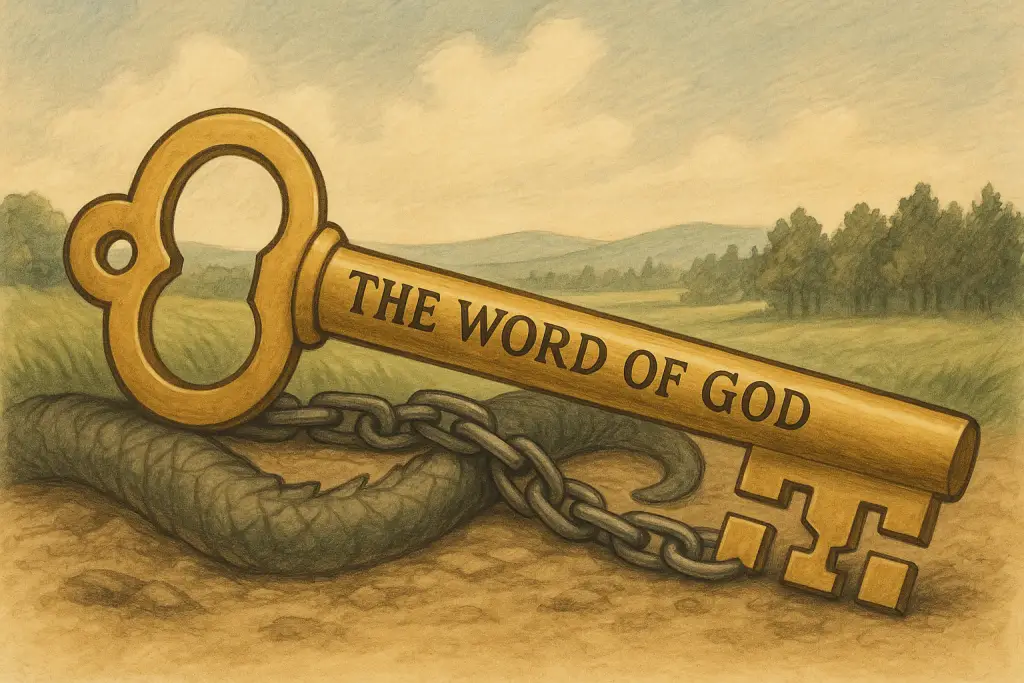
Revelation 20:1-3 describes Satan’s binding, limiting his deception of nations, corresponding to the gospel’s global advance:
- Matthew 12:28-29: Christ’s ministry binds Satan, enabling salvation.
- Colossians 2:15: Christ’s crucifixion disarmed spiritual powers.
- John 12:31-32: Christ’s crucifixion and ascension mark Satan’s loss of authority over nations.
This binding restricts Satan’s global influence while allowing his limited activity (1 Peter 5:8).
Satan’s Release and Final Tribulation and the Lord’s Return
The symbolic millennium concludes with a brief, intense tribulation:
- Revelation 20:7-8: Satan is briefly released to deceive nations.
- Matthew 24:21: This aligns with Jesus’ prediction of a great tribulation preceding His return.
The release symbolizes a final testing before Christ’s return, marking a literal culmination of a symbolic period.
- 2 Peter 3:10 “But the day of the Lord will come as a thief in the night; in the which the heavens shall pass away with a great noise, and the elements shall melt with fervent heat, the earth also and the works that are therein shall be burned up.”

One Salvation Plan for All
There are no separate salvation tracks. The plan of salvation remains consistent and unified, available only by faith:
- 2 Corinthians 5:7: Salvation is always by faith, not sight.
- Galatians 3:28-29: All believers—Jew and Gentile—are Abraham’s heirs through faith in Christ.
- Romans 11:25-26: “All Israel” refers to the spiritual Israel—believers in Christ, Jew and Gentile, grafted into God’s redemptive plan.
The idea of a future ethnic salvation separate from the current gospel contradicts the New Testament teaching that faith alone defines God’s people (John 8, Romans 4).
The Historical Origins and Harm of Dispensationalism
Dispensationalism, popularized by John Nelson Darby in the 1830s, introduced a radical departure from historical Christian understanding. This theology, emphasizing a separate future for ethnic Israel and a pre-tribulation rapture, contradicts earlier teachings from Augustine and other church fathers, who saw Christ’s reign as current and spiritual.
Dispensationalism’s escapist theology (e.g., the pre-tribulation rapture) has tangible negative impacts, as noted by Corrie Ten Boom, who observed Chinese Christians falling away due to unmet expectations of escaping persecution.
The Danger of Escapist Theology
A belief system centered around escaping tribulation contradicts the New Testament’s repeated emphasis on endurance and perseverance:
- Matthew 24:13: “He that endures to the end shall be saved.”
- Hebrews 5:9: Christ is Savior of those who obey Him.
A Call to Biblical Faithfulness
Rather than pursuing escapist theology, believers must prepare spiritually for perseverance:
- Matthew 7:13-14: The narrow path of endurance leads to life.
- Matthew 7:21-23: Many claim Christ but lack genuine faith and obedience.
The parable of the ten virgins (Matthew 25:1-13) emphasizes readiness, vigilance, and endurance, not reliance on last-minute rescue.
Conclusion
The teaching that Jesus Christ currently reigns from David’s throne spiritually, that believers are presently living in the symbolic millennium, and that salvation is universally accessible by faith alone aligns closely with scripture’s unified testimony. Rejecting dispensationalism’s novel interpretations, believers are called to endure faithfully, trust fully, and embrace the present spiritual reality of Christ’s reign, awaiting His final return and judgment.
Next: See Continuity, God’s One People from Genesis to Revelation