A Study of How the Apostles Teach Us to Read the Bible
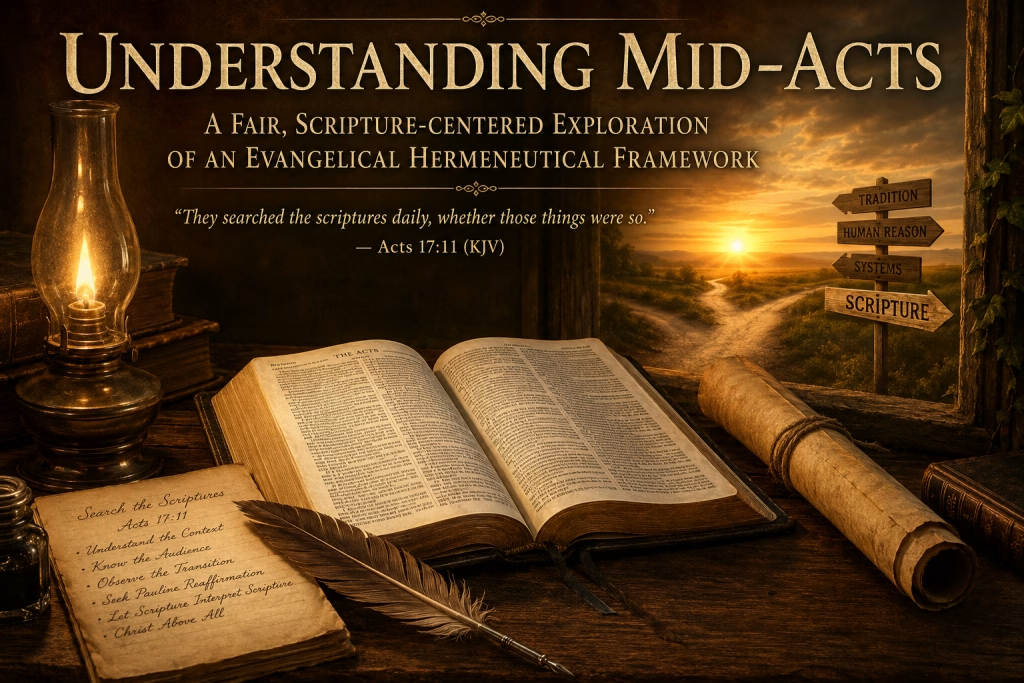
“These were more noble than those in Thessalonica, in that they received the word with all readiness of mind, and searched the scriptures daily, whether those things were so.” — Acts 17:11 (KJV)
How to Read This Series
This series is intentionally progressive. The early chapters explain the Mid-Acts framework on its own terms before evaluating it through the teaching of Christ and His apostles. Later chapters build upon earlier ones, so readers will benefit most by beginning with Part One.
About This Series
Every generation of Christians has wrestled with the same question: How should we rightly understand and apply the Word of God?
Sincere Bible-believing Christians often arrive at different conclusions regarding Israel and the Church, water baptism, the Great Commission, the book of Hebrews, the beginning of the Church, and God’s unfolding redemptive plan.
Those differences usually arise, not because believers love Christ differently, but because they begin with different assumptions about how Scripture should be read.
Mid-Acts is not simply a collection of distinctive doctrines. It is a comprehensive interpretive framework—a particular way of reading the whole of Scripture. Once that framework is understood, many of its conclusions become much easier to understand, whether one ultimately agrees with them or not.
This series invites readers to understand that framework on its own terms before evaluating it by Scripture.
Why This Series?
Rather than relying upon secondhand descriptions or popular critiques, I wanted to hear Mid-Acts teachers explain their own beliefs in their own words.
Over many months I studied books, articles, conference messages, videos, public discussions, and conversations from numerous contemporary Mid-Acts proponents. My purpose was not to collect isolated proof texts, but to understand the framework that consistently produces their conclusions.
One discovery quickly became clear: Mid-Acts is not merely a collection of distinctive doctrines. It is a remarkably coherent hermeneutical system.
As the study progressed, another realization emerged. The central questions were not primarily about water baptism, the beginning of the Church, Hebrews, or even Israel. Those discussions all flowed from a much deeper interpretive framework. Once that framework became visible, the individual conclusions began to make sense—even where I ultimately reached different conclusions.
Gradually, the discussion itself changed. The deeper issue was no longer merely when the Body of Christ began, or which passages belonged to Israel or the Church.
The deeper question became:
Does the New Testament present the mystery primarily as the unveiling of a second redemptive program, or as the unveiling of how God’s eternal purpose is fulfilled in Jesus Christ?
That question has become the guiding question of this series.
Our Commitment
This series is committed to four principles.
1. Understanding Before Evaluation Every theological position deserves to be represented by its strongest arguments before it is evaluated by Scripture. If Mid-Acts believers cannot recognize their own framework in these pages, then this study has failed its first responsibility.
2. Scripture Above Systems Every theological framework attempts to organize biblical truth. Scripture itself must always remain the final authority. Throughout this study, theological systems—including my own assumptions—must continually yield to the testimony of God’s Word.
3. Charity Without Compromise This series is not written against Mid-Acts believers. Many sincere Christians within this movement have demonstrated genuine love for Christ, serious commitment to Scripture, and graciousness in discussing their convictions. Their willingness to answer questions, explain their reasoning, and engage in thoughtful conversation has strengthened this study considerably.
Where agreement exists, it should be acknowledged. Where disagreement exists, it should be expressed carefully, honestly, and with respect.
4. Christ Above All Every theological framework exists to serve Christ. None should ever become more central than the One to whom all Scripture points.
The apostles repeatedly proclaim Christ as the fulfillment of the Law, the Prophets, the promises, the covenants, and God’s eternal purpose. Throughout this study, our highest aim is not merely to understand a theological system, but to ask whether the apostles themselves organize Scripture around that same Christ-centered vision.
What This Series Is?
This is not a debate. This is not a caricature. This is not an attempt to score theological points.
It is a careful exploration of one evangelical hermeneutical framework.
Rather than asking, “Is Mid-Acts right or wrong?” we will first ask, “How does Mid-Acts arrive at its conclusions?”
Only after understanding the architecture will we evaluate whether that architecture adequately explains the whole counsel of God.
The issue is not whether Mid-Acts can explain its conclusions. It clearly can. The question is whether the apostles themselves consistently interpret the Scriptures according to the same organizing principle.
The chapters below build progressively. Each article lays a foundation for those that follow, so readers will benefit most by beginning with Part One and working through the series in order.
What You Will Find
Part One — Understanding the Framework
- Why Study Mid-Acts?
- A Berean Invitation to Understand Before We Evaluate
- The Interpretive Engine
- How Mid-Acts Reads the Bible
- The Load-Bearing Beams
- The Architecture Behind the Conclusions
- Mystery and Prophecy
- The Heart of the Mid-Acts System
Part Two — Walking Through the Architecture
- Acts: The Great Transition
- Why the Book of Acts Carries So Much Weight
- One New Man
- The Cross and the Church’s Identity in Christ
- Preserving Distinction or Proclaiming Union?
- The Fundamental Hermeneutical Divide
- Romans 9–11
- The Remnant, Israel, and the Future
- Acts 15 and Amos 9
- Prophecy, Gentile Inclusion, and the Tabernacle of David
- The New Covenant
- Promise, Participation, and Fulfillment in Christ
- Hebrews
- Audience, Salvation, Warning, and Christian Application
Part Three — Testing the Conclusions
- When Did the Church Begin?
- Israel and the Body of Christ
- Water Baptism
- The Great Commission
- Rightly Dividing the Word of Truth
- The Pauline Epistles and the Rest of the Canon
- Does Audience Limit Christian Application?
Part Four — Final Reflections
- Conclusion
- Lessons Learned from Comparing Evangelical Hermeneutics
- Epilogue
- Pastoral Observations and Potential Spiritual Risks
The Heart Behind This Project
If this study accomplishes only one thing, I hope it is this: that Christians become more careful before dismissing one another.
Understanding should precede criticism. Listening should precede conclusions. And every theological discussion should leave us with greater admiration for Christ than for our own interpretive systems.
My prayer is not merely that readers agree or disagree with Mid-Acts, but that they become more careful interpreters of Scripture, more charitable toward fellow believers, and more captivated by Christ Himself.
If this series helps readers search the Scriptures more carefully, appreciate fellow believers more graciously, think more clearly, and know Christ more deeply, then it will have accomplished its purpose.
Above all, I hope this study encourages readers to ask a larger question than whether Mid-Acts is right or wrong:
How did the apostles themselves teach us to read the Scriptures?
That question reaches beyond any single theological system. It invites us to let the apostles become our guides as they open Moses, the Prophets, the Psalms, and the Gospel itself in the light of the risen Christ.
Throughout this series we will repeatedly return to the Scriptures themselves—not merely asking what conclusions a theological framework reaches, but how the apostles themselves interpreted Moses, the Prophets, the Psalms, the covenants, the kingdom, and the mystery in the light of the risen Christ. If they become our teachers, then whether we ultimately affirm or reject any theological system, our confidence will rest where it belongs: in the testimony of God’s Word.
The framework is a map; Christ is the destination. Wise travelers learn from the map, but they never mistake it for the journey itself.