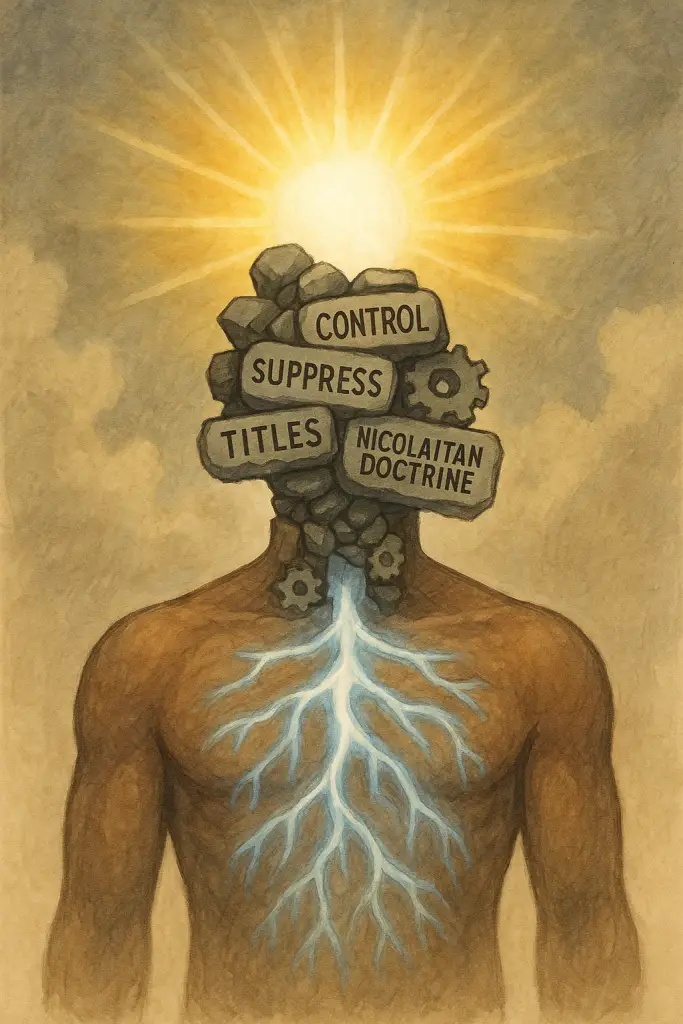
This article explores an idea shared at a Christian conference: that elders function as the “neck,” linking the body (the church) to the Head (Christ). This metaphor prompted further reflection on its scriptural and theological accuracy. The author examines this analogy in light of Scripture and church history, particularly concerned about displacing the role of the Holy Spirit with human intermediaries, especially in hierarchical church systems. The article also draws parallels to Ahab’s substitution of false altars for God’s, applying that metaphor to modern church structures.
The article argues:
- Christ is the Head of the Church (Eph. 5:23; Col. 1:18), and believers are directly connected to Him through the Holy Spirit (1 Cor. 12:13; John 14:26).
- Elders are important servants and overseers (Titus 1:5-9; 1 Pet. 5:2-4), but not mediators or spiritual pipelines.
- The Holy Spirit alone conveys Christ’s will to the church, serving as the vital and living link between the Head and the Body (Rom. 8:9-11; John 16:13-14).
Drawing from historical Protestant critiques (Luther, Anabaptists), the author highlights concerns with clergy-centered hierarchies that mirror Catholic and Orthodox traditions. The Spirit-led model emphasized in early Christianity and house church movements is favored.
A compelling analogy is made with King Ahab’s false altar (1 Kings 16–18). Ahab, influenced by his wife Jezebel, promoted Baal worship and built an altar to Baal, turning Israel away from the true worship of God. This act of replacing God’s altar with a counterfeit represents man-made religious systems that edge out God’s original design. This comparison serves as a caution against structures that elevate elders into roles that risk obstructing direct access to Christ.
Key theological points:
- Elders must be servants, not gatekeepers (Matt. 20:25-28; 1 Pet. 5:2-3).
- The Spirit alone unites believers and gives access to the Father (Eph. 2:18; 1 Tim. 2:5).
- The dangers of hierarchy are shown in history (e.g., Catholic papacy, shepherding movement, modern mega-church models).
- Churches should walk in the Spirit, not human systems (Gal. 5:25). This means relying on the Holy Spirit for guidance, conviction, and unity, rather than depending on man-made hierarchies or rigid structures. Walking in the Spirit includes prayerful discernment, openness to Scripture, and listening to the Spirit’s leading in community—rather than defaulting to top-down authority models.
The conclusion is that while elders are biblical and necessary, their role must never eclipse the Holy Spirit, who is the true connector of the body to Christ. Substituting the Spirit’s work with human systems can easily mirror Ahab’s altar—a man-centered counterfeit that displaces Christ’s authority in the name of religious structure.
This is a call to restore Christ’s centrality and the Spirit’s leadership in the church today.
Scriptural Foundation
1. Christ as the Head: The New Testament frequently describes Christ as the head of the church. Ephesians 5:23 states, “For the husband is the head of the wife, even as Christ is the head of the church: and he is the saviour of the body.“ Similarly, Colossians 1:18 says, “And he is the head of the body, the church.” These passages establish Christ’s direct authority and relationship with the church.
2. The Role of the Holy Spirit: The Holy Spirit is portrayed as the unifying and empowering presence within the church. In 1 Corinthians 12:13, Paul writes, “For by one Spirit are we all baptized into one body, whether we be Jews or Gentiles, whether we be bond or free; and have been made to drink into one Spirit.” This suggests that the Spirit is the means by which believers are joined to each other and, by extension, to Christ. John 14:26 reinforces this, with Jesus promising that the Holy Spirit “shall teach you all things and bring all things to your remembrance, whatsoever I have said unto you,” indicating a direct spiritual connection.
3. Elders in the Church: Elders (or overseers) are mentioned in passages like Titus 1:5-9 and 1 Timothy 3:1-7 as leaders appointed to guide and shepherd the flock. However, their role is never explicitly described as a “neck” or essential intermediary between Christ and the church. Instead, they serve under Christ’s authority (1 Peter 5:4: “And when the Chief Shepherd shall appear, ye shall receive a crown of glory that fadeth not away”). In this respect, elders don’t hold a structural position analogous to the Spirit’s role.
The Holy Spirit as the “neck” highlights its indispensable role in maintaining the life and unity of the body. In anatomy, the neck connects the head to the body, facilitating communication and sustenance (e.g., nerves, blood flow). Similarly, the Holy Spirit conveys Christ’s guidance, power, and presence to believers. This aligns with the idea in Romans 8:9-11 that the Spirit indwells believers, linking them to Christ without requiring human mediation.
I am aware that suggesting that elders aren’t the “neck” might imply a critique of ecclesiastical hierarchies where leaders are seen as gatekeepers to God. This resonates with Protestant traditions, like those emphasizing the “priesthood of all believers” (1 Peter 2:9), which assert that every Christian has direct access to God through Christ and the Spirit, not through clergy. For example, Martin Luther argued against the Catholic Church’s elevation of priests as necessary intermediaries, pointing to scriptures like 1 Timothy 2:5: “For there is one God and one mediator between God and men. the man Christ Jesus.” I thought this analogy about the neck really tied into your presentation of Ahab which I comment later on in this article. The ramifications of both, flowed well.
The Anabaptists of the Reformation era, for instance, emphasized the Spirit’s direct guidance over institutional authority, sometimes downplaying the role of elders. Similarly, Pentecostal and charismatic traditions today often stress the immediacy of the Spirit’s work in the believer’s life, sometimes viewing human leadership as secondary to divine leading.
Further Thoughts
While elders have a practical role—teaching, guiding, protecting—their authority is derivative and functional, not ontological. The true “neck,” the life-giving connection, remains the Holy Spirit. This might also imply a preference for a flatter, less hierarchical church structure, where the Spirit’s presence trumps human organization which is most like our fellowship. That the Holy Spirit, not elders, is the “neck” connecting the Head (Christ) to the body (the church)—plays out practically in our fellowship and I think theologically with the scriptures.
1. The Spirit’s Direct Work: Jesus’ words in John 16:13-14 amplify the Holy Spirit’s role: “Howbeit when he, the Spirit of truth, is come, he will guide you into all truth: for he shall not speak of himself; but whatsoever he shall hear, that shall he speak: and he will shew you things to come.“ This suggests the Spirit acts as a direct conduit of Christ’s will, bypassing human filters. It’s not that elders can’t teach or guide, but they’re not the pipeline—the Spirit is.
2. Unity Without Middle-Man: Ephesians 4:4-5 ties this together: “There is one body, and one Spirit, even as ye are called in one hope of your calling; One Lord, one faith, one baptism.” The unity of the church flows from the Spirit, not from a chain of command. Elders might organize or oversee, but the spiritual bond is unmediated.
3. Elders as Servants, Not Lords: Jesus sets the tone in Matthew 20:25-28: “Ye know that the princes of the Gentiles exercise dominion over them… But it shall not be so among you: but whosoever will be great among you, let him be your minister;” Elders, then, aren’t structural necessities but servant-leaders under Christ. Peter echoes this in 1 Peter 5:2-3, urging elders to “Feed the flock of God which is among you, taking the oversight thereof, not by constraint, but willingly; not for filthy lucre, but of a ready mind;”
Practical Implications
If the Holy Spirit is the “neck,” what does that mean for the church today? Here’s where it gets interesting:
Decision-Making: In Acts 15, the early church faced a big question about Gentile believers. Elders and apostles debated, but the resolution came with, “It seemed good to the Holy Ghost and to us” (Acts 15:28). The Spirit had the final say, not just the leaders’ authority. This could suggest that discernment through prayer and spiritual sensitivity trumps top-down rulings.
Church Structure: We know in our experience that this has been a push toward a more organic, Spirit-led community—think house churches or similar movements which historically minimized formal leadership in favor of collective listening to the Spirit. It doesn’t erase elders but redefines them as facilitators, not gatekeepers.
Personal Faith: For the individual believer, this emphasizes a direct relationship with Christ through the Spirit. You don’t need an elder to “connect” you to God—Romans 8:26-27 says the Spirit intercedes for you personally. Elders might encourage or correct, but they’re not our lifeline. I would not want that responsibility and God does not put that on us. He wants no one between Him and His Church. Think of how he said twice, “I hate the deeds of the Nicolaitans.”
Potential Pushback
This view definitely ruffles feathers in traditions with strong hierarchies—like Catholicism (what I was brought up in) or some Orthodox branches—where bishops or priests are seen as vital links in the chain of grace (e.g., through sacraments), or increasingly even Protestant branches. And, I have even encountered this “Ahab” spirit in House Churches. They might argue Hebrews 13:17 (“Obey them that have the rule over you, and submit yourselves: for they watch for your souls”) implies a necessary role for elders. But you could counter that obedience is contextual—elders watch over, not mediate.
Living It Out
Imagine a church where the Spirit’s presence is the pulse—worship, teaching, and decisions flow from that, not from a rigid structure. Elders might still exist (Titus 1:5), but they’re like gardeners tending a vine (John 15:1-5), not the vine itself. The true growth comes from Christ via the Spirit. In Isaiah 5:1-7 is the Song of the Vineyard where Israel is described as God’s vineyard. God is the one Who planted and tended it and spiritual leaders such as kings and priests are indirectly responsible for tending His vineyard but they failed, so God brings judgment (but that is another study). Similarly, 1 Cor 3:7, “So then neither is he that planteth any thing, neither he that watereth; but God that giveth the increase.” Our life comes from God.
We have all seen in our lives how human structures can sometimes usurp Christ’s place, and this conduct can easily be tied to Ahab’s actions in the Old Testament. In 1 Kings 16:32, Ahab “set up an altar for Baal in the temple of Baal that he built in Samaria,” sidelining worship of God. Isn’t that what man (who desires to rule over men) does. They “sideline” God, so that they can now be in control, the neck if you will.
Ahab’s Substitution
Ahab’s reign is a classic case of swapping the divine for the man-made. In 1 Kings 16:31-33, he marries Jezebel, adopts Baal worship, and builds that altar, effectively pushing God’s altar—the true center of worship—to the margins. The real altar, tied to Jehovah’s covenant (like the one at Bethel or Jerusalem), gets overshadowed by a counterfeit. This isn’t just about physical altars; it’s a power grab, where Ahab and Jezebel’s agenda replaces God’s. The prophet Elijah later calls this out on Mount Carmel (1 Kings 18), exposing the false system and restoring focus to the true God.
Religion—or at least its human distortions—can mimic Ahab by elevating man (or man-made structures) over Christ. If the Holy Spirit is the “neck” connecting us to Christ, then setting up elders (or any leader) as the “neck” is like Ahab’s false altar—a substitute that obscures the real thing. Just as Ahab’s Baal altar diverted worship from God, overemphasizing human authority might shift reliance from the Spirit’s direct work to a system of control.
Galatians 1:6-7 comes to mind: Paul warns against “a different gospel,” where human additions twist the truth. If elders become the “neck,” it’s a different gospel—one where man mediates what Christ already accomplished.Jesus himself critiques this tendency in Matthew 23:8-10: “But be not ye called Rabbi: for one is your Master, even Christ; and all ye are brethren.”… “Neither be ye called masters: for one is your Master, even Christ.” Notice what Jesus did, He dismantled the urge to let human titles replace divine authority.
Religion’s Habit
Historically, this substitution pops up often. The Pharisees in Jesus’ day piled traditions on top of God’s law (Mark 7:8-9), sidelining its heart. The medieval church, at times, made priests indispensable for grace—think indulgences or confession—until reformers like Luther pointed back to Christ alone (solus Christus). Even today, some churches might lean so hard on pastoral authority that the Spirit’s role feels secondary, like Ahab’s altar crowding out the real one. Anyone here who was a Christian in the 80’s remembers the “Shepherding and Discipleship” movement where in very extreme cases the Christian had to get permission from the “Elder” for every life decision they wanted to make.
The Real Altar
Christ’s sufficiency is always accessed through the Spirit, not human proxies. Hebrews 13:10 ties this together: “We have an altar, whereof they have no right to eat which serve the tabernacle.” It’s Christ’s sacrifice, not a man-made construct, that’s central.
Ahab’s false altar then is a symbol of human systems edging out the divine.
Ahab’s Playbook: Substituting the True for the False
Actually, this is Satan’s playbook, counterfeiting. How do you tell a counterfeit, but to know the real thing. John 10:4-5 “And when he putteth forth his own sheep, he goeth before them, and the sheep follow him: for they know his voice. And a stranger will they not follow, but will flee from him: for they know not the voice of strangers.”
In 1 Kings 16:31-33, Ahab doesn’t just add a Baal altar; he institutionalizes it, making it the centerpiece of Israel’s worship while God’s altar—symbolizing the covenant at places like Bethel (1 Kings 13:1-2) or Jerusalem—fades into the background. It’s not accidental; it’s deliberate. He’s got Jezebel pushing the agenda, priests of Baal running the show (1 Kings 18:19), and a whole system that props up the counterfeit. The real altar, tied to God’s presence and sacrifice, gets sidelined, not destroyed—just ignored.
Elders as a “False Altar”?
Elders are biblical—Acts 14:23 shows Paul and Barnabas appointing them, and 1 Timothy 3:1-7 lays out their qualifications. They’re shepherds, overseers, tasked with protecting and guiding (Acts 20:28). But nowhere are they called the “neck” or mediators. That role’s reserved for Christ (1 Timothy 2:5) and enabled by the Spirit (Ephesians 2:18: “For through him we both have access by one Spirit unto the Father”).
The snag comes when elders—or any human leader—become the functional center, like Ahab’s altar.
Think of:
Control Over Access: If a church teaches you need an elder’s blessing to hear from God or grow spiritually, it’s a substitute altar. Contrast that with John 10:9, where Jesus says, “I am the door: by me if any man enter in, he shall be saved”
Elevated Status: When elders are treated as untouchable—like Ahab’s Baal priests—it shifts focus from Christ. Jesus flips this in Luke 22:26: “but he that is greatest among you, let him be as the younger; and he that is chief, as he that doth serve.“
Modern Examples:
This isn’t just ancient history. Look at churches where:
– Pastors dictate every move, and personal discernment via the Spirit is discouraged—akin to Ahab’s top-down idolatry.
– Tradition or bureaucracy (think councils, synods) trumps the Spirit’s leading, much like Ahab’s system drowned out God’s voice until Elijah stepped in (1 Kings 18:21).
The reformers saw this in the Catholic Church’s papacy—Luther called it a “Babylonian captivity” of the church, arguing it replaced Christ’s headship with human rule. Today, it might be subtler: celebrity pastors or rigid hierarchies where the Spirit’s freedom gets boxed out. And, it happens in House Churches because all outward structures begin as inward structures in the heart of man, first. We are either lining up our heart with the Holy Spirit and the word or we are lining it up with “other voices.”
Restoring the Real Altar
Elijah’s showdown in 1 Kings 18 is the antidote. He repairs God’s altar (v. 30), calls on the true God, and fire falls (v. 38)—proof of who’s really in charge. For us, keeping Christ and the Spirit central means:
– Direct Reliance: Like Elijah bypassing Ahab’s system, believers lean on the Spirit’s guidance (John 16:13) over human gatekeepers.
– Elders in Their Place: They’re helpers, not hinges. Titus 1:9 says they “Holding fast the faithful word as he hath been taught,” pointing to Christ, not themselves.
This Ahab example frames elders as potential distractions—not because they’re bad, but because human nature loves a tangible substitute. Think of the children of Israel and the golden calf. The Spirit, invisible but vital, keeps getting elbowed aside, just like God’s altar under Ahab. False religion swaps man for Christ, the visible for the invisible because man would rather walk by sight than walk by faith. It’s easier to walk by sight and have someone visible to tell you what to do rather than seek God and His will for your life.
Ahab’s Substitution: A Deeper Cut
Ahab’s false altar in 1 Kings 16:32 wasn’t just a one-off—it was a system. He built a temple for Baal, staffed it with prophets (1 Kings 18:19), and let Jezebel kill off God’s prophets (1 Kings 18:4). The real altar—linked to God’s covenant, like the one at Bethel where Jeroboam’s priests got judged (1 Kings 13:1-5)—wasn’t torn down; it was just rendered irrelevant. Ahab didn’t deny God outright; he diluted Him, letting a human-led counterfeit take center stage.
When religion slides man into Christ’s spot, it’s not always blatant rejection—it’s a sneaky swap. Elders (or any leader) can become that false altar when they’re treated as the vital link to God, edging out the Holy Spirit’s role as the “neck” connecting us to the Head.
The Holy Spirit is the lifeline. 1 Corinthians 12:7: “But the manifestation of the Spirit is given to every man to profit withal.” No elder’s mentioned as the glue; it’s the Spirit binding us to Christ.
But here’s where the Ahab move creeps in:
– Elders as Mediators: If a church says you need their approval for spiritual gifts, forgiveness, or direction—like Ahab’s Baal priests controlling worship—it’s a false altar. Compare that to Acts 2:17-18, where the Spirit’s poured out on “all people”—no middleman required.
– Power Shift: Ahab centralized worship under his system. When elders (or pastors) centralize authority—say, claiming sole rights to interpret scripture or dictate God’s will—it sidelines the Spirit’s voice. Jesus warns against this in Matthew 23:13: “…ye shut up the kingdom of heaven against men:…”
Real-World Snapshots
This isn’t abstract. Picture:
– A church where the pastor’s word is final, and questioning it’s rebellion—echoing Ahab’s top-down control, not the Spirit’s freedom (Galatians 5:1). I am sure we have all seen and even may have experienced this in our lives.
– Denominations where elders or bishops gatekeep “sacraments”, like communion, despite 1 Corinthians 11:25 putting Christ at the center: “This cup is the new covenant in my blood.”
– Even subtle stuff: when “elder-led” becomes “elder-ruled,” and the congregation’s role as a Spirit-filled body (1 Peter 2:5) gets sidelined.
Elijah’s fix in 1 Kings 18:30-39 is the playbook: he rebuilds God’s altar, steps back, and lets God prove Himself. Fire falls, the people turn, and Baal’s system crumbles. People witness the authentic and now understand the former was counterfeit.
Ahab’s actions in 1 Kings 16-18 was about control—replacing God’s altar with one he could manage, backed by Jezebel and her crew. It wasn’t chaos; it was calculated, with a shiny new system to keep people in line. Fast-forward to now, and that same impulse shows up when human leaders—like elders—get propped up as the essential connection to Christ, nudging the Spirit aside.
The Elder Trap: Scripture gives elders a clear role—oversee, teach, protect (1 Timothy 3:2, Acts 20:28). But when they’re seen as the pipeline to God, it’s Ahab 2.0. Think of churches where you can’t join, serve, or even pray without their sign-off—like Baal’s priests gatekeeping worship. That’s not Titus 1:7’s “God’s steward”; it’s a power play.
The Spirit Sidelined: John 14:17 calls the Spirit “the Spirit of truth; whom the world cannot receive, because it seeth him not, neither knoweth him:” He’s not flashy, so it’s easy to swap Him for a visible elder. But Acts 13:2 shows the Spirit calling the shots: “As they ministered to the Lord, and fasted, the Holy Ghost said, Separate me Barnabas and Saul for the work whereunto I have called them.” No elder decision, veto or not, there.
Here’s how it looks in 2025:
– Personality Cults: Mega-pastors with millions of followers—hyping them as “God’s voice”—can turn into Ahab’s altar. Fans lean on their word over the Spirit’s nudge, forgetting Hebrews 1:1-2: God speaks “through his Son,” not a middleman.
– Rigid Structures: Some denominations make elders or bishops the “neck”—you need their ordination or blessing for anything spiritual. Contrast that with 1 John 2:27: “But the anointing which ye have received of him abideth in you, and ye need not that any man teach you:” The Spirit’s the teacher; elders just echo.
– Cultural Twists: In a world obsessed with authority figures (think CEOs, influencers), churches can mimic that, treating elders like spiritual bosses instead of servants (Mark 10:42-44).
The Spirit Stays the Neck
The Holy Spirit’s the connector. Colossians 2:19 warns against losing connection ““And not holding the Head, from which all the body by joints and bands having nourishment ministered, and knit together, increaseth with the increase of God.” No elder’s in that equation—it’s Christ and the Spirit knitting us in. Elders might steer (1 Peter 5:2), but they don’t bind us to the Head.
– Elijah’s Move: In 1 Kings 18:31-32, he rebuilds God’s altar with twelve stones—Israel’s covenant roots—not some flashy new setup. Today, that’s sticking to the Spirit’s work over human hype. Think Acts 4:31: “And when they had prayed, the place was shaken where they were assembled together; and they were all filled with the Holy Ghost, and they spake the word of God with boldness.” No elder bottleneck there.
If a church’s life—worship, decisions, growth—hinges on elders more than the Spirit’s leading, it’s Ahab’s altar creeping back. The fix? Galatians 5:25: “If we live in the Spirit, let us also walk in the Spirit.”