Flesh and Spirit: Why Christian Zionism Can’t See the Kingdom — Post 4
“By faith he sojourned in the land of promise, as in a strange country… for he looked for a city which hath foundations, whose builder and maker is God.”
— Hebrews 11:9–10, KJV
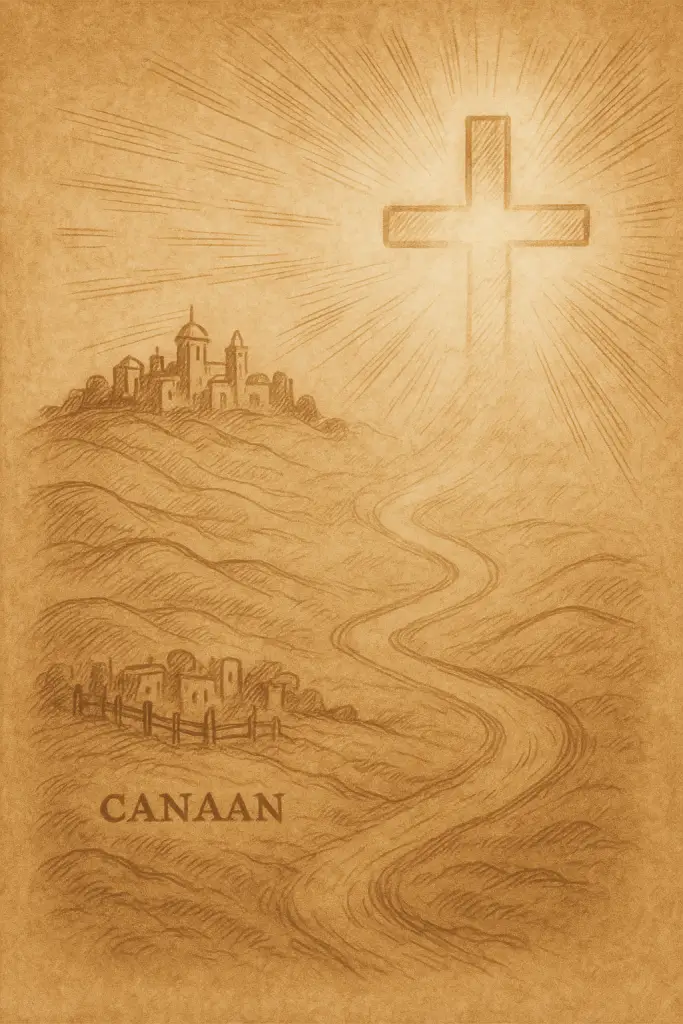
Christian Zionism puts the land of Israel at the center of God’s redemptive plan.
According to this teaching, the covenant God made with Abraham concerning the land remains in force today — and is independent of Israel’s belief or obedience. Therefore, the modern nation-state of Israel is viewed as the rightful heir of divine promise, and any spiritualization of that promise is seen as a dangerous error.
But this view misunderstands the entire purpose of the land in biblical history.
The land was never the end goal — it was a shadow pointing to something greater. It was a temporary inheritance designed to prepare a people for the true inheritance: Christ Himself.
The Promise of Land: Literal and Limited
Yes, God promised Abraham a land:
“Unto thy seed have I given this land…”
— Genesis 15:18
But that promise was always connected to covenant obedience (Deut. 28), and it was never the final reward.
In fact, Joshua 21:43–45 says the promise was fulfilled:
“And the LORD gave unto Israel all the land which he sware to give unto their fathers… There failed not ought of any good thing which the LORD had spoken… all came to pass.”
They possessed it — and they lost it. Repeatedly.
Why?
Because the physical land was conditional — a picture, a type, not the permanent inheritance.
Abraham Looked Beyond
Hebrews 11 destroys the foundation of Christian Zionism’s obsession with the land:
“By faith he sojourned in the land of promise, as in a strange country…”
— Hebrews 11:9
He was in the land — but didn’t settle into it. Why?
“For he looked for a city which hath foundations, whose builder and maker is God.”
— Hebrews 11:10
And again:
“If they had been mindful of that country from whence they came out, they might have had opportunity to have returned. But now they desire a better country, that is, an heavenly…”
— Hebrews 11:15–16
The fathers of the faith weren’t longing for a national homeland — they were longing for Christ.
The True Inheritance Is in Christ
The New Testament does not affirm a return to the land. Instead, it points to a greater inheritance — Christ and His kingdom.
“Blessed are the meek: for they shall inherit the earth.”
— Matthew 5:5
“And if children, then heirs; heirs of God, and joint-heirs with Christ…”
— Romans 8:17
“Giving thanks unto the Father… who hath made us meet to be partakers of the inheritance of the saints in light.”
— Colossians 1:12
The land was never meant to be an eternal possession. Even under the Old Covenant, the Levites had no inheritance in the land — for “the LORD God of Israel was their inheritance” (Joshua 13:33).
This is the spiritual reality now revealed in Christ.
Why a Physical Inheritance Falls Short
Christian Zionism reverts back to flesh-centered promises:
- A kingdom of borders
- A temple made with hands
- A holy land tied to geography
But the New Covenant centers on:
- A spiritual kingdom that is not of this world (John 18:36)
- A heavenly country prepared for the faithful (Heb. 11:16)
- An inheritance undefiled and reserved in heaven (1 Pet. 1:4)
The question is not whether God keeps His promises.
The question is: What did He really promise?
And to whom?
“For all the promises of God in him are yea, and in him Amen…”
— 2 Corinthians 1:20
Christ Is the Land
The land of Canaan was always a shadow of the true rest — a type of our life in Christ.
“Come unto me, all ye that labour and are heavy laden, and I will give you rest.”
— Matthew 11:28
He is the dwelling place (John 15:4), the Sabbath rest (Heb. 4:9), the tabernacle of God (Rev. 21:3).
To return to the land apart from Christ is to go backward. It’s to prefer the symbol over the substance — the earth over heaven — the picture over the Person.
The Danger of Making the Land the Lord
When the land becomes the focus, the Lord is reduced to a means to a political end.
Christian Zionism doesn’t just distract from the Gospel — it replaces it.
It enthrones ethnic privilege over spiritual rebirth.
It elevates a nation above a new creation.
It preaches a coming kingdom without the cross.
But the Gospel proclaims something far better:
“He is our peace, who hath made both one… For through him we both have access by one Spirit unto the Father.”
— Ephesians 2:14,18
➕ The Lord Is Our Portion
David didn’t long for a strip of earth. He longed for the Lord:
“The LORD is the portion of mine inheritance and of my cup…”
— Psalm 16:5
So must we.
Next: The Everlasting Covenant Argument
Does “Everlasting” Really Mean Forever?