Flesh and Spirit: Why Christian Zionism Can’t See the Kingdom — Post 5
“He hath remembered his covenant for ever, the word which he commanded to a thousand generations.”
— Psalm 105:8, KJV
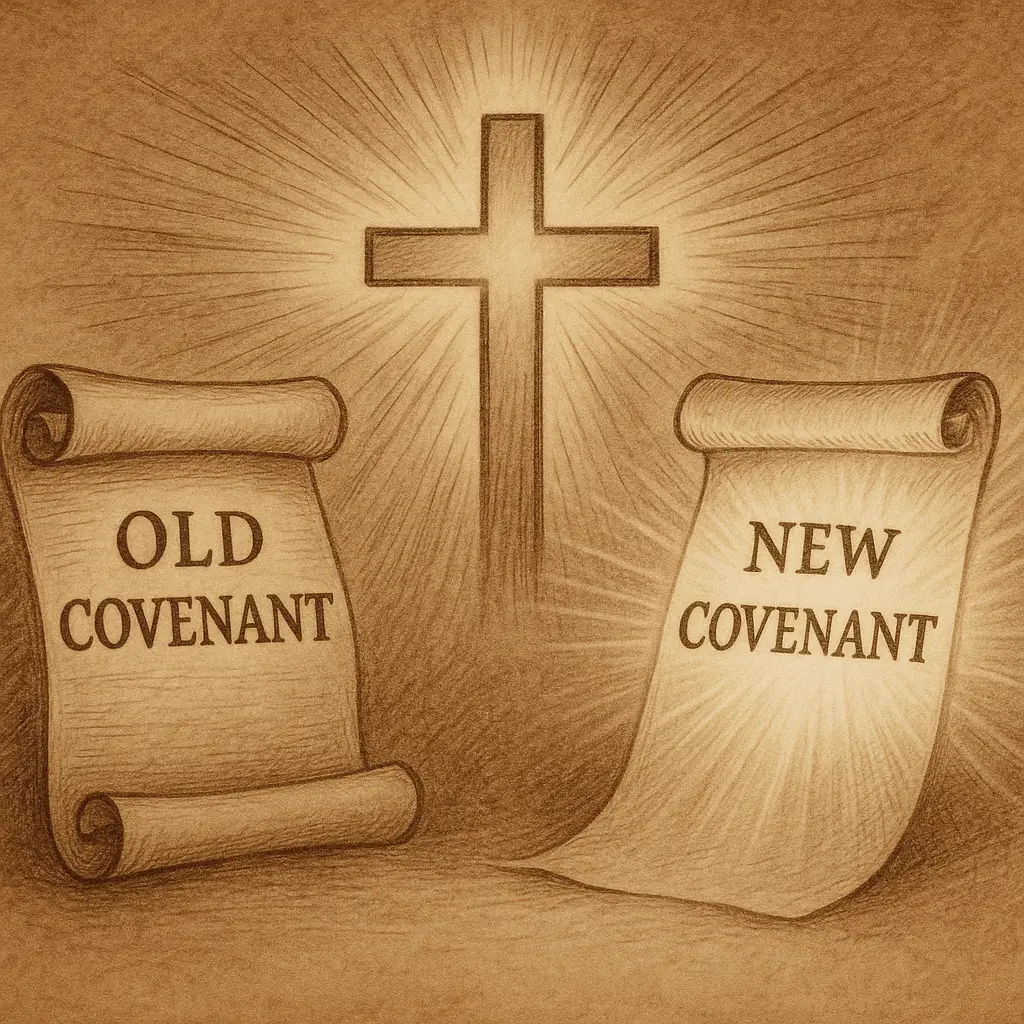
One of the most frequently used talking points in Christian Zionism is this:
“God made an everlasting covenant with Israel. That means it can’t be changed, revoked, or fulfilled spiritually.”
But this argument ignores a foundational truth of Scripture: that God’s covenants are fulfilled in Christ, not bypassed by Him — and that the word “everlasting” must be understood in light of the covenant’s purpose, structure, and fulfillment.
When rightly divided, the Bible shows that not every “everlasting” covenant remains in force forever, and not every promise remains attached to the original outward form. Instead, what is everlasting is God’s faithfulness to His redemptive plan — not the fleshly systems used temporarily along the way.
A Word on “Everlasting”
The Hebrew word translated “everlasting” is olam — a term that can mean:
- Eternal (forever with no end)
- Indefinite continuation (as long as its purpose endures)
- Hidden or unknown duration (a long time, with no set limit)
It is used for:
- The Levitical priesthood (Ex. 40:15)
- Animal sacrifices (Lev. 3:17)
- The feast days (Lev. 23:41)
- The Sabbath (Ex. 31:16)
- The covenant of circumcision (Gen. 17:13)
- And yes, the land promise to Abraham (Gen. 17:8)
Clearly, then, “everlasting” does not always mean “eternal in form.” Rather, it refers to a covenant’s appointed duration under God’s purpose.
Conditional, Temporal, and Fulfilled
God’s covenant with Abraham did include land, circumcision, and a great nation — but each of these was typological, pointing forward to something greater:
- The land pointed to the rest in Christ (Heb. 4:8–10)
- Circumcision pointed to the circumcision of the heart (Rom. 2:29)
- The nation pointed to a spiritual people from every tongue and tribe (1 Pet. 2:9)
And the Levitical priesthood, which was also called “everlasting,” was abolished in Christ — not because God was unfaithful, but because God was faithful to fulfill His plan.
What Did God Really Swear to Abraham?
God’s covenant with Abraham was not just about land — it was ultimately about Christ:
“Now to Abraham and his seed were the promises made… to thy seed, which is Christ.”
— Galatians 3:16
The promises were not left dangling — they were fulfilled:
- In a Person (Christ)
- In a people (those in Him)
- In a place (heavenly Jerusalem)
The eternal dimension of the Abrahamic covenant is preserved — but in a better form. As Hebrews says:
“But now hath he obtained a more excellent ministry, by how much also he is the mediator of a better covenant…”
— Hebrews 8:6
Everlasting… Until Fulfilled
There are dozens of examples in Scripture of things called “everlasting” that did not last forever in form:
| “Everlasting” Element | Scripture | Fulfillment or End |
|---|---|---|
| Levitical priesthood | Exodus 40:15 | Ended (Hebrews 7:12) |
| Circumcision | Genesis 17:13 | Replaced (Gal. 5:6; Rom. 2) |
| Sabbath | Exodus 31:16 | Fulfilled (Col. 2:16–17) |
| Temple sacrifices | Leviticus 6:18 | Abolished (Hebrews 10:9–10) |
| Land covenant (Canaan) | Genesis 17:8 | Typologically fulfilled in Christ (Heb. 11:16) |
To argue that the “everlasting” land covenant still applies to a Christ-rejecting nation is to contradict the Gospel, which says all God’s promises are “Yea and Amen in Him.” (2 Cor. 1:20)
If Christ Is the Fulfillment, Then He Is the Heir
“And if ye be Christ’s, then are ye Abraham’s seed, and heirs according to the promise.”
— Galatians 3:29
There is no longer a promise outside of Christ.
There is no parallel inheritance.
There is no dual heirship.
Those in Christ — Jew or Gentile — are the heirs.
A More Glorious Covenant
“For if that which is done away was glorious, much more that which remaineth is glorious.”
— 2 Corinthians 3:11
The Old was not destroyed in anger. It was fulfilled in glory.
Christian Zionism tries to revive what God has retired — to resurrect the types and shadows when the substance has already come.
But the true “everlasting covenant” is found in:
“The blood of the everlasting covenant” — Hebrews 13:20
That is the covenant that saves. That is the covenant that abides forever.
Next: The Seed of Abraham: One, Not Many
Why Christ Alone Inherits the Promise — and All Who Are in Him