Sometimes a thought spreads widely online because it feels humble and compassionate. Recently a post on X argued that the great lesson of the book of Job is this: the best theology may be silence.
The reasoning goes like this. Job’s friends had correct theology but applied it with too much certainty. God later rebuked them, even though one of their statements was true enough for Paul to quote in the New Testament. Therefore, the real lesson of Job must be restraint, standing beside suffering without explanation.
There is a kernel of truth in that observation. Job’s friends did indeed begin well. When they first saw Job’s grief, they sat with him seven days and spoke nothing.
“So they sat down with him upon the ground seven days and seven nights, and none spake a word unto him: for they saw that his grief was very great.” Job 2:13
Compassion often begins with quiet presence.
But the conclusion drawn from the story, that theology should ultimately fall silent, misses the real message of the book. The Scriptures themselves tell us something more direct and far more searching.
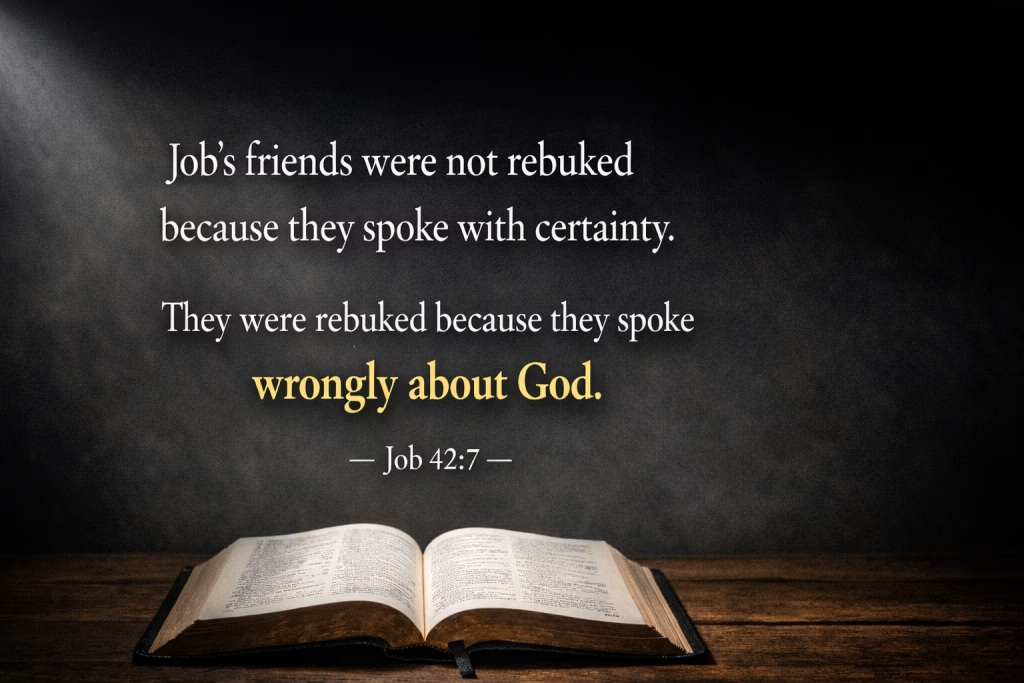
The problem was not merely overconfidence, it was speaking wrongly about God.
When Truth Is Spoken in the Wrong Framework
One observation from the X post is correct. Paul quotes something Eliphaz said:
“He taketh the wise in their own craftiness.” Job 5:13
Paul later cites this same sentence:
“For the wisdom of this world is foolishness with God. For it is written, He taketh the wise in their own craftiness.” 1 Corinthians 3:19
So a statement spoken by Eliphaz was true.
But Scripture often records true statements spoken by people who are otherwise wrong.
Caiaphas unknowingly prophesied that Christ would die for the nation (John 11:50–52).
Balaam spoke genuine prophecy despite his corrupt heart (Numbers 22–24).
Even Satan quoted Scripture accurately during the temptation of Christ (Matthew 4:6).
A true sentence does not make an entire system correct.
Job’s friends knew many correct things about God. Their failure lay in how they used those truths.
The Framework That Fell Apart
The theology of Job’s friends rested on a simple formula.
Righteous people prosper, wicked people suffer. Therefore, if someone suffers greatly, they must have committed great sin. This was their interpretive grid for the entire situation. Again and again they urged Job to repent because, in their view, suffering could only be divine punishment.
But the reader of the book knows something they do not. The opening chapters reveal a heavenly conversation hidden from them. Job was not suffering because he was wicked, he was suffering because he was righteous.
Satan had challenged the integrity of Job’s faith. The entire argument of the friends falls apart once this reality is understood.
And this is why God later rebukes them so strongly.
What God Actually Says
At the end of the book, the Lord gives a clear verdict.
“My wrath is kindled against thee, and against thy two friends: for ye have not spoken of me the thing that is right, as my servant Job hath.” Job 42:7
Notice carefully what God does not say. He does not say their problem was simply too much confidence, He says they did not speak rightly about Him.
Their conclusions about God’s dealings were false. They had built a system and forced reality to fit inside it.
Job’s Words Were Honest — But Not Always Correct
Some readers assume this means everything Job said was right. The book itself corrects that assumption.
When God finally appears, Job admits:
“I have uttered that I understood not; things too wonderful for me, which I knew not.” Job 42:3
Job said things in anguish that were mistaken, but there was a crucial difference between Job and his friends. Job directed his struggle toward God while the friends directed their certainty against Job.
Job wrestled with the Lord, but the friends defended a theory.
The Structural Key Most Readers Miss
The book of Job also contains a fascinating structural feature.
The debates between Job and the three friends unfold in cycles. At first each man speaks confidently. But as the discussion continues, the friends’ arguments grow shorter and weaker. By the final round, one of them disappears from the conversation entirely.
Their system cannot explain Job.
Then a new voice appears: Elihu.
Elihu is younger than the others and says he waited because of their age. When he finally speaks (Job 32–37), he rebukes both sides. He rebukes Job for justifying himself more than God, and he rebukes the friends because they condemned Job without answering him.
Most importantly, Elihu introduces a broader understanding of suffering.
He explains that suffering is not always punishment. Sometimes it is instruction.
“He openeth also their ear to discipline, and commandeth that they return from iniquity.” Job 36:10
Elihu prepares the way for the Lord’s appearance. His final speech describes God’s power in storms, thunder, and lightning.
Then immediately the text says:
“Then the LORD answered Job out of the whirlwind.” Job 38:1
The structure of the book moves deliberately:
Human debate → broader perspective → divine revelation.
Why God Speaks About Creation
When the Lord finally answers Job, He does something that puzzles many readers. He does not explain the heavenly conversation from chapter one, instead, He asks Job questions about creation.
Where were you when the earth was founded?
Can you command the morning?
Do you understand the paths of the stars?
Why?
Because the issue was never simply Job’s suffering, the issue was whether human beings can fully understand the governance of God’s world.
If we cannot explain snow, oceans, or the instincts of animals, how could we possibly map the purposes of divine providence?
God’s speech restores humility.
The Real Lesson of Job
The lesson of Job is not that theology should fall silent, scripture never calls believers to abandon truth or doctrine.
The real warning of Job is this:
Do not claim to know what God has not revealed.
Job’s friends spoke confidently about hidden purposes they did not understand. They defended God with arguments that actually misrepresented Him. This principle appears elsewhere in Scripture.
“Not to think of men above that which is written.“ 1 Corinthians 4:6
And again:
“The secret things belong unto the LORD our God: but those things which are revealed belong unto us.” Deuteronomy 29:29
Faithfulness does not mean silence about what God has revealed, it means humility about what He has not.
The Mediator Job Longed For
One of the most powerful moments in the book occurs when Job cries out:
“Neither is there any daysman betwixt us, that might lay his hand upon us both.” Job 9:33
Job longed for a mediator between himself and God. That mediator has now come.
Jesus Christ.
The cross answers questions the book of Job only foreshadows. In Christ we see that suffering can serve purposes beyond human understanding — even redemption itself.
The righteous One suffered for the salvation of the world.
Compassion Without False Theology
The friends were wrong not because they spoke, they were wrong because they spoke falsely about God while claiming certainty. They defended a system and they ignored the reality before them.
They accused a righteous man.
The book of Job warns us against doing the same.
We should comfort the suffering with humility and compassion. But we must also guard the truth about God. Silence may sometimes be appropriate.
But Scripture itself ultimately speaks — and it calls us to speak only where God has spoken.
Read more:
Full Review of The Story of Job, by Jessie Penn-Lewis