Introduction
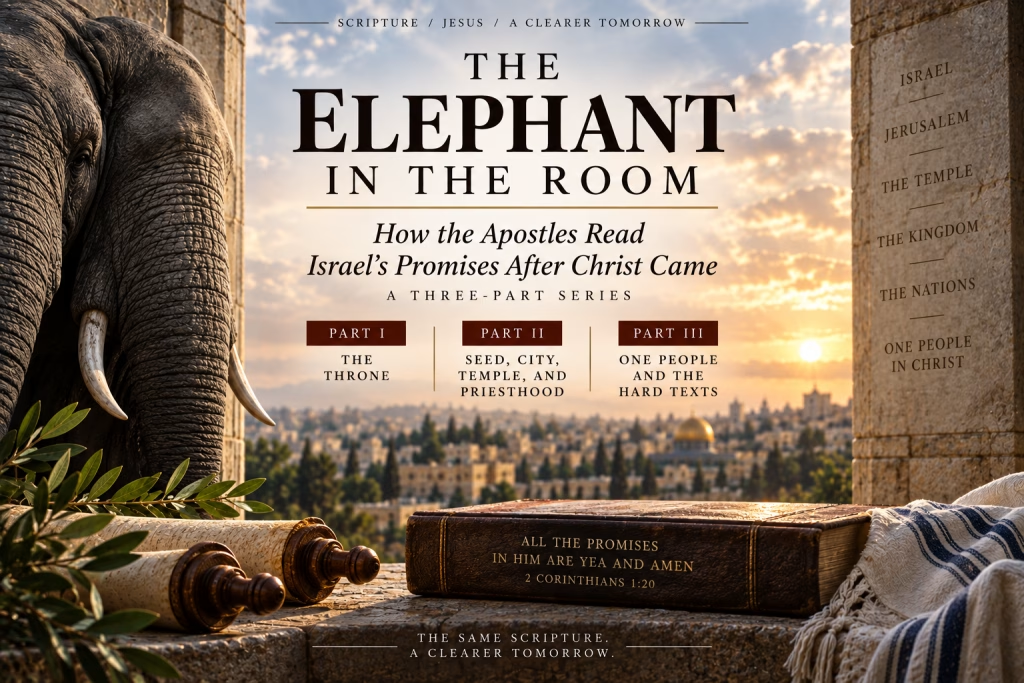
There is an elephant in the room whenever Christians discuss Israel, Jerusalem, Bible prophecy, and the return of Jesus Christ.
We are often told that the Old Testament requires a future restoration of Israel as a distinct national people in the land, Jerusalem as the governmental center of Messiah’s kingdom, a restored temple and priestly order, and the Son of David personally reigning from earthly Jerusalem. In many prophetic systems these are not minor details. They become essential for understanding the last days.
But before we ask how Isaiah, Ezekiel, Zechariah, or Amos should be fitted into such a system, there is a prior question: How did the apostles themselves read those prophets after Jesus Christ had come?
That is the question this series follows.
The issue is not simply that the apostles fail to give us a modern prophecy chart. An argument from silence can only take us so far. The stronger argument is positive. When the apostles open the Scriptures concerning David, Abraham, Zion, the temple, the priesthood, the covenant, and the kingdom, they repeatedly interpret those promises through the death, resurrection, ascension, and present reign of Jesus Christ.
The New Testament does not disappear when we open the prophets, it teaches us how to read them.
This series does not attempt a complete eschatology. It does not choose a camp on Revelation 20 and it does not deny a future as large as resurrection, judgment, and a new heavens and a new earth. It asks a narrower question: Do the apostles teach that the climax of redemption requires a return to the shadows that anticipated Christ?
The five articles follow a deliberate progression. We begin with the throne, then follow the apostles through Israel’s great covenant promises and institutions. From there, we examine the promise of restoration, Paul’s teaching concerning Israel, and finally the temple and the millennium. Each article builds upon the apostolic interpretation established in those preceding it.
Begin where the apostles begin. Let the difficult texts speak. And ask whether any of them requires God to move from Christ back to the forms that pointed to Him.
Introduction
There is an elephant in the room whenever Christians discuss Israel, Jerusalem, Bible prophecy, and the return of Jesus Christ.
We are often told that the Old Testament requires a future restoration of Israel as a distinct national people in the land, Jerusalem as the governmental center of Messiah’s kingdom, a restored temple and priestly order, and the Son of David personally reigning from earthly Jerusalem. In many prophetic systems these are not minor details. They become essential for understanding the last days.
But before we ask how Isaiah, Ezekiel, Zechariah, or Amos should be fitted into such a system, there is a prior question: How did the apostles themselves read those prophets after Jesus Christ had come?
That is the question this series follows.
The issue is not simply that the apostles fail to give us a modern prophecy chart. An argument from silence can only take us so far. The stronger argument is positive. When the apostles open the Scriptures concerning David, Abraham, Zion, the temple, the priesthood, the covenant, and the kingdom, they repeatedly interpret those promises through the death, resurrection, ascension, and present reign of Jesus Christ.
The New Testament does not disappear when we open the prophets. It teaches us how to read them.
This series does not attempt a complete eschatology. It does not choose a camp on Revelation 20. It does not deny a future as large as resurrection, judgment, and a new heavens and a new earth. It asks a narrower question: Do the apostles teach that the climax of redemption requires a return to the shadows that anticipated Christ?
The five articles follow a deliberate progression. We begin with the throne, then follow the apostles through Israel’s great covenant promises and institutions. From there, we examine the promise of restoration, Paul’s teaching concerning Israel, and finally the temple and the millennium. Each article builds upon the apostolic interpretation established in those preceding it.
How to Read the Series
Part I — establishes the starting point: the apostles present an already enthroned Son of David. The waiting takes place from the throne.
Part II — follows the same apostolic method through Abraham’s Seed, the inheritance, Jerusalem, the temple, and the priesthood. The movement is from shadow to Substance, from temporary form to greater fulfillment in Christ.
Part III — examines what Christ has created between Jew and Gentile before turning to the promises of restoration. Acts 3, Luke 1, and Matthew 19 are allowed to speak, but they must be considered alongside the realities established through Christ’s resurrection and exaltation.
Part IV — gives Romans 11 the attention it deserves. Israel’s fullness, the receiving of the natural branches, partial blindness, and the declaration that “all Israel shall be saved” are considered within Paul’s larger argument. The question is whether a future mercy toward ethnic Israel requires a separate covenantal destiny or restoration of the Mosaic order.
Part V — brings the remaining questions together. Ezekiel’s temple, the priesthood and sacrifices, and Revelation’s millennium are examined in light of Hebrews and the New Jerusalem. The series concludes by returning to its central question: Do the apostles teach that the climax of redemption requires a return to the shadows that anticipated Christ?
Begin where the apostles begin. Let the difficult texts speak. And ask whether any of them requires God to move from Christ back to the forms that pointed to Him.
Contents
Part 1 — How the Apostles Read the Throne
The apostles do not present Jesus as a King waiting for a later coronation. They proclaim a risen, seated, and reigning Son of David.
Part II — Seed, City, Temple, and Priesthood
The same apostolic movement continues through Israel’s great covenant forms. The Seed reaches Christ. The inheritance expands. Jerusalem opens into its greater reality. The temple reaches Christ and His people. The priesthood reaches its permanence.
Part III — One People and the Promise of
RestorationChrist has made of twain one new man. The promises concerning restoration, David’s throne, and the twelve tribes must be understood without setting aside what Christ has already accomplished. Acts 3, Luke 1, and Matthew 19 are examined directly, without requiring them to establish a covenantal system they do not themselves describe.
Part IV — All Israel Shall Be Saved
Romans 9–11 receives a careful examination, with particular attention to Israel’s fullness, receiving, partial blindness, and future salvation. The possibility of a future turning of ethnic Israel to Christ is considered without confusing that hope with the restoration of a separate Mosaic covenantal order. The natural branches are grafted into the same olive tree through faith.
Part V — The Temple, the Millennium, and the End of the Shadows
Ezekiel’s temple vision and the memorial-sacrifice interpretation are examined alongside Hebrews and Revelation. The millennium is then considered without assuming that Revelation 20 teaches the entire restored-Mosaic system commonly associated with it. The series concludes with the apostolic movement toward Christ and the final dwelling of God with His people.
The Center
Paul gives the simplest statement of the whole principle:
For all the promises of God in him are yea, and in him Amen, unto the glory of God by us. — 2 Corinthians 1:20
In Him. Not around Him. Not beside Him. Not back behind Him.
The prophetic hope does not terminate in the restoration of the shadows. It terminates in Jesus Christ.