Series: Why I Trust the KJV — Post 1
The Real Danger of Translation Philosophy
There are many reasons I trust the King James Bible. Some of them involve manuscripts, textual history, and particular verses that have been weakened, altered, bracketed, or omitted in modern versions. Those matters deserve careful treatment, and we will come to them. But before we begin talking about Greek manuscripts, textual families, translation committees, or disputed passages, I want to begin somewhere much simpler. I want to begin with Psalm 23.
Nearly every Christian knows it and many can recite at least part of it from memory. Its words have comforted believers beside hospital beds, at gravesides, in seasons of loss, and through valleys where there seemed to be no way forward. Yet the psalm also gives us an excellent lesson in something most Christians rarely think about: translation philosophy. And the lesson begins with a very simple question. Who is doing the acting?
The Shepherd Acts; the Sheep Receives
The King James Bible reads:
The LORD is my shepherd; I shall not want.
He maketh me to lie down in green pastures: he leadeth me beside the still waters.
He restoreth my soul: he leadeth me in the paths of righteousness for his name’s sake. Psalm 23:1–3
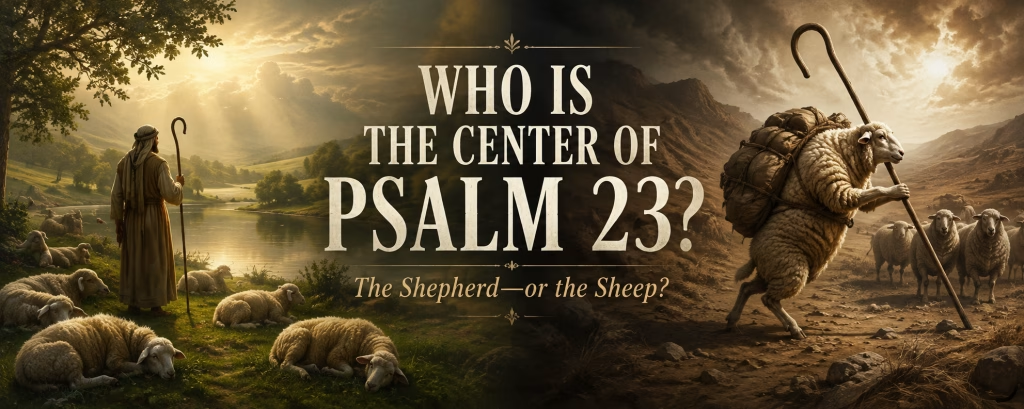
Read those verses again, but this time pay attention to the verbs. The LORD is. He maketh. He leadeth. He restoreth. He leadeth. Who is at the center? Not David. Not the sheep. The Shepherd. The sheep is certainly present. David says my, I, and me. But David is overwhelmingly the recipient of what Another is doing. The Shepherd acts. The sheep receives.
“He Maketh Me” or “He Lets Me”?
Some modern English versions render Psalm 23:2 along the lines of, “He lets me lie down in green pastures.” That sounds harmless enough. It sounds simpler, more contemporary, perhaps even easier to understand. But is it saying the same thing? Not quite.
To let someone do something ordinarily means to permit it. To make someone do something means to cause it. Those are not the same thoughts. And the Hebrew behind the expression supports the stronger causative idea reflected in the KJV: the Shepherd causes the sheep to lie down.
That does not mean the Shepherd brutally forces the sheep to the ground. Quite the opposite. A good shepherd brings his sheep into a place where they can rest. He feeds them, protects them, quiets their fears and He removes danger. He brings them into green pasture and establishes the conditions in which they can cease wandering and lie down. The Shepherd brings the sheep into rest. That is what makes the wording so beautiful: “He maketh me to lie down.”
David is not saying, I found a pleasant pasture and God allowed me to rest there. He is saying, My Shepherd brought me into rest. There is a world of difference between the two.
David Knew What He Was Saying
David knew what he was saying because David had been a shepherd. He knew that sheep did not manage themselves. When danger came, the sheep did not defeat the lion or the bear. David went after them:
Thy servant kept his father’s sheep, and there came a lion, and a bear, and took a lamb out of the flock: And I went out after him, and smote him, and delivered it out of his mouth…. 1 Samuel 17:34–35
The lamb did not rescue itself, the shepherd went after it. David knew what it meant to find pasture, lead the flock, protect the vulnerable, recover the wandering, and stand between the sheep and death.
So when David wrote, “The LORD is my shepherd,” he was not using a sentimental religious metaphor. He was confessing dependence. As completely as the sheep had depended upon David, David depended upon the LORD. That is why the verbs that follow matter: He maketh. He leadeth. He restoreth. David knew something modern self-sufficient Christianity easily forgets. The sheep cannot do the shepherd’s work.
The Sheep Is Not Managing the Shepherd
Much of modern Christianity has subtly taught us to think of God as Someone who assists us in managing our lives. We make the plans, establish the goals, determine the direction. We decide what kind of life we want, and then we ask God to bless it, help us accomplish it, and perhaps rescue us when things go wrong. Psalm 23 gives us an entirely different picture. The sheep does not manage the Shepherd, the Shepherd shepherds the sheep.
David does not say that he found green pastures, discovered peaceful water, repaired his damaged soul, or located the righteous path. He says the Shepherd made him lie down, led him beside still waters, restored his soul, and led him in the paths of righteousness. The entire passage dethrones self. This is not the testimony of a remarkably capable sheep. It is the testimony of a faithful Shepherd.
Translation Is Never Just About Making Something Easier
This is where the issue becomes larger than Psalm 23. We often hear that modern Bible translations simply put old language into words that contemporary readers can understand. Sometimes that is exactly what they do. There is nothing inherently spiritual about archaic vocabulary merely because it is old. But we need to understand something. The moment a translator moves from closely rendering the words and grammatical relationships of the text toward expressing what he believes the author means, interpretation has entered the process more heavily. And interpretation always carries assumptions.
That is the real danger of translation philosophy. Not every difference is corruption, not every modernization destroys doctrine and not every modern version makes the same choices. But neither should we assume that changing the wording never changes anything important. Sometimes the change is almost invisible. A stronger verb becomes a softer one, causation becomes permission, certainty becomes possibility. An objective act of God becomes a subjective experience of man. God is the active cause in the original expression, while the new wording can leave the reader hearing man as the principal actor and God as the One who merely permits. And because the sentence still sounds biblical, the reader may never realize anything happened.
That is why I want believers to learn something more useful than simply repeating, “The KJV is better.” I want us to learn to look.
The question is not merely, “Can I understand this translation?” The question is, “What has the translation taught me to see?”
Whenever a translation changes the wording significantly, ask what else changed with it. Did God act, or did man? Did God cause something, or merely permit it? Did Christ accomplish something, or has the wording subtly turned the passage into something I must accomplish? Has a promise become a possibility? Has a finished work become a process? Has something God supplies become something I must produce? These are not trivial questions. They touch the very heart of the difference between grace and performance.
“I Shall Not Want”
Even the opening verse deserves careful attention. The KJV says, “The LORD is my shepherd; I shall not want.” Some modern renderings put the thought more like, “The Lord is my shepherd; I lack nothing.” That certainly communicates something true. But listen to the movement of the KJV sentence: The LORD is my shepherd; I shall not want. There is a relationship between the two declarations. He is, therefore I shall not. My confidence is not ultimately grounded in an inventory of everything presently surrounding me (all the stuff I have). My confidence rests in who my Shepherd is. The assurance flows from Him. That is faith.
It does not say that David will never experience hardship. Psalm 23 itself immediately disproves that idea. There is a valley, there is the shadow of death and yes, there are enemies. Yet even there David does not say that he has developed enough inner strength to handle this. He says, “for thou art with me.” Again, the center is not David. The center is the Shepherd.
From “He” to “Thou”
There is something beautiful that happens when David enters the valley. Before the valley, he speaks about the Shepherd: He maketh, he leadeth, He restoreth. But when he reaches the valley of the shadow of death, the language changes. David no longer merely speaks about Him. He speaks to Him: “for thou art with me; thy rod and thy staff they comfort me.”
The valley does not drive David toward greater self-reliance, it drives him into greater consciousness of the Shepherd. And the psalm continues: “Thou preparest a table before me in the presence of mine enemies: thou anointest my head with oil; my cup runneth over.” Who prepares the table? Thou. Who anoints? Thou. Who supplies the overflowing cup? Again, the source is the Shepherd. David receives.
“For His Name’s Sake”
Perhaps the phrase that most completely destroys man-centered religion appears softly at the end of verse 3: “he leadeth me in the paths of righteousness for his name’s sake.” Why does He lead me? Ultimately, for His name’s sake. Even my righteous walk does not finally terminate upon me; not my reputation, not my achievement, not my spiritual performance, not my ability to demonstrate what a good Christian I have become. His name.
That does not make obedience unimportant. It puts obedience in its proper place. The sheep is not passive; it follows. David himself says, “Yea, though I walk…” Dependence does not mean inactivity. But following is not shepherding. The Shepherd leads; the sheep follows. The Shepherd produces life; the sheep bears fruit. The Shepherd gives; the sheep receives. And everything returns to the glory of the Shepherd.
This is exactly where performance-based Christianity reverses the order. Performance religion asks, What must I produce so that God will be pleased with me? Grace asks, What does the life of Christ produce in those who abide in Him? One puts the burden upon the sheep. The other reveals the sufficiency of the Shepherd.
Psalm 23 Leads Us to Christ
For the Christian, we cannot read Psalm 23 without eventually hearing the words of Jesus: “I am the good shepherd: the good shepherd giveth his life for the sheep” (John 10:11). The Shepherd of Psalm 23 is revealed to us in Christ. He is “that great shepherd of the sheep” (Hebrews 13:20). Peter calls Him “the Shepherd and Bishop of your souls” (1 Peter 2:25) and “the chief Shepherd” (1 Peter 5:4).
Psalm 23 therefore becomes much more than a comforting poem about God helping us through difficult circumstances. It reveals the character of the Shepherd whose fullness we behold in Jesus Christ. He feeds, leads, restores, protects, comforts, and supplies. He brings His sheep home. The Christian life is not primarily the story of everything I am accomplishing for Christ. It is the unfolding story of what Christ is accomplishing in His people.
Learn to See It for Yourself
The greatest danger in translation is not always that a version will suddenly say something obviously heretical. Sometimes the danger is far more subtle. A word changes, a verb softens, the sentence becomes easier. Nothing appears dramatically wrong, yet almost imperceptibly, the center begins to move. The Shepherd becomes the helper, the sheep becomes the actor. God offers, and man achieves. God permits, and man performs. God assists, and man directs. And before long, Christianity itself begins to be understood primarily through the question, What am I doing? instead of, What has Christ done, and what is His life now producing in me?
That is why translation philosophy matters. Words carry theology, grammar carries theology, who acts and who receives carries theology. And sometimes one apparently insignificant word reveals far more than we imagined. “He maketh me.” Not merely, He lets me. The Shepherd is doing the shepherding.
As we continue through this series, I am not only going to give you a collection of verses where I believe the King James Bible is superior and ask you to take my word for it. I want you to learn to see the issues for yourself. Compare. Observe. Ask questions. When the wording changes, ask what else changed with it. Has causation become permission? Has certainty become possibility? Has God’s work become man’s performance? Has translation quietly become interpretation? And above all: Has Christ remained at the center?
Sometimes you will discover that a modern translation has preserved the thought very well. Other times you may discover something you had read a hundred times without ever noticing what had been lost. That kind of discernment is far more valuable than simply being told which Bible to carry. Because once you learn to see, you will begin noticing things for yourself.
The Answer Is Given in the Opening Sentence
By the end of the psalm, the sheep has been fed, rested, restored, guided, protected, comforted, supplied, pursued by goodness and mercy, and brought into the house of the LORD. None of the shepherding is his accomplishment. That is not performance Christianity. That is the life of a sheep under the faithful government of his Shepherd.
And perhaps that is one reason those old words strike the spirit so deeply: “He maketh me to lie down.” There is no independent sheep there. There is no man sitting upon the throne of his own life asking God to assist him with his plans. There is a Shepherd, and there is a sheep. The Shepherd leads. The sheep follows.
So who is the center of Psalm 23? The answer is given before we finish the opening sentence: “The LORD.” And that is exactly where He belongs.