Giants in the Land: Volume 1 (War for Possession) — Post 17 of 33
Part III — The War for Rest
Bread, Water, and Spiritual Supply Are Contested
(Exodus 17; 1 Corinthians 10:1–4; Ephesians 6:10–18)
Israel had been redeemed from Egypt, carried through the Red Sea, and led into the wilderness by the visible presence of God. Yet redemption did not place them beyond need, and divine guidance did not remove resistance from their path.
At Rephidim, two events unfolded side by side. First, Israel found no water. Then Amalek came and fought against them.
Scripture does not say Amalek attacked because of the water, nor should we force the connection. But the order is instructive. God supplied His people from the rock, and immediately afterward they were required to stand against an enemy determined to hinder their progress.
Provision and warfare were not opposites. They belonged to the same wilderness training.
The Crisis of No Water
“And all the congregation of the children of Israel journeyed from the wilderness of Sin, after their journeys, according to the commandment of the LORD, and pitched in Rephidim: and there was no water for the people to drink.” — Exodus 17:1
They were exactly where God had led them, yet there was no water.
This alone corrects a common misunderstanding. Obedience does not guarantee that every necessity will appear before the need arises. Sometimes God leads His people into a place where natural supply fails so that they may learn the source of spiritual supply.
Israel interpreted lack as abandonment:
“Wherefore is this that thou hast brought us up out of Egypt, to kill us and our children and our cattle with thirst?” — Exodus 17:3
Their thirst was real, however their interpretation was unbelief.
The absence of visible provision did not mean the absence of God. The Lord was present, but He intended to reveal His supply in a way they could neither manufacture nor control.
The Rock Was Christ
God commanded Moses to strike the rock in Horeb, and water came forth for the people.
Paul removes all uncertainty concerning the spiritual meaning:
“And did all drink the same spiritual drink: for they drank of that spiritual Rock that followed them: and that Rock was Christ.” — 1 Corinthians 10:4
Christ is not merely the One who gives the supply, He is the supply.
Israel could not produce water from the wilderness and Moses could not reason water out of the stone nor could the people murmur it into existence. Life came from the smitten rock.
The cross is therefore central to every provision of the Christian life. Forgiveness, righteousness, peace, strength, joy, endurance, and the life of the Spirit flow from Christ crucified and risen.
We do not overcome by drawing more deeply from ourselves, we overcome by drinking more deeply of Him.
Supply Does Not Eliminate Conflict
Immediately after the water flowed, Scripture says:
“Then came Amalek, and fought with Israel in Rephidim.” — Exodus 17:8
The people had received provision, but they had not been exempted from warfare.
This is where many believers become confused. They assume that when God supplies, resistance should disappear. But the wilderness record reveals that spiritual supply often prepares us to meet resistance rather than removing resistance from our path.
The water strengthened Israel for the conflict ahead. God did not give them life so they could remain motionless beside the rock, He sustained them so they could continue toward the land.
Provision is unto progress.
Amalek Attacks the Pilgrim People
Amalek did not pursue Israel while they were settled in Egypt. He attacked them after they had been redeemed and were moving toward inheritance.
This is an important spiritual pattern. The enemy opposes those who are advancing.
The warfare of the believer is not an attempt to earn redemption. Israel fought Amalek after the blood of the lamb, after deliverance from Pharaoh, after the Red Sea, and after drinking from the rock.
They fought as a redeemed people.
Likewise, the Christian does not fight for acceptance with God. He fights from acceptance in the Beloved. He does not fight to make Christ victorious. He fights because Christ has triumphed and because the enemy still contests the believer’s practical possession of what Christ has won.
The Battle in the Valley and the Hands on the Hill
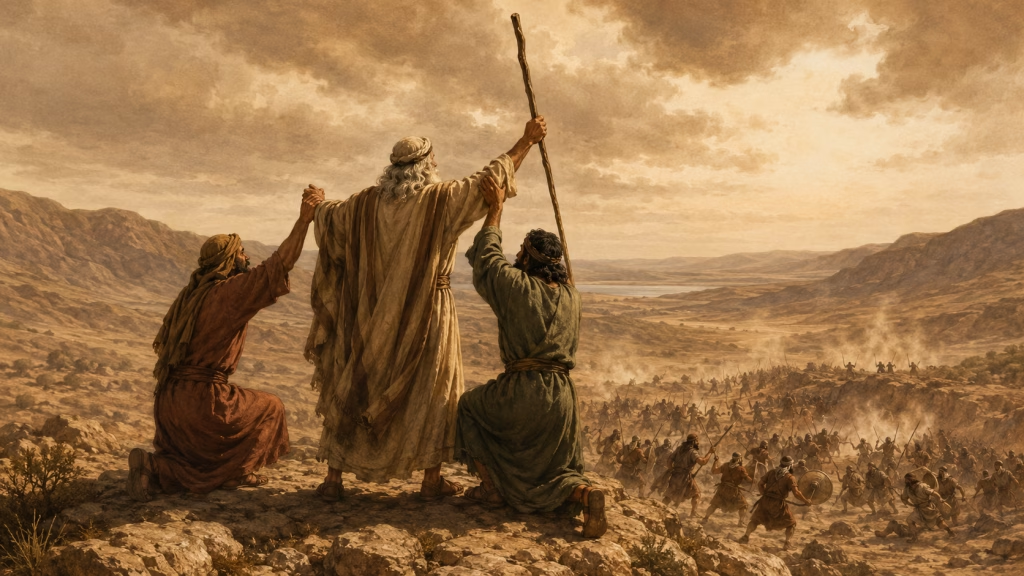
Joshua fought Amalek below while Moses stood above with the rod of God in his hand.
“And it came to pass, when Moses held up his hand, that Israel prevailed: and when he let down his hand, Amalek prevailed.” — Exodus 17:11
The battle required both engagement and dependence.
Joshua could not remain in the tent claiming that God had already promised victory. He had to go down into the valley and fight. But Joshua’s strength alone could not prevail. Victory depended upon the raised hands of Moses before God.
Here we see the balance of spiritual warfare:
- faith does not replace obedience
- obedience does not replace dependence
- prayer does not replace engagement
- engagement does not make prayer unnecessary
God supplied the victory, but Israel still had to stand in the battle.
This is the pattern of sovereign grace and obedient cooperation.
Even Intercession Requires Support
Moses’ hands became heavy. Aaron and Hur placed a stone beneath him and held up his hands until the sun went down.
“And his hands were steady until the going down of the sun.” — Exodus 17:12
This detail matters.
The man standing on the hill was not naturally inexhaustible. Even Moses required support. Spiritual warfare exposes the insufficiency of isolated strength.
There are battles in which another believer must help uphold our hands. There are seasons when the faith of the Body steadies a weary saint. This is not weakness to be ashamed of. It is the Lord’s provision through fellowship.
God did not design His people to possess the land as detached individuals. The warfare is personal, but it is also corporate.
The Enemy Contests Practical Enjoyment
Christ has given His people peace, yet peace must be guarded. Christ has given access to grace, yet believers must stand therein. Christ has given His Word, yet thoughts must be brought into captivity. Christ has given the Spirit, yet the saints are commanded to walk in the Spirit.
These are not contradictions. They reveal the difference between what is ours in Christ and what is practically possessed through faith and obedience.
Paul therefore commands:
“Finally, my brethren, be strong in the Lord, and in the power of his might.” — Ephesians 6:10
He does not say, “Produce strength from yourself.” Neither does he say, “Because Christ is strong, no battle remains.”
He says, “Be strong in the Lord.”
The strength is His. The standing is ours.
When the Enemy Attacks the Supply
The enemy cannot destroy Christ, but he seeks to interrupt the believer’s enjoyment of Christ.
He does this through distraction, accusation, fear, weariness, unbelief, and neglected communion. He attempts to separate the saint—not from the objective sufficiency of Christ—but from the practical drawing upon that sufficiency.
A spring may be full while a thirsty man refuses to drink.
The enemy therefore works upon the mind, the conscience, and the affections. He seeks to persuade the believer that prayer is useless, Scripture is dry, fellowship is burdensome, obedience is impossible, and God is distant.
The supply has not failed. The warfare concerns our access, confidence, attention, and obedience.
The Rock Still Gives Water
The answer is not frantic striving. Neither is it passive talk about rest while the enemy occupies the field.
The answer is to return continually to Christ.
He is the Rock that was smitten once. He is the fountain that does not run dry. He is the bread of life. He is our peace. He is our righteousness. He is the strength by which we stand.
The believer does not fight to create provision. He fights to remain in the enjoyment and obedience of the provision already given in Christ.
This is why the Christian life contains both drinking and standing, receiving and resisting, resting and wrestling.
Provision and Warfare Belong Together
In the wilderness journey, provision and warfare are often found side by side.
God supplies His people because they must advance. He strengthens them because resistance remains. He teaches them to draw life from Christ so they will not fight in the strength of the flesh.
The lesson of Rephidim is not that every hardship is caused by direct satanic attack. Nor is it that every provision must be earned through battle.
The lesson is that redeemed people live by divine supply while advancing through contested ground.
Christ is sufficient. The enemy is real. Dependence is necessary. Obedience is not optional. Victory is the Lord’s. The battle must still be joined.
Overcomer’s Checkpoint
Where has resistance caused you to question God’s provision?
Have you interpreted spiritual dryness as proof that the Rock has ceased to give water? Have distraction, accusation, or weariness drawn you away from the very means through which Christ strengthens you? Are you attempting to fight in your own strength, or are your hands raised in conscious dependence upon God?
And when your hands grow heavy, have you allowed the Body of Christ to help uphold them?
Provision is not a promise that no conflict will come. It is God’s assurance that everything necessary for obedience and endurance is already present in Christ.
Drink from the Rock. Lift up the hands that hang down. Stand with the brethren. Go forward into the battle.