Giants in the Land: Volume 1 (War for Possession) — Post 18 of 33
Part III — The War for Rest
Peace as Inheritance, Not Therapy
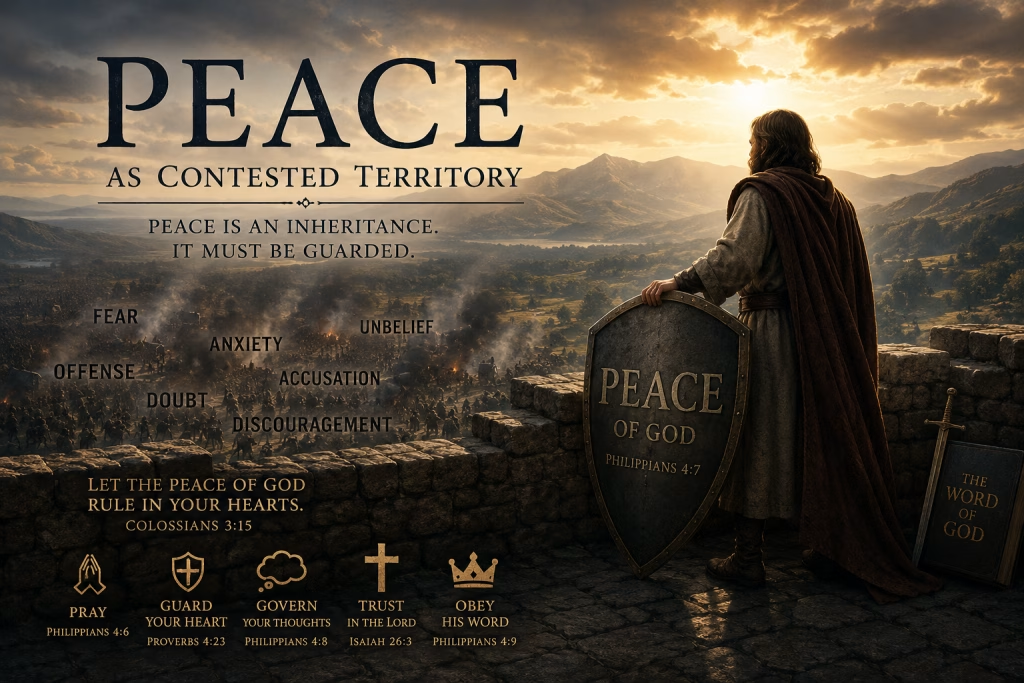
(John 14:27; Colossians 3:15; Philippians 4:6–9; Isaiah 26:3)
Peace is one of the believer’s greatest inheritances in Christ.
Yet peace is also one of the first territories the enemy seeks to disturb.
Many Christians think of peace mainly as a feeling—something that comes when circumstances become quiet, problems are resolved, and pressure subsides. But the peace Christ gives is not dependent upon outward calm.
Jesus said:
“Peace I leave with you, my peace I give unto you: not as the world giveth, give I unto you.” — John 14:27
The world gives peace when conflict disappears.
Christ gives peace in the midst of conflict.
His peace is not fragile. It is not built upon favorable conditions. It flows from His own settled relationship with the Father and from His complete victory over the world.
This peace has been given.
But it must also be guarded, obeyed, and possessed.
A Gift That Must Govern
Paul wrote:
“And let the peace of God rule in your hearts, to the which also ye are called in one body; and be ye thankful.” — Colossians 3:15
The word “let” reveals that the believer has a responsibility.
The peace of God is present, but it must be allowed to rule.
Something will govern the heart. Fear may rule. Anger may rule. Suspicion may rule. Hurt may rule. Human reasoning may rule. Or the peace of God may rule.
Peace is not merely something we feel after making a decision. It is meant to act as an inward governor beneath the lordship of Christ.
When peace rules, the heart is not controlled by every report, every emotion, or every disturbance.
This does not mean peace replaces truth, wisdom, or obedience. A false peace can arise from avoidance, denial, compromise, or self-deception. The peace of God never leads us away from the Word of God.
True peace rules within the boundaries of truth.
The Enemy Attacks the Inner Territory
A city whose walls have been broken down lies open to invasion.
So does an unguarded heart.
The enemy may not be able to change what Christ has accomplished, but he will seek to disturb the believer’s inward enjoyment of it. He works through anxious thoughts, accusations, imagined disasters, unresolved offenses, and ceaseless mental rehearsals.
The battle for peace is therefore often fought in the mind.
Paul says:
“Be careful for nothing; but in every thing by prayer and supplication with thanksgiving let your requests be made known unto God.” — Philippians 4:6
“Careful” here carries the thought of anxious care.
Paul does not tell believers that there will be nothing capable of troubling them. He tells them what to do when trouble presses upon the heart.
Bring it to God.
Not once merely, but as often as anxiety returns.
Prayer transfers the burden from the creature to the Creator. Supplication names the need. Thanksgiving remembers the faithfulness of God before the answer is visible.
Then comes the promise:
“And the peace of God, which passeth all understanding, shall keep your hearts and minds through Christ Jesus.” — Philippians 4:7
Peace becomes a guard.
It stands watch over the heart and mind.
Peace Is Not Passivity
Biblical peace is often mistaken for passivity.
Some believers avoid necessary conflict and call it peace. They remain silent when truth requires speech. They refuse difficult obedience because they do not want disturbance. They confuse the absence of confrontation with the presence of God.
But Christ’s peace does not make the believer passive.
Jesus possessed perfect peace, yet He confronted hypocrisy, rebuked unbelief, cleansed the temple, and set His face steadfastly toward Jerusalem.
Peace is not the refusal to act.
It is freedom from inward disorder while acting in obedience.
A peaceful man may speak firmly. A peaceful man may resist evil. A peaceful man may endure opposition. A peaceful man may enter battle.
The difference is that he is not governed by panic, rage, pride, or fear.
The Land Had to Be Possessed
Israel was promised a land of rest, but the land was occupied.
The promise was real. The enemies were also real.
God did not tell Israel to manufacture the land. It was already given by covenant. But they still had to enter, fight, and possess what had been promised.
Peace follows the same spiritual pattern.
Christ has given peace, but the inner land may still contain entrenched enemies:
- fear
- resentment
- unbelief
- self-protection
- uncontrolled imagination
- the need to control outcomes
These enemies do not become rightful occupants merely because they have lived in the heart for many years.
They must be confronted.
The believer must learn to say: This thought does not belong here. This fear will not rule me. This offense will not govern my spirit. This imagined disaster will not become my master.
That is not positive thinking.
It is spiritual possession.
The Mind Must Be Stayed
Isaiah wrote:
“Thou wilt keep him in perfect peace, whose mind is stayed on thee: because he trusteth in thee.” — Isaiah 26:3
Peace is connected to the direction of the mind.
A mind stayed upon circumstances will rise and fall with circumstances. A mind stayed upon human strength will collapse when human strength fails. A mind stayed upon possible outcomes will become divided by endless possibilities.
But a mind stayed upon God is anchored in One who does not change.
Trust is therefore central to peace.
The heart becomes troubled when it believes everything depends upon its own ability to control what happens next.
Peace returns when the soul remembers:
God is present. God is faithful. God is wise. God is not surprised. God is able to keep what has been committed unto Him.
Thoughts Must Be Governed
After speaking of prayer and peace, Paul continues:
“Finally, brethren, whatsoever things are true, whatsoever things are honest, whatsoever things are just, whatsoever things are pure, whatsoever things are lovely, whatsoever things are of good report… think on these things.” — Philippians 4:8
Peace does not guard a mind that continually feeds upon fear.
The believer cannot dwell on rumors, offenses, suspicions, disasters, and accusations all day and then wonder why peace has departed.
Attention is part of warfare.
Not every thought deserves hospitality.
Some thoughts must be rejected because they are false. Others may concern real possibilities but are being entertained in a way that produces torment rather than wisdom.
Paul does not command denial. He commands disciplined thought under truth.
The overcomer learns to ask:
Is this true? Is it pure? Is it just? Is it useful for obedience? Or is it merely feeding fear?
Peace Must Be Practiced
Paul then says:
“Those things, which ye have both learned, and received, and heard, and seen in me, do: and the God of peace shall be with you.” — Philippians 4:9
Peace is not maintained by thought alone.
There are things to do.
Truth must be practiced. Forgiveness must be extended. Prayer must replace anxious rehearsal. Obedience must replace hesitation. Gratitude must replace murmuring. Fellowship must replace isolation.
The God of peace meets His people in the path of obedience.
Many seek peace while refusing the very action God has placed before them. But disobedience divides the heart. It produces inward friction because the conscience knows what the will is resisting.
Peace deepens when obedience becomes settled.
Christ’s Peace Was Tested
Jesus did not speak of peace from a life untouched by pressure.
He spoke these words on the eve of betrayal, abandonment, accusation, suffering, and death.
“Let not your heart be troubled, neither let it be afraid.” — John 14:27
He knew what was coming.
His peace was not ignorance of the cross. It was confidence in the Father through the cross.
This is the peace He gives His people.
Not the peace of never facing Gethsemane, but the peace that says:
“Nevertheless not my will, but thine, be done.” — Luke 22:42
Peace reaches its deepest expression when the will rests in God even while the soul feels the weight of the hour.
The Prince of Peace Governs the Land
Peace is not merely a condition. It is the fruit of Christ’s government.
Where self rules, peace is unstable.
Where fear rules, peace is displaced.
Where resentment rules, peace is poisoned.
But where Christ rules, peace begins to order the inward life.
The kingdom of God is:
“Righteousness, and peace, and joy in the Holy Ghost.” — Romans 14:17
Peace belongs to the present reign of Christ in the believer.
The more fully the heart yields to His government, the more deeply His peace occupies the land.
Overcomer’s Checkpoint
What currently contests the peace of God in you?
Is it a real burden that must be brought repeatedly to the Lord? Is it a thought pattern that has been allowed to run without restraint? Is it an offense you continue to rehearse? Is it fear of an outcome you cannot control? Is there an act of obedience you have delayed because it threatens your comfort?
Do not merely ask God to remove the feeling of unrest.
Ask Him to expose the ruler beneath it.
Peace returns as Christ regains government.
Bring the burden to God. Reject the lie. Obey the truth. Guard the mind. Give thanks. Let the peace of God rule.
Peace is your inheritance in Christ.
Do not surrender the territory.
Next in the Series