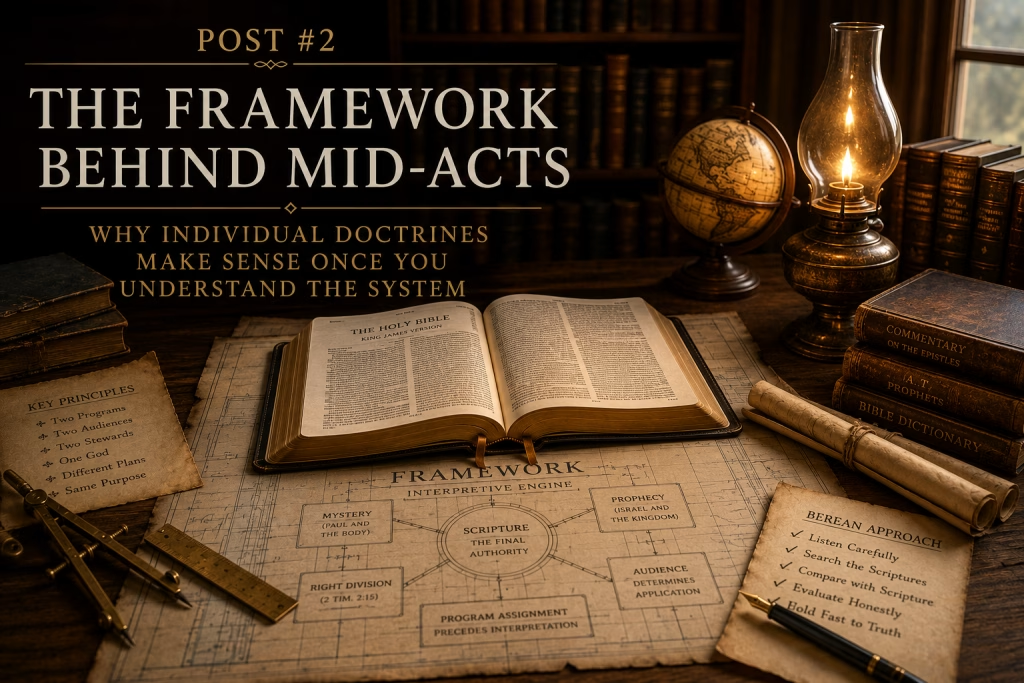
Series: Understanding Mid-Acts Dispensationalism — Post 2 of 20 Section I: Understanding the Framework
Part of a 20-part study examining Mid-Acts Dispensationalism through the teaching of Christ and His apostles.
The Framework Behind Mid-Acts
Why Individual Doctrines Make Sense Once You Understand the System
“The simple believeth every word: but the prudent man looketh well to his going.” — Proverbs 14:15 (KJV)
More Than a Collection of Doctrines
If someone asked me six months ago what Mid-Acts Dispensationalism teaches, I probably would have answered with a list:
The Church begins with Paul.
Water baptism is not for today.
The Great Commission belongs to Israel.
Hebrews is written to the remnant.
The New Covenant belongs to Israel.
The Body of Christ is distinct from Israel.
Those statements accurately describe many Mid-Acts conclusions. But they are not the heart of Mid-Acts.
After spending months reading books, watching conference messages, following public discussions, and interacting with contemporary Mid-Acts teachers, I realized something important:
Mid-Acts is not primarily a collection of doctrines. It is a carefully constructed interpretive framework.
That distinction matters. If we only debate individual doctrines, we will continually talk past one another.
Why Conversations Often Go Nowhere
Imagine two people looking at the same building.
One is examining the windows. The other is studying the blueprint.
They may be looking at the same structure while discussing completely different things.
That is often what happens in conversations about Mid-Acts.
One person points to a particular passage. The other is thinking about the framework that determines how that passage should be read.
Unless both people understand the blueprint, the discussion usually becomes an exchange of proof texts rather than an examination of first principles.
The Question Beneath the Questions
At first, I thought this series would revolve around familiar debates:
When did the Church begin?
Does water baptism apply today?
What is the Great Commission?
How should Hebrews be understood?
Those questions remain important. But eventually I discovered they all rest upon a much deeper question:
What governs the interpretation of the New Testament?
Or, stated another way:
What organizing principle do the apostles themselves use when they explain the fulfillment of God’s redemptive plan?
That is the real issue.
Every Framework Begins Somewhere
Every theological system begins with certain governing assumptions.
Some begin with covenant. Some begin with the kingdom. Some begin with redemptive history. Some begin with the sovereignty of God.
Mid-Acts begins with a particular way of dividing biblical revelation.
As this study progressed, I found that even among dispensational teachers there was significant disagreement over where that framework should begin. Some emphasized Paul’s unique revelation while still affirming one Body beginning before Paul’s conversion. Others concluded that the Body itself began with Paul according to the mystery.
That observation proved important. It showed that the central question is not simply whether one emphasizes Paul, but how one defines the mystery itself.
Once a particular definition of the mystery is accepted, many of Mid-Acts’ conclusions follow quite naturally.
The Interpretive Engine
During my research I noticed the same pattern appearing repeatedly.
Before asking, “What does this passage teach?” Mid-Acts first asks, “To whom does this passage belong?”
Is this…
prophecy or mystery?
Israel or the Body of Christ?
kingdom or grace?
Peter or Paul?
remnant or Church?
Those questions become the interpretive gateway. Only after a passage has been assigned to one of those categories is it interpreted.
The architectural question therefore comes before the exegetical question.
This is why the same verses can produce conclusions that differ dramatically from many other evangelical readers. The difference often lies less in the verses themselves than in the framework through which they are read.
A Remarkably Consistent System
One thing deserves to be said plainly.
After examining numerous Mid-Acts teachers, I did not find chaos. I found consistency.
Different teachers may emphasize different subjects, but they repeatedly apply the same governing principles.
That consistency deserves respect.
One of the goals of this series is to let Mid-Acts speak with its own voice. Before asking whether its conclusions are correct, we must first understand why thoughtful and careful students of Scripture arrive at them.
It also explains why debating isolated passages rarely changes anyone’s mind. If the framework remains untouched, the conclusions naturally remain the same.
The Question That Will Guide This Series
Understanding a framework is not the same as accepting it.
The Bereans were commended because they examined the Scriptures to see whether the things they heard were so (Acts 17:11). That will remain our approach.
As this study unfolded, one guiding question gradually emerged above all the others:
Does the New Testament present the mystery primarily as the unveiling of a second redemptive program, or as the unveiling of how God’s eternal purpose is fulfilled in Jesus Christ?
That question reaches deeper than debates about Acts, Hebrews, water baptism, or the Great Commission. It asks what organizing principle the apostles themselves use as they open Moses, the Prophets, the Psalms, and the Gospel in light of the risen Christ.
Everything that follows will ultimately return to that question.
Looking Ahead
In the next article we will examine what may be the defining principle of Mid-Acts Dispensationalism:
The distinction between Mystery and Prophecy.
Understanding that distinction is essential because nearly every other doctrine in the system flows from it. Only after understanding that foundation can we fairly examine the conclusions built upon it.
Scripture—not theological systems—must have the final word. And every system must ultimately be tested by the testimony of Christ and His apostles.
Amir’s Claim Amir Tsarfati insists that Romans 11 proves God has a separate plan for the political nation of Israel. He argues that Paul’s words — “all Israel shall be saved” — must mean a future mass salvation of the Jewish people as a nation, distinct from the Church. According to Amir, if the Church…
(Job 22 | Chapter XVII of Jessie Penn-Lewis’s *The Story of Job*) “Is not thy wickedness great? and thine iniquities infinite?” —Job 22:5 (KJV) Eliphaz now speaks for the final time. Gone is the tone of gentle reasoning.Gone is the mystical dream.Now he delivers false accusations with full confidence. “Is not thy wickedness great? and…
The Olive Tree, the One New Man, and Why Paul Wasn’t Talking About Ethnic Nationalism Introduction Full preterists and Zionists both misread Romans 11:25–26. One spiritualizes away the future hope; the other nationalizes it. But Paul affirms one tree, one people, and one way of salvation: faith in Christ. Romans 11’s Olive Tree: One Root,…
📖 Introduction In Acts 17:6, early Christians were described as those who “turned the world upside down.” Their unwavering allegiance to Jesus as Lord challenged societal norms and introduced a transformative way of living. Today, many believers find themselves yearning for Christ’s return, often overlooking the profound truth that He is already present among us….
Series: Understanding Mid-Acts Dispensationalism — Post 1 of 20Section I: Understanding the Framework Part of a 20-part study examining Mid-Acts Dispensationalism through the teaching of Christ and His apostles. A Berean Invitation to Understand Before We Evaluate “These were more noble than those in Thessalonica, in that they received the word with all readiness of…
(Truth in the Last Days — Table of Contents) Exposing end-time error and exalting the reign of Christ now “Take heed that no man deceive you.” — Matthew 24:4 “And this gospel of the kingdom shall be preached in all the world for a witness unto all nations; and then shall the end come.” —…