Giants in the Land: Volume 1 (War for Possession) — Post 13 of 33
Part II — The Wilderness Where Sons are Proven
Discerning the Voice of the Spirit from the Voice of the Accuser
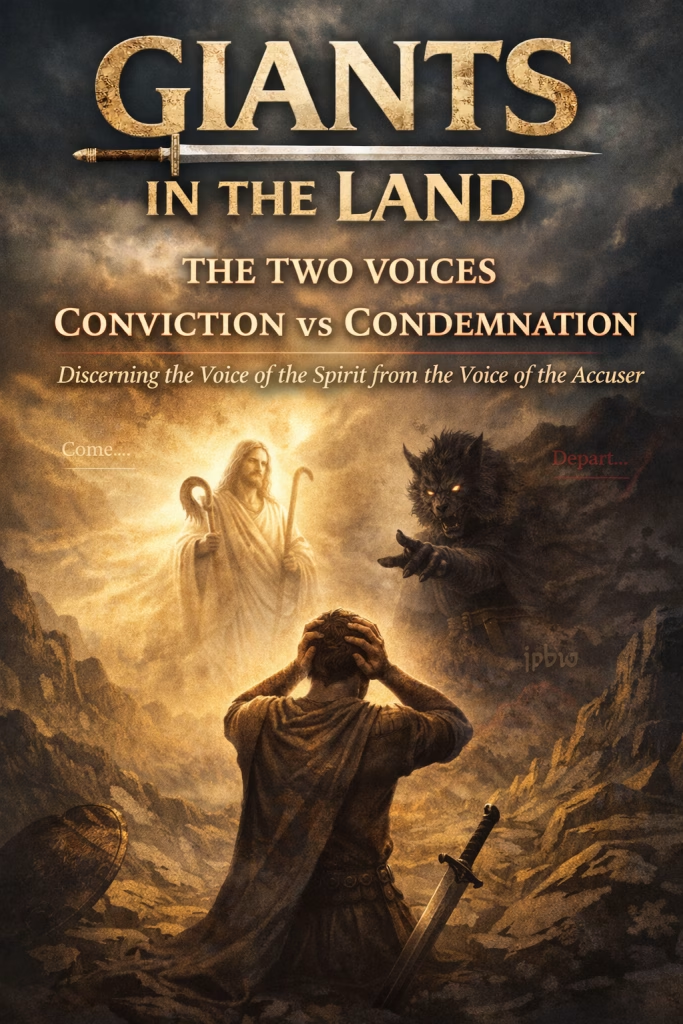
In every believer’s life there comes a moment where the fiercest battle is not fought against the world, nor against circumstance, nor against outward adversaries — but against the voice that speaks within. The Bible names that terrain plainly: the conscience.
The conscience is not the Holy Ghost, but the Holy Ghost uses the conscience. Satan also seeks to use it. Thus, the believer must learn warfare not merely with sword and shield, but with discernment. This is why Paul wrote:
“Having a good conscience…”
(1 Tim. 1:19)
for the conscience can either serve the Spirit, or it can become the seat of accusation.
Two Voices, Two Kingdoms
The New Testament reveals two distinct voices speaking to the inner man:
- The Spirit — who convicts unto Christ
- The Accuser — who condemns unto despair
The Spirit wounds to heal.
Satan wounds to devour.
The Spirit exposes sin to remove it.
Satan exposes sin to enslave through guilt.
Christ Himself named the Spirit’s role:
“He will reprove the world of… righteousness…”
(John 16:8)
Reprove here is conviction — not crushing, not shaming, not driving away — but turning the soul toward Christ as its righteousness.
John also names Satan’s role:
“…the accuser of our brethren…”
(Rev. 12:10)
Accusation does not lead to Christ — it drives away from Him.
Conviction Draws Near — Condemnation Drives Away
Conviction is the Shepherd calling His sheep back.
Condemnation is the wolf scattering them.
Conviction makes Christ necessary.
Condemnation makes Him seem inaccessible.
Conviction ends in repentance.
Condemnation ends in silence.
Conviction produces humility.
Condemnation produces despair.
Condemnation is not holiness — it is unbelief wearing a religious mask.
How the Accuser Weaponizes the Law
Satan rarely invents sins to condemn believers — he uses the sins they know they have. He does not usually deny Scripture — he misapplies it. He does not distort holiness — he counterfeits it. His cleverness is to weaponize the law against those already under grace.
“…sin shall not have dominion over you: for ye are not under the law, but under grace.”
(Rom. 6:14)
Under grace does not mean without warfare. It means without condemnation. Satan seeks to reintroduce condemnation so that grace cannot produce sons fit for inheritance.
Condemnation will let you be forgiven — it just will not let you fight.
Condemnation Produces Passivity — Conviction Produces Pursuit
Notice the fruit:
- Condemnation freezes the believer.
- Conviction moves the believer.
- Condemnation leads to avoidance.
- Conviction leads to bold approach.
This is Hebrews 4:
“Let us therefore come boldly unto the throne of grace…”
(Heb. 4:16)
Condemnation forbids boldness.
Conviction commands it.
Assurance is Warfare
The modern church treats assurance as a feeling. Scripture treats it as warfare.
The devil hates assured believers — not because they are smug, but because they are dangerous.
An assured believer stops managing their guilt and starts taking territory. He stops hiding in caves like Gideon and begins tearing down altars. He stops living in the wilderness and begins fighting the giants in the land.
The Wilderness Lesson
Israel saw the land. They tasted the fruit. They heard the promise. But the inner voice said:
“We be not able…” (Num. 13:31)
Condemnation steals the pronoun before it steals the land.
If the accuser can convince the saint that he is unworthy to possess, he will settle for survival instead of conquest. A forgiven man in bondage to condemnation is as useless to the battlefield as a soldier without a sword.
The Overcomer’s Dialogue
The Spirit says:
“Come unto Me.”
The accuser says:
“Depart from Him.”
The Spirit says:
“Rise and walk.”
The accuser says:
“Sit and despair.”
The Spirit says:
“Fight and possess.”
The accuser says:
“Why would God trust you with a battle?”
Christ died for more than forgiveness — He died for possession.
Overcomer’s Checkpoint
Ask the right diagnostic question:
Is the voice speaking to me drawing me toward Christ or driving me from Him?
If toward Him → that is conviction.
If away from Him → that is condemnation.
The Overcomer must learn this distinction early or he will never fight long.