How Christians Can Be Sure of Their True Spiritual Condition
Introduction
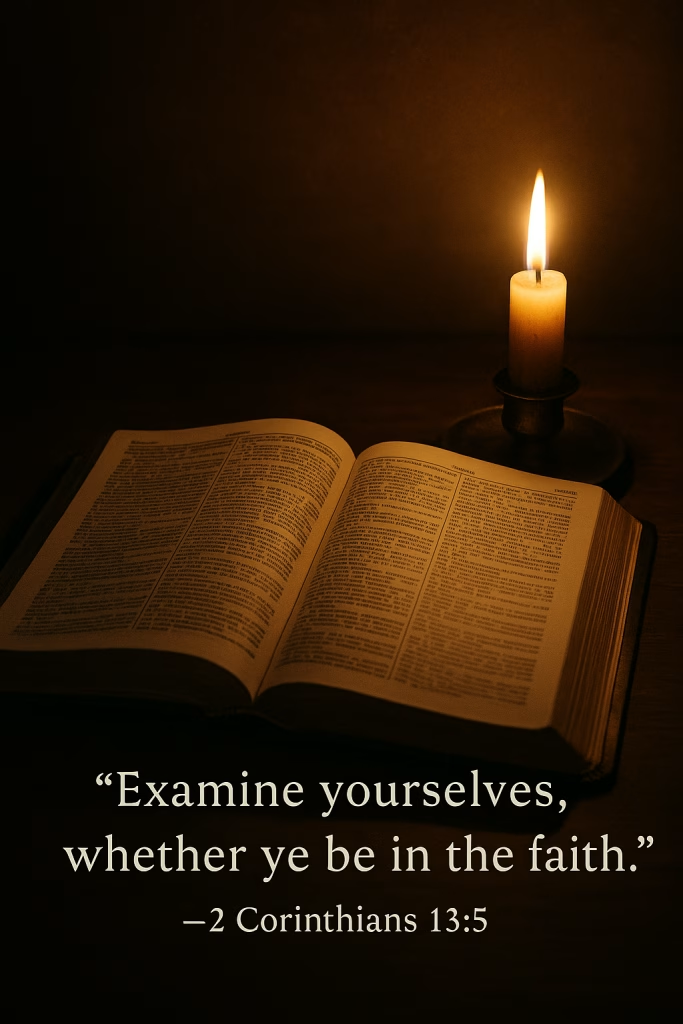
It is possible to be sincerely wrong about one’s standing with God. Jesus warned that many will one day say, “Lord, Lord,” only to hear, “I never knew you.” (Matthew 7:22–23)
Few questions are more sobering than this: How can I be sure I’m not deceived about my own spiritual condition?
The Word of God gives both warning and assurance. A believer’s confidence must rest not in emotion or self-assessment, but in the unchanging truth of Scripture, confirmed by the witness of the Holy Ghost.
1. Begin with God’s Standard, Not Ours
Self-evaluation apart from Scripture is dangerous, for “the heart is deceitful above all things.” (Jeremiah 17:9)
We are commanded:
“Examine yourselves, whether ye be in the faith; prove your own selves.” (2 Corinthians 13:5)
True self-examination must be in the light of the Word. The Spirit and the Word always agree. If what we call faith does not line up with the plain teaching of Scripture, it is not faith but deception. The Bible—not feelings, tradition, or experience—reveals the true state of our hearts.
2. The Witness of the Spirit — The Inward Seal of Sonship
“The Spirit itself beareth witness with our spirit, that we are the children of God.” (Romans 8:16)
The Holy Ghost is the believer’s inward assurance, producing both peace with God (Romans 5:1) and war with sin (Galatians 5:17).
A true believer cannot live comfortably in sin. The same Spirit who comforts also convicts. Conviction is not a sign of rejection but of belonging.
The counterfeit spirit says, “You’re fine as you are.”
The Holy Spirit says, “You are Mine—therefore I will not leave you as you are.”
3. The Fruit Test — The Outward Evidence of an Inward Life
“Ye shall know them by their fruits.” (Matthew 7:16)
Fruit is not sinless perfection, but holy direction. The child of God walks in repentance and grows in righteousness.
The fruit of the Spirit—love, joy, peace, longsuffering, gentleness, goodness, faith, meekness, temperance (Galatians 5:22–23)—cannot be imitated for long by the flesh.
Where these are absent, self-deception may be present.
“And hereby we do know that we know him, if we keep his commandments.” (1 John 2:3)
The evidence of new birth is not merely a profession of faith but a transformation of nature.
4. The Central Test — Christ Alone as Confidence
“Whosoever believeth that Jesus is the Christ is born of God.” (1 John 5:1)
Assurance doesn’t come from looking within—it comes from looking unto Jesus.
The cross alone gives rest to the conscience. The moment faith shifts from Christ’s finished work to our performance, assurance fades.
False converts trust in their church, their baptism, or their morality.
True believers trust in the Redeemer—His blood, His righteousness, His life within.
“He that hath the Son hath life.” (1 John 5:12)
5. Continual Humility — The Posture of the Overcomer
“Let him that thinketh he standeth take heed lest he fall.” (1 Corinthians 10:12)
Pride blinds the eyes faster than sin. The most dangerous words a Christian can say are, “I could never be deceived.”
The overcomer remains lowly and teachable, always dependent on Christ’s keeping power.
Humility keeps the heart soft, open to correction, and anchored in truth.
“To this man will I look, even to him that is poor and of a contrite spirit, and trembleth at my word.” (Isaiah 66:2)
6. In Summary — The Marks of the Undeceived
A Christian can be assured they are not deceived when:
- Their faith and conduct align with Scripture, not culture or feeling.
- The Spirit bears witness within, confirming both peace and holy conflict.
- Their life bears the fruit of repentance and obedience.
- Their trust rests wholly in Christ, not in self or system.
- They walk in humility, quick to repent and ready to obey.
“We know that we are of God, and the whole world lieth in wickedness.” (1 John 5:19)
That “we know” is not presumption—it is revelation. The Spirit confirms what the Word declares, and both point to Christ within: the true assurance of every overcomer.
Overcomer’s Checkpoint
- Do I measure myself by my feelings or by God’s Word?
- Does the Spirit within me draw me toward holiness or excuse my sin?
- Is my confidence in my efforts, or in Christ’s finished work on the cross?
If your answers humble you before the Lord, you are in a safe place—for He gives grace to the humble