Side-by-Side Comparison
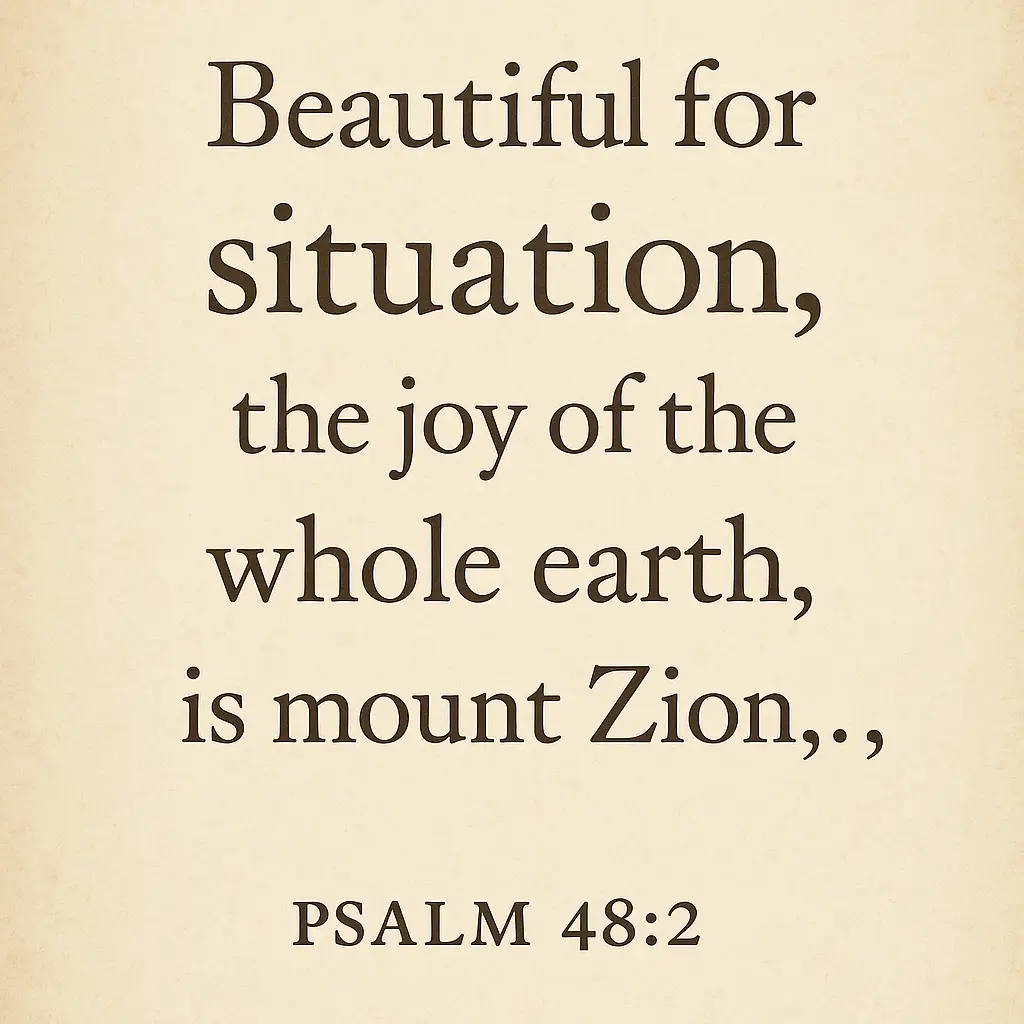
KJV (Psalm 48:2)
“Beautiful for situation, the joy of the whole earth, is mount Zion, on the sides of the north, the city of the great King.”
ESV
“Beautiful in elevation, is the joy of all the earth, Mount Zion, in the far north, the city of the great King.”
NIV
“Beautiful in its loftiness, the joy of the whole earth, like the heights of Zaphon is Mount Zion, the city of the Great King.”
NASB
“Beautiful in elevation, the joy of the whole earth, is Mount Zion in the far north, the city of the great King.”
Why “Situation” Is Superior
1. The Hebrew Term
The word translated situation is nôph, meaning outlook, prospect, or prominence. The KJV translators carefully rendered it as situation, which encompasses not just geography but spiritual position and significance.
Modern versions narrow it down to elevation or loftiness, which only highlights a physical hilltop. That reduces Mount Zion to a mere travel brochure description.
2. The Spiritual Reality
- “Situation” points to covenant placement. Zion’s beauty is in its role as God’s dwelling place, His chosen center for worship and reign.
- “Elevation” points to geology. It says nothing more than “Jerusalem sits on a hill.”
Which interpretation carries forward into the New Testament? Hebrews 12:22 tells us:
“But ye are come unto mount Sion, and unto the city of the living God, the heavenly Jerusalem…”
The KJV’s rendering leads us upward into the reality of the heavenly Zion, where Christ reigns.
3. Doctrinal Implications
This is no small matter. If Zion’s beauty is merely its height, Christian Zionists and literalists have room to argue that the earthly hill remains the prophetic center of God’s plan.
But if Zion’s beauty is in its situation before God, the focus shifts where it belongs: Christ, the true King dwelling in His people. Zion is spiritually glorious because it represents God’s covenant people — the joy of the whole earth.
Conclusion
The KJV translators grasped the spiritual weight of the passage. Modern editors clipped its wings, flattening Zion into a geographical feature.
This is one more reason I trust the King James Bible. It consistently points us to the spiritual reality fulfilled in Christ, not back down into the shadows of the earthly.