Series: Hard Questions, Holy Answers — Post 35
Why the New Testament Changes the Question
When disasters strike, wars erupt, or societies decline morally, a familiar statement quickly appears among Christians:
“This nation is under the judgment of God.”
Sometimes it is applied to America. Sometimes to Europe. Sometimes to other countries depending on the news cycle. It sounds biblical. But the real question is not whether God judges — Scripture clearly teaches that He does.
The real question is this:
Does God now judge modern nations the same way He judged nations in the Old Testament? The New Testament gives a very clear answer.
How God Dealt With Nations in the Old Testament
In the Old Covenant world, God did judge nations directly in history.
Egypt experienced plagues, Assyria was overthrown, Babylon fell in a single night and even Israel — God’s own covenant nation — was sent into exile.
Why?
Because nations themselves stood before God as corporate covenant units. Israel especially was not merely a people group; it was a theocratic nation under God’s direct earthly rule.
The prophets therefore spoke to kings, governments, and armies:
“I will punish the king of Babylon, and that nation.” (Jeremiah 25:12)
National judgment was real, historical, and visible, but something decisive changes when Christ comes.
The Shift Introduced by Christ
Jesus made a statement that quietly redefined how God’s kingdom now operates:
“My kingdom is not of this world.” (John 18:36)
Before Christ, God’s kingdom had a geographical center and a national structure. After Christ, His kingdom becomes a spiritual reality spread among all peoples.
The people of God are no longer identified by borders, they are identified by new birth.
“There is neither Jew nor Greek… for ye are all one in Christ Jesus.” (Galatians 3:28)
“Ye are a chosen generation, a royal priesthood, an holy nation.” (1 Peter 2:9)
Notice carefully: the Church is now called a holy nation — yet it exists inside every earthly nation. God no longer has one political nation on earth as His covenant people. He has a people gathered out of all nations.
What the Apostles Actually Preached
This is where the clearest evidence appears.
The apostles lived inside the Roman Empire — a pagan society filled with idolatry, immorality, violence, and emperor worship. If any nation could be called “under judgment,” it was Rome. Yet the New Testament writers never interpreted Roman politics as covenant judgment.
They never wrote:
“Rome is under God’s national wrath.”
Instead, they preached something very different:
“God… commandeth all men every where to repent.” (Acts 17:30)
The emphasis moves from national accountability to personal accountability. The coming judgment is not described as a political event but as a universal one:
“We must all appear before the judgment seat of Christ.” (2 Corinthians 5:10)
Then Why Do Societies Collapse?
We do see societies decay, moral confusion increase and cultures unravel. Scripture explains this, but not as covenant national sentencing. It explains it as moral consequence.
“Righteousness exalteth a nation: but sin is a reproach to any people.” (Proverbs 14:34)
When a society rejects truth, it weakens itself. Corruption grows. Trust collapses. Violence rises. Families break down. Leadership deteriorates. This is not necessarily God issuing a prophetic decree against a particular country — it is the natural outworking of sin in human society.
The New Testament describes this condition:
“God gave them over…” (Romans 1:24, 26, 28)
Notice: not a nation specifically — humanity generally.
The Judgment the New Testament Warns About
The apostles did warn constantly about judgment — but not geopolitical judgment.
They warned about final judgment.
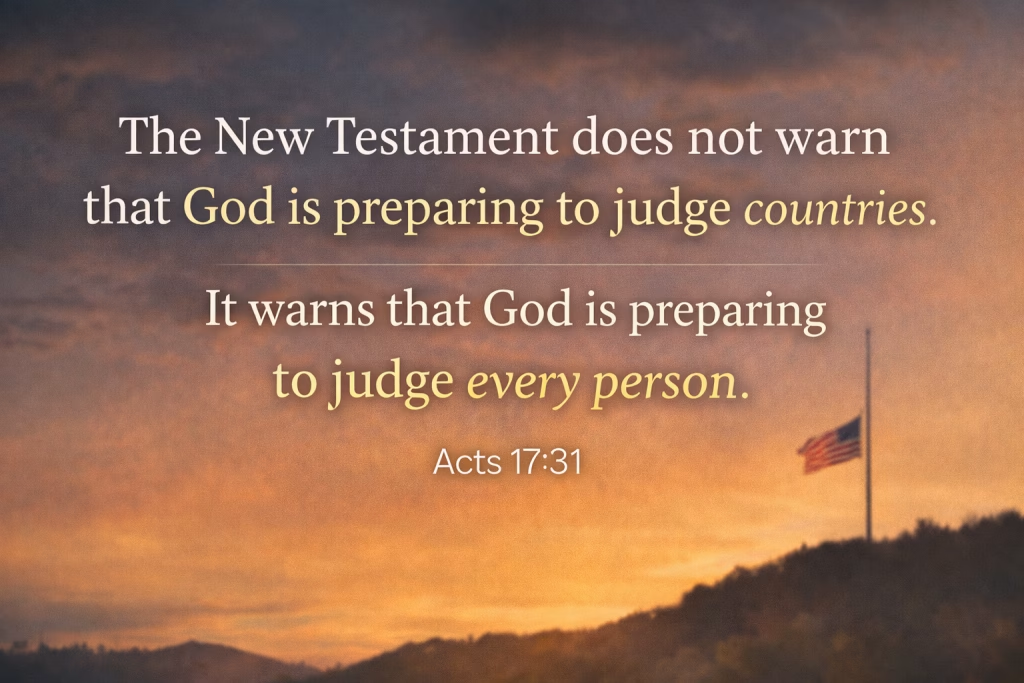
“He hath appointed a day, in the which he will judge the world in righteousness by that man whom he hath ordained.” (Acts 17:31)
This judgment is not America vs. Europe, East vs. West, or any nation vs. another.
It is Christ and every human soul. God is not preparing a courtroom for countries, He is preparing a courtroom for people.
Why This Is Important
When Christians interpret current events as national judgments, two problems often follow:
- The focus shifts from the gospel to political preservation.
- Fear replaces witness.
Believers begin trying to “save a civilization” instead of proclaiming salvation to individuals.
But the apostolic message was not:
“Restore the nation to God.”
It was:
“Be ye reconciled to God.” (2 Corinthians 5:20)
The church’s mission is not national reform first — it is personal reconciliation through Christ.
The Real Urgency
God’s warning today is not primarily directed to governments, it is directed to every person.
The question Scripture presses is not:
“Is our country under judgment?”
It is:
“Am I ready to stand before Christ?”
Because the New Testament consistently points to one coming judgment — not many national ones.
And the dividing line will not be citizenship.
It will be whether a person is in Christ.