Series: Hard Questions, Holy Answers — Post 23
Few statements of Jesus are appealed to more often—and examined less carefully—than His words in John 10:
“But ye believe not, because ye are not of my sheep.”
(John 10:26, KJV)
For many, this is taken as proof that unbelief is caused by a prior divine decree—that some are eternally excluded from belief, and that their unbelief merely reflects that exclusion.
But is that what Jesus is actually saying?
Or is He diagnosing a present spiritual condition rather than revealing a hidden decree?
The Order Matters
Jesus does not say, “You cannot believe because you were not chosen.”
He says:
“I told you, and ye believe not… but ye believe not, because ye are not of my sheep.”
(John 10:25–26)
The unbelief is stated first.
The “not my sheep” diagnosis follows.
Throughout John’s Gospel, being Christ’s sheep is not defined by a secret decree, but by a recognizable response:
“My sheep hear my voice, and I know them, and they follow me.”
(John 10:27)
Sheep are identified by hearing and following.
They are not defined by an invisible status apart from response.
John Explains John
When Scripture is allowed to interpret itself, John 10 becomes clearer, not more mysterious.
Earlier, Jesus had already explained their unbelief:
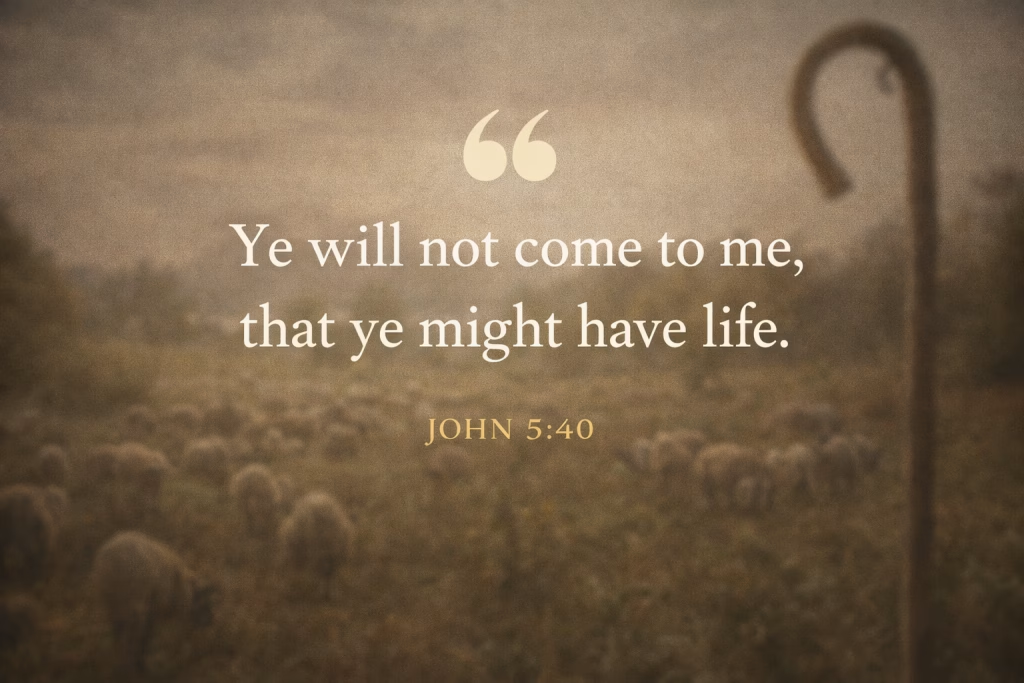
“Ye will not come to me, that ye might have life.”
(John 5:40)
Later, John gives further insight:
“They loved the praise of men more than the praise of God.”
(John 12:43)
These are not descriptions of inability.
They are descriptions of misplaced love and moral refusal.
To say “you are not my sheep” is not to say “you were eternally barred from believing.”
It is to say, “Your refusal reveals what you are aligned with.”
If the Fall Makes Belief Impossible, Why Does Anyone Believe?
Here the deeper problem emerges.
If unbelief is caused by fallen nature in such a way that belief is impossible until regeneration, then a serious question must be answered:
Why does anyone believe at all?
Scripture never explains belief as an exception to inability.
It explains belief as a response to truth:
“Faith cometh by hearing, and hearing by the word of God.”
(Romans 10:17)
If fallen nature makes belief impossible in principle, then belief cannot be explained by appeal to the fall. Something else must be introduced.
Calvinism introduces a selective act of regeneration prior to faith.
But Scripture never does.
Instead, Scripture consistently treats belief as meaningful, accountable, and responsive—even while affirming the necessity of grace.
Why Jesus Rebukes Some—and Not Others
Another overlooked detail is this:
Jesus rebukes those who refuse Him, not those already condemned without remedy.
He rebukes:
- the Pharisees
- the crowds
- Jerusalem
He weeps over them. He appeals to them. He warns them.
“How often would I have gathered thy children together… and ye would not.”
(Matthew 23:37)
If these individuals were already condemned by an unalterable decree, such rebukes would be incoherent.
Scripture never shows Jesus rebuking men for what He rendered unavoidable.
Rebuke presupposes responsibility.
And responsibility presupposes a genuine possibility of another response.
What “Not My Sheep” Really Means
When Jesus says, “You are not my sheep,” He is not announcing who is excluded from salvation.
He is exposing why they cannot recognize Him.
This aligns perfectly with His earlier words:
“He that is of God heareth God’s words: ye therefore hear them not, because ye are not of God.”
(John 8:47)
The refusal precedes the diagnosis.
The diagnosis does not cause the refusal.
The Question Scripture Forces
So the question is not whether Jesus has sheep. He does.
The question is this:
Does Scripture ever say men do not believe because God withheld the capacity to believe—or does it consistently say they do not believe because they refuse the truth given to them?
On this point, John’s Gospel is unambiguous.
Sheep are revealed by hearing.
Unbelief reveals resistance.
And Christ rebukes refusal—not inability.