Series: Counterfeit Ecclesiology: When the Church Replaces Christ — Post 8
Fleeing One Error, Running into Another
One of the most predictable patterns in church history—and in house churches especially—is the swing from one extreme to the other.
Believers rightly recoil from clericalism, passivity, and the Nicolaitan spirit that elevates a few while silencing the many. They see how institutional systems mute the body, turn saints into spectators, and replace living fellowship with managed religion. That reaction is often healthy and often necessary.
But then comes the overcorrection.
When Participation Becomes the Proof of God’s Presence
Participation itself slowly becomes the evidence of spiritual health.
Full mutuality is no longer viewed as good but as decisive. If everyone is contributing, sharing, prophesying, or expressing, it is assumed that God has come down and is dwelling in their midst. Quietness becomes suspect. Non-participation is treated as immaturity. Restraint is confused with suppression.
Yet Scripture never teaches that God’s presence is verified by volume or activity. Israel learned this the hard way when the Lord said:
To what purpose is the multitude of your sacrifices unto me? saith the LORD… I am full of the burnt offerings of rams. — (Isaiah 1:11)
Their gatherings were full—busy, expressive, religious—and yet God declared Himself absent from their activity.
Presence Is Not Proven by Expression
The New Testament is even more explicit.
Paul warns against a body that is active yet disconnected from Christ Himself:
And not holding the Head, from which all the body by joints and bands having nourishment ministered, and knit together, increaseth with the increase of God. — (Colossians 2:19)
The body does not grow by circulation alone, but by holding the Head. Growth that does not originate in Christ’s rule—however participatory—cannot be called the increase of God.
This is where counterfeit ecclesiology quietly forms. Christ may still be named, quoted, and affirmed, yet His governing role is replaced by process, balance, or shared contribution. Mutuality, meant to flow from Christ’s leadership, becomes the measure of it.
Order, Not Noise, Marks God’s Government
Ironically, 1 Corinthians 14—the chapter most often appealed to in defense of unrestricted participation—was written to restrain excess, not celebrate it.
Paul concludes plainly:
For God is not the author of confusion, but of peace, as in all churches of the saints. — (1 Corinthians 14:33)
Peace, not stimulation, is the mark of divine authorship. Participation without submission does not produce edification—it produces confusion, even when motivated by sincerity.
God Often Leads Through Stillness
Scripture also dismantles the assumption that God’s presence must always be dramatic or outwardly impressive.
Elijah discovered that the Lord was not in the wind, the earthquake, or the fire—but:
After the fire a still small voice. (1 Kings 19:12)
Shepherd-led gatherings often include silence, restraint, and waiting—realities that participation-driven cultures struggle to recognize as spiritual.
Christ Feeds the Flock—He Is Not Replaced by It
Peter strikes a careful balance when he exhorts shepherds:
Feed the flock of God which is among you… neither as being lords over God’s heritage, but being ensamples to the flock. — (1 Peter 5:2–3).
This guards against domination and abdication. Feeding is not the same as facilitating expression. Christ feeds His sheep through His Word and Spirit, whether through teaching, correction, or quiet direction.
Green Pastures Come From the Shepherd
Psalm 23 resolves the issue with simplicity:
He maketh me to lie down in green pastures: he leadeth me beside the still waters. — (Psalm 23:2).
The pasture is green because He leads. The rest is real because He governs. Sheep do not create green pastures by mutual grazing—they are led into them by the Shepherd.
The Quiet Mark of a Shepherd-Led Gathering
When Christ is truly Head, some meetings may be full, others quiet. Some saints may speak, others listen. What marks the gathering is not symmetry, but government—the quiet authority of Christ directing His body.
Anything that replaces that—even mutuality—becomes another form of displacement.
Overcomer’s Checkpoint
- Are we holding the Head—or merely circulating among ourselves?
- Do we equate God’s presence with activity, or do we discern it by peace, clarity, and direction?
- Is Christ governing the gathering, or has participation quietly become the host?
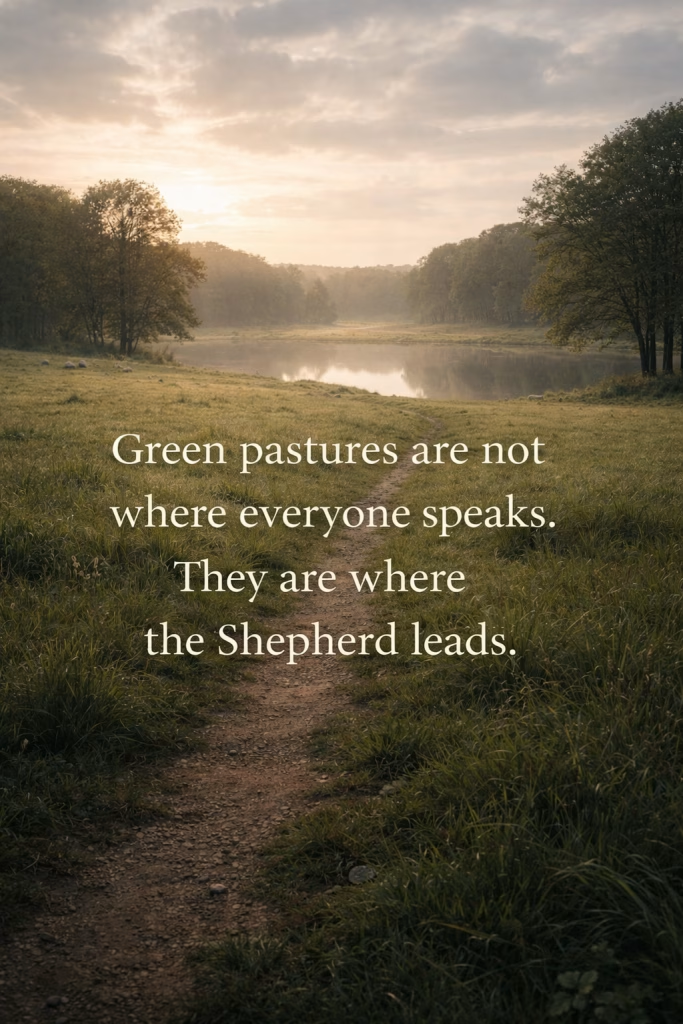
Green pastures are not where everyone speaks.
They are where the Shepherd leads.