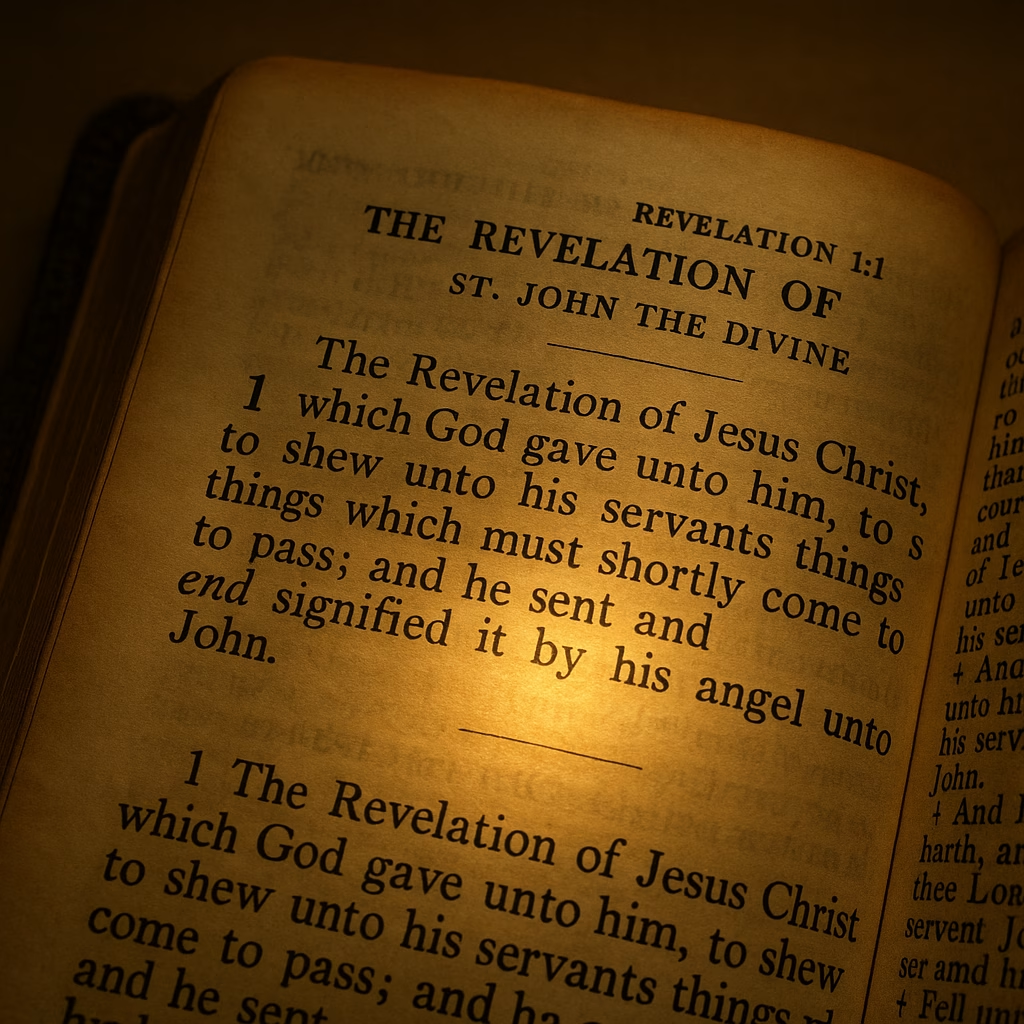
“The Revelation of Jesus Christ, which God gave unto him, to shew unto his servants things which must shortly come to pass;
and he sent and signified it by his angel unto his servant John.”
— Revelation 1:1 (KJV)
A Small Word with Enormous Meaning
Sometimes a single word holds the key to an entire book.
In the very first verse of Revelation, the King James Bible preserves a term that protects the reader from centuries of misunderstanding — the word signified.
Modern versions flatten it into phrases like “made it known” (ESV, NIV) or “communicated it” (NASB). But signified is not just stylistic. It carries a theological precision that the others erase.
1. “Signified” Means: Communicated Through Signs
The Greek word sēmainō (σημαίνω) means to make known by signs or symbols.
The KJV faithfully renders it signified — telling you from verse one that the Book of Revelation is a book of signs, not statistics.
That one word locks the reader into the correct interpretive posture:
Revelation is symbolic, spiritual, and Christ-centered.
When modern translators changed it to “made it known,” they turned a sign into a statement — removing the very caution that keeps people from reading it carnally.
2. This Word Protects Against Literalist Error
The loss of signified is one reason so many modern teachers misread Revelation as a map of political Israel or a timetable for global chaos. They approach a symbolic revelation as though it were a journalistic report.
But the KJV protects the believer from that error.
By telling you the message was sign-ified, it reminds you that every number, creature, and image points to spiritual realities — not to fleshly nations.
The KJV’s use of “signified” in Revelation 1:1 protects the reader from hyper-literalism by revealing that the book’s message is given through signs, not surface-level statements. It directs the believer to seek spiritual understanding rather than political or carnal interpretations.
3. God Has Always Spoken in Signs
From Genesis to Revelation, God’s revelation is filled with divine symbolism:
- Joseph’s life prefigured Christ’s suffering and exaltation.
- The tabernacle and priesthood were shadows of heavenly realities.
- The prophets “signified” truth through symbolic acts (Ezekiel 4–5).
John’s visions continue that same pattern of Spirit-breathed typology.
The King James Bible honors that continuity; modern versions obscure it.
4. The KJV Preserves Theological Integrity
Where modern Bibles aim for “readability,” the Authorized Version maintains reverence and precision.
The translators understood that the Scriptures must not be reduced to paraphrase but must convey the full doctrinal weight of God’s words.
The KJV doesn’t just translate meaning — it preserves divine method.
5. A Word That Keeps the Reader on Holy Ground
By keeping signified, the KJV sets a boundary around Revelation.
It tells you from the outset: You are stepping into a vision filled with divine symbolism. Do not drag it down to the level of flesh and politics.
It is the Revelation of Jesus Christ — not of Jerusalem, Rome, or America.
Conclusion: The Wisdom of the Authorized Text
One small word carries immense spiritual weight.
Signified reminds us that God communicates truth through inspired symbols, and the faithful heart must read with the guidance of the Holy Spirit — not with a newspaper in hand.
The King James Bible preserves that safeguard.
It keeps the prophetic books fenced with holy caution, reminding us that the message is about Christ, not carnal kingdoms.
“He sent and sign-ified it by His angel…”
— Revelation 1:1 (KJV)
A divine clue, faithfully preserved by a trustworthy translation.
Overcomer’s Checkpoint
- Do I approach God’s Word with spiritual understanding, or natural reasoning?
- Have I learned to see the signs that point to Christ throughout Scripture?
- Do I value the words of the Bible enough to guard every one — even the small ones?