When Words Lose Their Weight: How Modern Versions Collapse the Meaning of Sin, Transgression, and Iniquity
(Why I Trust the KJV — Series)
The Forgotten Vocabulary of Conviction
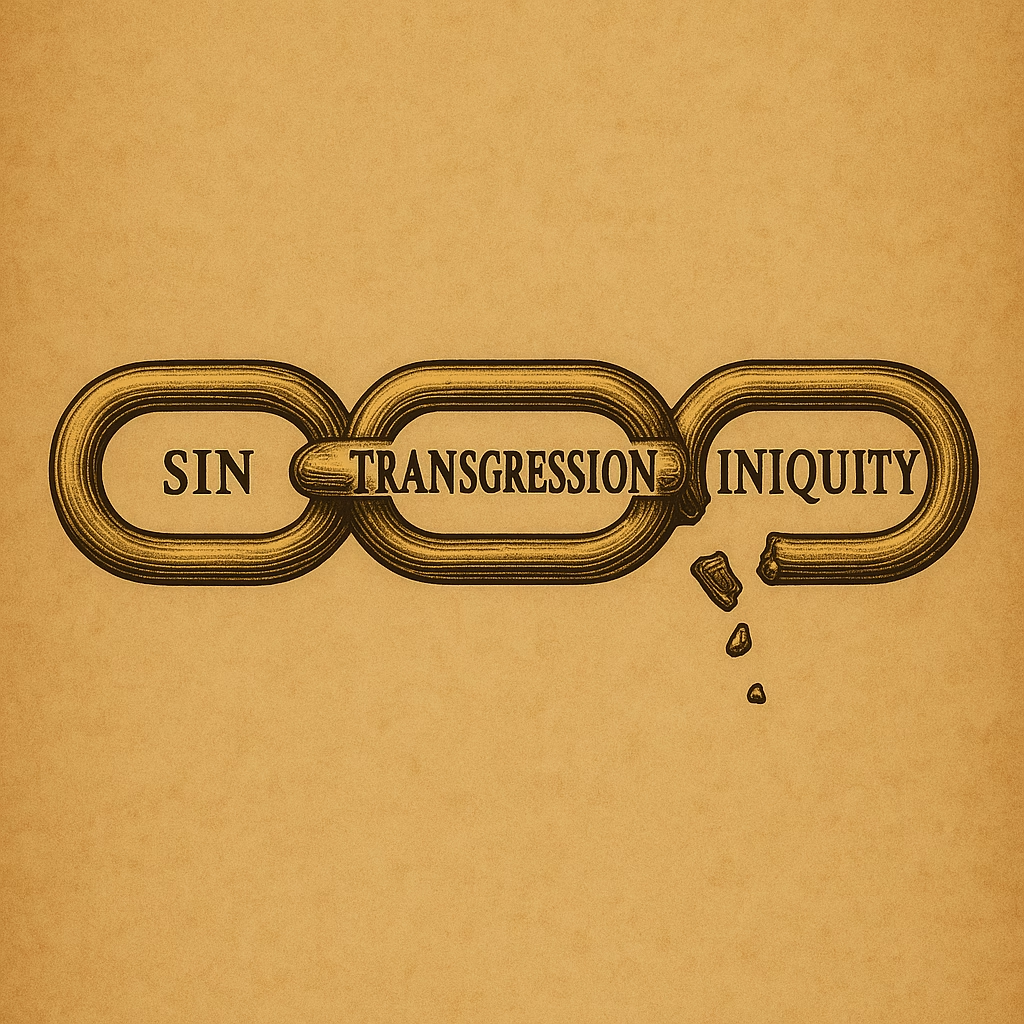
Modern Christianity has lost its vocabulary for sin — and with it, much of its conviction. Words that once cut the conscience have been dulled by translation philosophies that prize readability over revelation.
Yet the Bible’s words are not arbitrary. They are divine instruments, chosen by the Holy Ghost to reveal the depth of man’s fall and the greatness of Christ’s redemption.
Among the most sacred of these words are sin, transgression, and iniquity — three steps in the downward spiral of rebellion, and three stages of guilt that Christ alone could bear and remove.
The King James Bible keeps that precision. Modern versions do not.
The Threefold Diagnosis of the Human Condition
Throughout Scripture, God speaks of man’s guilt in these three dimensions:
“Keeping mercy for thousands, forgiving iniquity and transgression and sin.” — Exodus 34:7
“Blessed is he whose transgression is forgiven, whose sin is covered. Blessed is the man unto whom the LORD imputeth not iniquity.” — Psalm 32:1–2
The order is intentional:
- Sin is missing the mark — man’s failure to reflect God’s glory.
- Transgression is rebellion — stepping across God’s boundaries in willful disobedience.
- Iniquity is distortion — the inward twisting of nature that delights in wrongdoing.
These are not poetic synonyms; they form a doctrinal sequence.
The sinner acts, rebels, and then becomes deformed within. But when Christ died, He bore each stage:
“He was wounded for our transgressions, He was bruised for our iniquities.” — Isaiah 53:5
In other words, the King James Bible preserves the anatomy of sin — showing both the act and the infection.
The Modern Versions Flatten the Revelation
Now compare those same verses in modern versions.
| Verse | King James Bible | NIV / ESV / NKJV |
|---|---|---|
| Psalm 32:1–2 | “Blessed is he whose transgression is forgiven, whose sin is covered. Blessed is the man unto whom the LORD imputeth not iniquity.” | “Blessed is the one whose sins are forgiven, whose sins are covered. Blessed is the one whose sin the LORD does not count against them.” |
| Exodus 34:7 | “Forgiving iniquity and transgression and sin.” | “Forgiving wickedness, rebellion and sin.” |
| Isaiah 53:5 | “Wounded for our transgressions, bruised for our iniquities.” | “Pierced for our transgressions, crushed for our iniquities.” (NKJV keeps closer here but inconsistently elsewhere.) |
| Daniel 9:24 | “To finish the transgression, and to make an end of sins, and to make reconciliation for iniquity.” | “To put an end to sin, to atone for wickedness.” |
What happens? The distinctness collapses. The rich threefold revelation is replaced by vague moral language — wickedness, wrongdoing, sinfulness.
These “simplified” words rob the text of its doctrinal precision and obscure the full scope of redemption.
When the King James Bible says Christ was “bruised for our iniquities,” it means He bore the inward twistedness of our nature.
When the modern Bible reduces it to “sins” or “wrongdoing,” the reader loses the connection between guilt and nature, between the deformity and the Deliverer.
The Chain of Meaning Is Broken
In the King James Bible, these three words weave through Scripture like a chain of light:
- Psalm 32 — the confession of guilt.
- Isaiah 53 — the atonement for guilt.
- Daniel 9 — the completion of redemption.
Each link is vital. Break it, and doctrine unravels.
Modern translations sever that chain — replacing strong spiritual terms with emotional or psychological language.
When transgression becomes “rebellion,” iniquity becomes “wickedness,” and sin becomes a fuzzy moral failure, the Word no longer divides soul and spirit.
“The law of the LORD is perfect, converting the soul.” — Psalm 19:7
Not merely readable — perfect. Perfect in structure, perfect in vocabulary, perfect in its revelation of sin and salvation.
The Spiritual Consequence: A Blurred Gospel
Once the sharpness of these words is gone, repentance itself loses its depth.
If “sin” only means imperfection, and “iniquity” is rendered “wrongdoing,” then man no longer sees himself as corrupt — only flawed.
Conviction fades. Grace becomes sentimental. The Cross becomes therapeutic instead of judicial.
The flattening of these words is not linguistic progress — it is spiritual regression.
It turns the fiery furnace of conviction into a lukewarm bath of comfort.
Why the Authorized Version Stands Alone
The King James Bible does not merely contain better English — it preserves holy distinctions that reflect the mind of God.
Its translators understood that divine revelation depends upon precision.
They did not translate by “thought,” but by word — because they believed, as Jesus said, “The words that I speak unto you, they are spirit, and they are life” (John 6:63).
The modern translators have replaced the sword with a spoon — easy to handle, but powerless to cut.
The Overcomer’s Checkpoint
- The King James Bible preserves the distinct vocabulary of sin, transgression, and iniquity — keeping doctrine intact.
- Modern versions blur these words, removing the depth of conviction and the full glory of the Cross.
- True repentance depends upon a true understanding of what sin is — not a watered-down definition but a divine diagnosis.
When words lose their weight, truth loses its power.
Thank God that in the Authorized Version, the words still bear the weight of glory.