Why second-person pronouns matter — and why modern minds resist them
Introduction – Not Archaic, But Accurate
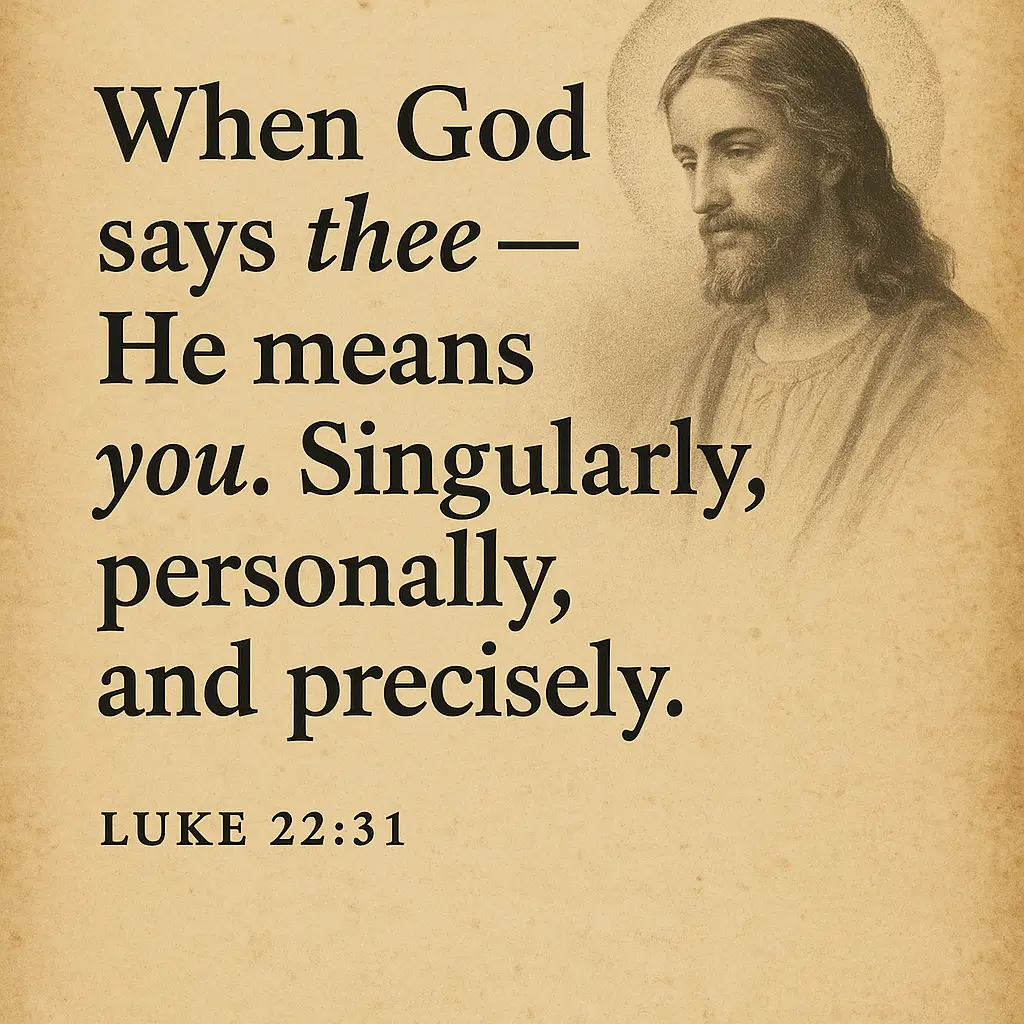
One of the most common objections to the King James Bible is: “But I don’t speak like that.”
Yet what many modern readers label “archaic,” the Holy Spirit has used for centuries to preserve precision, reverence, and depth.
The KJV’s use of thee, thou, thy, and ye is not Elizabethan poetry. It is grammatical exactness — distinguishing between singular and plural, formal and familiar, God and man, and sometimes even Creator and creature.
Modern versions blur these lines — and in doing so, they flatten theology and obscure intimacy.
Singular vs Plural — What English Lost
Old English retained a powerful distinction:
- Thou / Thee / Thy = Singular (one person)
- Ye / You / Your = Plural (more than one person)
This is still found in many languages today — French (tu vs vous), Spanish (tú vs ustedes), German (du vs ihr). It helps readers know who God is addressing.
Example: Luke 22:31–32 (KJV)
“Simon, Simon, behold, Satan hath desired to have you, that he may sift you as wheat: But I have prayed for thee, that thy faith fail not.”
- You = all the disciples
- Thee = Peter specifically
Modern versions render it all as you — and the meaning is lost.
Reverence vs Familiarity — Addressing the Divine
In Scripture, thou is consistently used when addressing God — not because He is a peer, but because it reflects reverence in relationship. The English reformers retained this to echo the tone of the Hebrew and Greek.
Modern language trends have flipped this completely:
- People now think thou is more formal
- But originally, thou was more intimate, and you was more formal or plural
So when the KJV has “Our Father which art in heaven, hallowed be thy name” — it’s intimate, not distant. Modern versions that replace it with your miss this tone entirely.
The Brainwashing of a Generation
By systematically removing thee, thou, and thy, modern versions have:
- Erased the ability to tell if a verse is speaking to one person or a group
- Removed the built-in reverence from how we address God
- Conditioned Christians to think that ancient = unclear
- Trained a generation to accept spiritual shallowness in the name of readability
It’s not just a language downgrade. It’s a doctrinal and devotional downgrade.
And it didn’t happen by accident.
What We Lose Without It
- Precision — You can’t build accurate doctrine on vague pronouns
- Typology — Passages addressed to “thee” (Israel, Mary, individuals) are distinct from those to “you” (nations, groups, churches)
- Devotion — We lose intimacy in prayer when we remove the sacred rhythms of scripture
Word for the Overcomer
Don’t be brainwashed by the world’s standard of clarity.
Choose the Bible that preserved precision, reverence, and relationship. When you read the KJV, you aren’t stepping into confusion — you’re stepping into sacred ground, where God speaks not just to the crowd — but to thee.