Hebrew Roots and the Return to Bondage Series
Introduction: A Crisis of Covenant Clarity
One of the major points of deception in the Hebrew Roots Movement is the confusion over which covenant believers are currently under. Many are led to believe that the Old Covenant—centered on Torah observance, feast days, and Sinai regulations—is still binding today. This confusion arises from a surface-level reading of scripture and a failure to understand how the covenants unfold in God’s redemptive plan.
1. The Old Covenant Was Conditional and Temporary
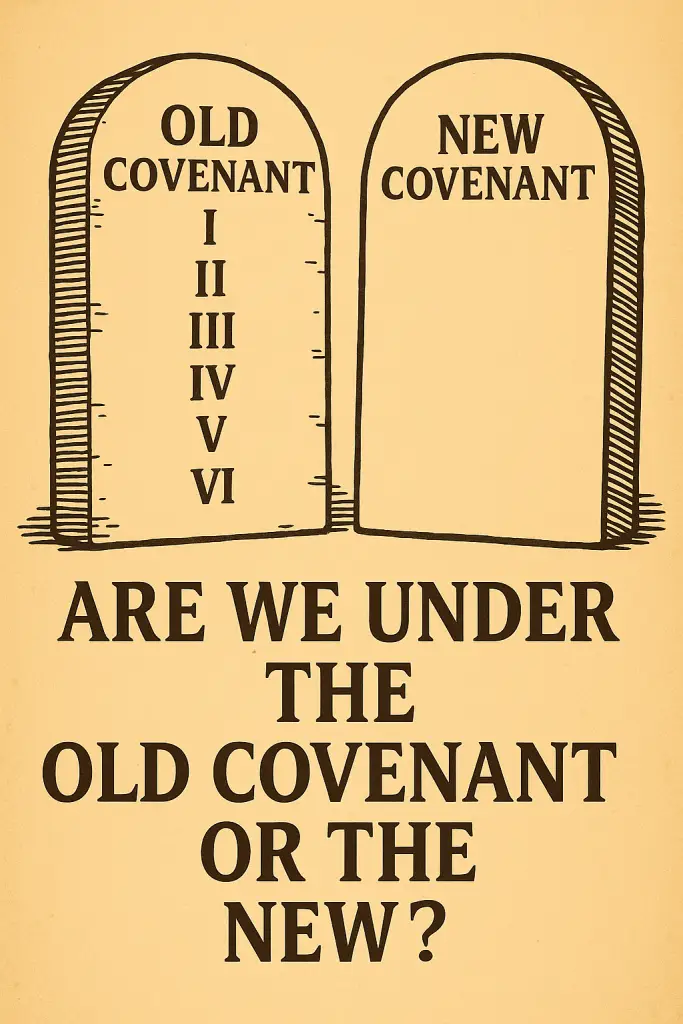
The Old Covenant given at Sinai was never presented as eternal. God Himself stated in Exodus 19:5, “Now therefore, if ye will obey my voice indeed, and keep my covenant, then ye shall be a peculiar treasure unto me above all people: for all the earth is mine.”
This conditionality is repeated throughout Deuteronomy 28–30. The blessings and curses were linked directly to Israel’s obedience. It was a covenant of law and works, given to a specific people for a specific purpose and time.
Galatians 3:19 declares, “Wherefore then serveth the law? It was added because of transgressions, till the seed should come to whom the promise was made.”
2. The New Covenant Is a Better Covenant
Hebrews 8:6 clearly proclaims: “But now hath he obtained a more excellent ministry, by how much also he is the mediator of a better covenant, which was established upon better promises.”
The New Covenant, sealed by the blood of Jesus Christ, is not an upgrade to the Mosaic Law but a replacement. Hebrews 8:13 confirms this: “In that he saith, A new covenant, he hath made the first old. Now that which decayeth and waxeth old is ready to vanish away.”
The old was outward, the new is inward. The old was written on stone, the new is written on hearts. The old required repeated sacrifices, the new rests on the one perfect offering.
3. Clarifying Jeremiah 31
Hebrew Roots proponents often quote Jeremiah 31:31–34 to support a renewed version of Torah observance. But they miss the heart of the passage:
“I will put my law in their inward parts, and write it in their hearts; and will be their God, and they shall be my people” (Jer. 31:33).
This prophecy doesn’t speak of a return to the external observance of Torah, but a spiritual transformation. The law in view is not the Sinai code, but God’s moral will, now written by the Holy Spirit within the believer (2 Cor. 3:3).
4. Are We Grafted Back into Sinai?
Romans 11 speaks of Gentiles being grafted into the olive tree, but it never says we are grafted back into the Mosaic Covenant. The root is not Moses, but Abrahamic faith—fulfilled in Christ (Rom. 11:16-18).
Galatians 4:24-26 is even more direct: “For these are the two covenants; the one from the mount Sinai, which gendereth to bondage, which is Agar.”
Paul urges the Galatians not to return to Sinai, not to try to live as sons of Hagar, but to live as children of promise.
5. The Role of the Law — and Its Expiration
Romans 7:6 says: “But now we are delivered from the law, that being dead wherein we were held; that we should serve in newness of spirit, and not in the oldness of the letter.”
The law had a role, but it was always temporary. Its purpose was to reveal sin, to restrain sin, and to lead us to Christ. But once Christ came, we are no longer under its schoolmaster authority (Gal. 3:24-25).
To return to Torah after Christ has fulfilled it is like going back to the scaffolding after the building is complete.
6. The Danger of Blending Covenants
Paul didn’t mince words with those who tried to blend law and grace:
“I marvel that ye are so soon removed from him that called you into the grace of Christ unto another gospel: Which is not another” (Gal. 1:6-7).
A law-grace hybrid is a false gospel. It is not the Gospel of Jesus Christ. It undermines the sufficiency of His sacrifice and the power of His resurrection.
Conclusion: Which Covenant Are You In?
Every believer must answer this question honestly: Am I living under the covenant God has declared old and obsolete, or am I standing in the finished work of Christ under the new?
Hebrews 10:29 gives a sobering warning: “Of how much sorer punishment, suppose ye, shall he be thought worthy, who hath trodden under foot the Son of God…and hath counted the blood of the covenant…an unholy thing.”
To return to the shadows is to insult the light. To cling to Sinai is to ignore Calvary. Let us not be bewitched (Gal. 3:1). We are not under the law—we are under grace.