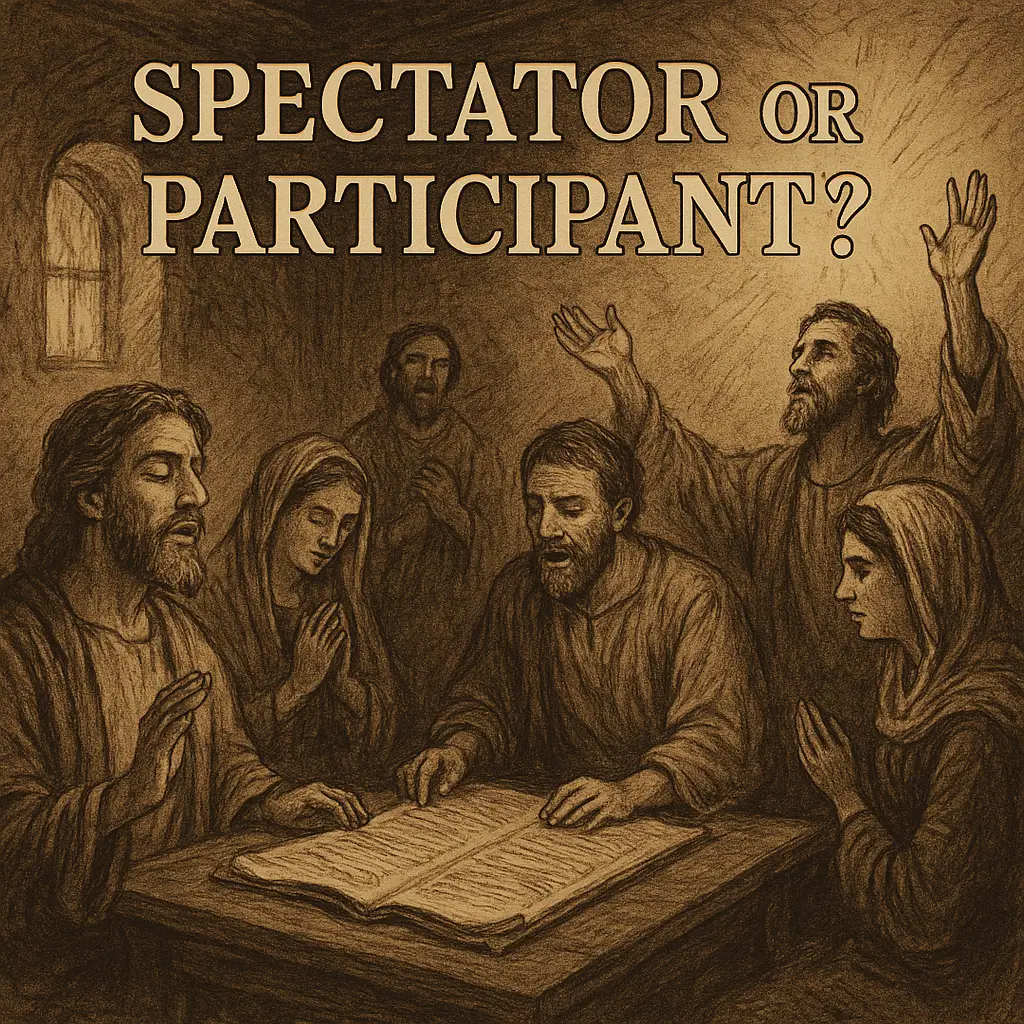
There’s a question Christians often ask one another — or are asked by others — that sounds simple, but reveals a lot about what modern religion has become:
“Do you regularly attend church?”
It’s a loaded question. It assumes that “church” is a building, a service, a weekly program. It presumes that attendance is the goal, and participation optional. But Scripture tells a different story — one that cuts through the religious fog of institutional Christianity and invites us into something far deeper, far more alive.
The Church Is Not a Service You Attend
When the Bible speaks of the Church, it never speaks of a building or a service. The Church is not a place — it is a people. It is not a performance — it is a body, “fitly joined together and compacted by that which every joint supplieth” (Ephesians 4:16). It is not a lecture hall for spiritual consumers — it is a living fellowship of believers where “every one of you hath a psalm, hath a doctrine, hath a tongue, hath a revelation” (1 Corinthians 14:26).
The Church is the ekklesia — the called-out ones — gathered in His name, under His headship, to worship, to pray, to exhort, to share, to grow, and to be built up in love. This is not passive religion. It is active participation. Christ did not redeem us to sit in rows and be entertained. He redeemed us to function as His Body on the earth.
Assembling Isn’t Optional — But It’s Not What You Think
The writer of Hebrews exhorts, “And let us consider one another to provoke unto love and to good works: Not forsaking the assembling of ourselves together…” (Hebrews 10:24–25). But the context is not a scheduled weekly event. The assembling described here is purposeful, mutual, and spiritual. It is about stirring one another up to walk in love. It is about meeting to exhort, to strengthen, to intercede.
The New Testament pattern of assembly looks far more like a spiritual family around a table than an audience in pews. There’s room for teaching. There’s room for order. But what’s missing in so many modern churches is the active participation of the saints — the very thing the Bible calls for.
Church Hierarchies vs. Christ’s Headship
One of the greatest distortions in church history has been the rise of top-down, clergy-laity models where a few lead and the rest merely receive. But Jesus said, “Be not ye called Rabbi: for one is your Master, even Christ; and all ye are brethren” (Matthew 23:8).
True leadership in the Body is servant leadership — humble, Spirit-led, and equipping others to function. Paul told the Corinthians that when they came together, “every one of you” should bring something to edify the Body (1 Corinthians 14:26). That is not possible in most church settings today — because the format itself is built for spectators, not saints.
So Do I “Attend Church”?
Not in the way most people mean. I seek fellowship with believers regularly — not out of legalism, but because the life of Christ in me needs the Body of Christ around me. I meet with others to share the Word, to worship the Lord, to pray for one another, and to walk in the light together. I don’t go to church. I gather with the Church. I don’t attend a performance. I participate in a priesthood.
And I would ask you, too: Are you a spectator — or a participant in the Body of Christ? Because the New Testament never envisioned a passive Church. It calls us into something vibrant, shared, and Spirit-led.
Let’s not settle for less than what Christ died to bring us into.
Overcomer’s Checkpoint
- Have you mistaken attendance for fellowship?
- Is your weekly gathering a place where you can minister to others — or only be ministered to?
- What would it look like to return to the simplicity of gathering in Jesus’ name, with mutual participation and shared spiritual responsibility?
“For where two or three are gathered together in my name, there am I in the midst of them.”
—Matthew 18:20 (KJV)