Shadows or Substance: Why the Old Covenant Cannot Return — 1 of 10
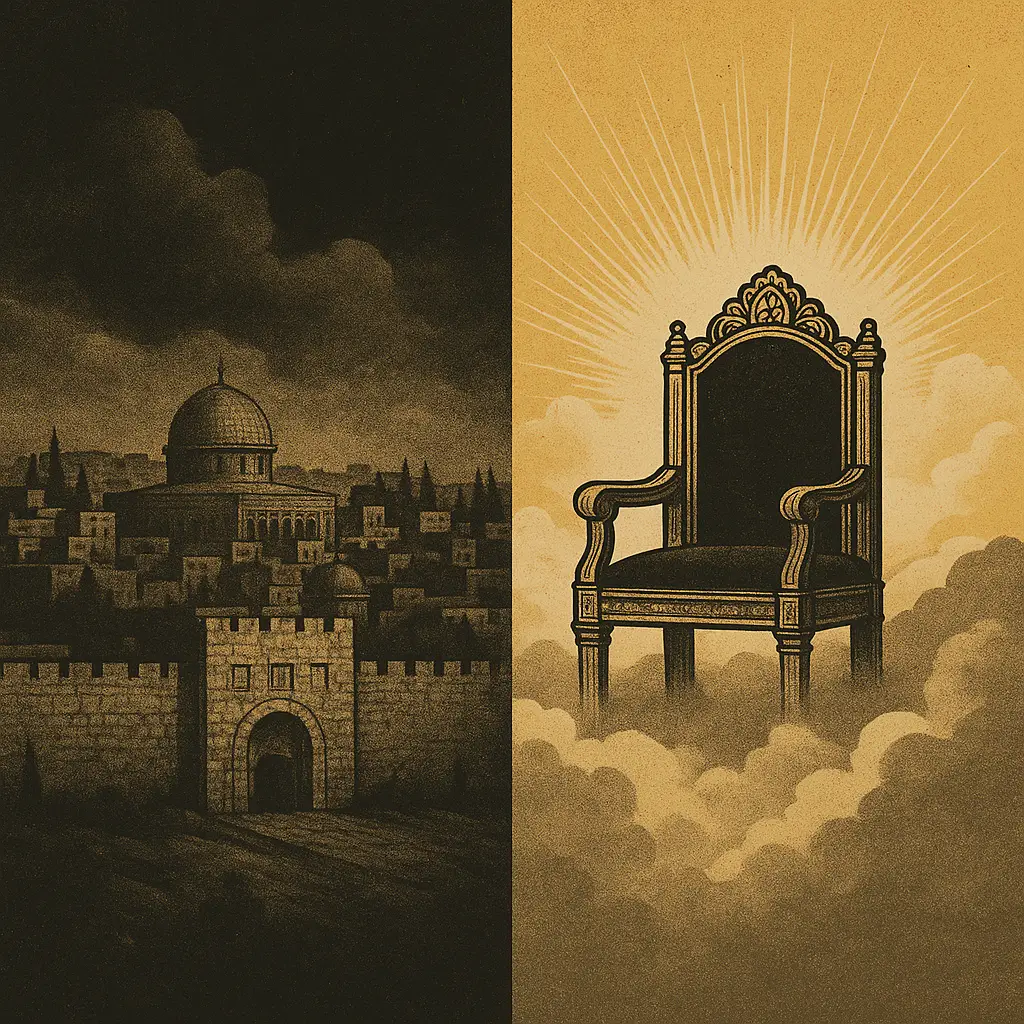
Why the Apostles Declared David’s Throne Already Occupied
“For unto us a child is born, unto us a son is given: and the government shall be upon his shoulder…” — Isaiah 9:6
Few questions shape our understanding of biblical prophecy more than this one:
Where is Jesus reigning today?
The answer determines how we read the promises made to David. It shapes our understanding of Jerusalem, the kingdom of God, and the prophetic hope of Israel. If Christ is not yet seated upon David’s throne, then His kingdom still awaits a future beginning. But if He is already enthroned, then many popular prophetic systems must be reexamined in the light of the apostles’ own teaching.
This series is not an attempt to force the Old Testament into a theological system. Quite the opposite. It is an invitation to let the New Testament explain the Old. Rather than beginning with later interpretations, we will allow Jesus and His apostles to show us how God fulfills His own promises.
The first question is foundational:
Has Jesus already taken David’s throne?
The apostles answer with remarkable clarity.
Peter Announces an Occupied Throne
On the Day of Pentecost, Peter stood before thousands of Jews in Jerusalem and explained what had just taken place. His sermon was not merely about the resurrection—it was about the fulfillment of God’s covenant with David.
He declared:
“Therefore being a prophet, and knowing that God had sworn with an oath to him, that of the fruit of his loins, according to the flesh, he would raise up Christ to sit on his throne… This Jesus hath God raised up…” — Acts 2:30–32
Notice Peter’s reasoning.
God promised David that one of his descendants would sit upon his throne forever.
David foresaw the resurrection of the Messiah.
Jesus was raised from the dead.
Therefore, God’s promise to David has been fulfilled in the risen Christ.
Peter does not tell his listeners that the throne must wait for a future millennium. He proclaims that the resurrection and exaltation of Jesus are the very fulfillment of God’s oath to David. The throne is not empty. The King is already seated.
This is confirmed just a few verses later:
“Therefore being by the right hand of God exalted…” (Acts 2:33)
Peter’s point is unmistakable. The throne promised to David has been glorified, not postponed. The Son of David now reigns from the right hand of the Father.
The Apostles Never Expected Another Enthronement
Many point to the disciples’ question in Acts 1:
“Lord, wilt thou at this time restore again the kingdom to Israel?” (Acts 1:6)
It is often assumed that Jesus answered, “Yes—but later.”
Yet He never says that.
Instead He replies:
“It is not for you to know the times or the seasons, which the Father hath put in his own power. But ye shall receive power… and ye shall be witnesses unto me…” (Acts 1:7–8)
Rather than giving a future political timetable, Jesus directs their attention to the coming of the Holy Spirit and the worldwide proclamation of the gospel.
Only days later, after the Spirit is poured out, Peter stands and declares that Jesus has already been exalted to God’s right hand. The apostles never preach an unoccupied Davidic throne awaiting Christ’s future arrival in Jerusalem. They preach an enthroned King whose reign has already begun.
A Greater Throne Than Earth Could Hold
Some object that David’s throne must be located in earthly Jerusalem because David ruled there.
But the New Testament consistently presents something greater than the shadow.
Jesus Himself declared:
“My kingdom is not of this world.” (John 18:36)
His kingdom is certainly in this world, advancing through the gospel and gathering citizens from every nation, but it is not of this world’s political order. Its authority comes from heaven.
Isaiah had already foretold this greater reign:
“Of the increase of his government and peace there shall be no end, upon the throne of David…” (Isaiah 9:7)
The increase never ends because the King Himself never dies.
Likewise, Hebrews declares:
“Thy throne, O God, is for ever and ever.” (Hebrews 1:8)
The throne of David reaches its fullest expression not in an earthly palace but in the eternal reign of the resurrected Son of God. The shadow has given way to the substance.
Jeremiah’s Promise Finds Its Perfect King
Jeremiah declared:
“David shall never want a man to sit upon the throne of the house of Israel.” (Jeremiah 33:17)
Some conclude that this requires a future earthly dynasty.
But Jeremiah’s promise is actually fulfilled more perfectly than many imagine.
There is indeed a Son of David who never ceases to reign.
Unlike every king before Him, He conquered death itself.
Unlike Solomon, He will never fall into idolatry.
Unlike the kings of Judah, His kingdom can never be overthrown.
Unlike every earthly ruler, His reign has no successor because His life has no end.
The permanence of David’s throne is secured precisely because Jesus lives forever.
Fulfillment Is How God Keeps His Promises
One of the greatest misunderstandings surrounding biblical prophecy is the idea that fulfillment somehow weakens God’s promises.
The opposite is true.
Fulfillment is how God demonstrates His perfect faithfulness.
The New Testament never apologizes for interpreting the Old Testament through Christ.
Matthew does it.
Peter does it.
Paul does it.
James does it.
The writer of Hebrews does it.
John does it.
Again and again, the apostles show that God’s promises reach their intended goal in His Son.
The New Covenant promised in Jeremiah 31 is established through Christ.
The Seed promised to Abraham is Christ (Galatians 3:16).
The throne promised to David belongs to Christ.
The kingdom belongs to Christ.
The inheritance belongs to all who are united to Christ by faith.
God has not abandoned His promises.
He has fulfilled them in a way even greater than the shadows anticipated.
Don’t Exchange Heaven’s Throne for an Earthly Chair
There is a profound irony in insisting that Jesus must someday return merely to occupy an earthly throne in Jerusalem.
The New Testament repeatedly directs our eyes upward.
Paul tells us that Christ is already seated:
”…at his own right hand in the heavenly places, far above all principality, and power…” (Ephesians 1:20–21)
The writer of Hebrews tells believers:
“Ye are come unto mount Sion, and unto the city of the living God, the heavenly Jerusalem…” (Hebrews 12:22)
Our hope is not that Christ will finally begin to reign, our hope is that the King who already reigns will one day appear in glory and consummate the kingdom that is already His.
The question is not whether God will keep His promises to David, the question is whether we will recognize the way He has kept them.
The apostles point us to an occupied throne, an exalted King, a kingdom that has already begun, and to Jesus Christ.
Why the New Testament Leaves No Room for a Return to Levitical Sacrifices