Post 3 of the Forensic Book Reviews
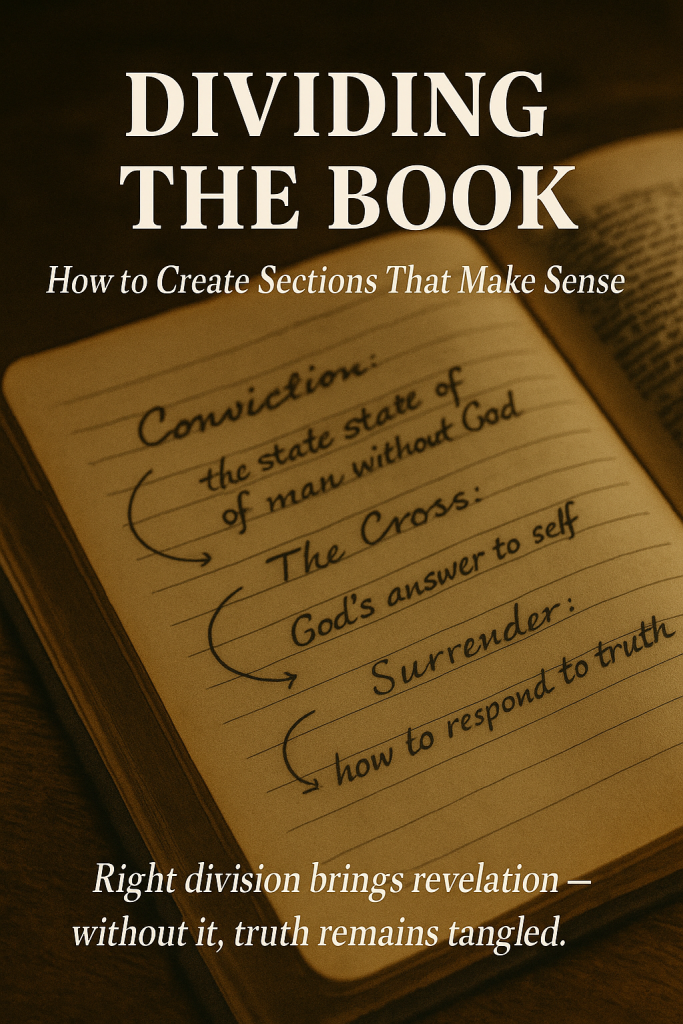
How to Create Sections That Make Sense
When you open a complex Christian book, it can feel like stepping into the middle of someone else’s deep conversation. There are truths being spoken — but unless you can find the flow, much of it may go right past you.
That’s why dividing the book is one of the most important tools of the Forensic Review method.
God is not a God of confusion. And any book that bears His truth — even if imperfectly — will have an underlying spiritual flow. Your task is to find it.
Why Sectioning Matters
Without division, everything blends together. Key insights get buried. Contradictions go unnoticed. And readers walk away either overwhelmed or underfed.
But when you divide rightly, the truth becomes visible — and memorable.
You are creating spiritual chapters that help the reader walk through the argument or revelation with clarity. Not all books do this well on their own. That’s where you come in.
How to Create Sections
Here are 5 practical steps to help you divide a book or passage spiritually:
1. Read Through Once Without Stopping
Let it wash over you. Don’t mark yet. Get the sense of the flow. What is the author building toward? Where does the emotional or doctrinal tone shift?
2. Look for Natural Turns
Pay attention to:
– A new paragraph or heading
– A shift in tone or focus (e.g., from sin to solution)
– Repeated phrases or a change in key words
– A transition from theology to testimony, or from principle to application
If it feels like a new spiritual movement — it probably is.
3. Assign Temporary Labels
Start naming the sections in the margin or in a notebook:
– “Conviction: the state of man without God”
– “The Cross: God’s answer to self”
– “Surrender: how to respond to truth”
This will help you summarize later and communicate the heart of each part to others.
4. Group Related Thoughts
Sometimes several pages are saying the same thing in different ways. That’s one section. Don’t divide just because of paragraph breaks. Divide by spiritual meaning.
5. Check for Balance
Ask:
– Is each section about one main idea?
– Are the sections building toward something?
– Would a reader know what each part is about just by the heading?
You are mapping the terrain so others don’t get lost.
Example from “The Story of Job” (Simplified)
Let’s say we’re reviewing Jessie Penn-Lewis’ The Story of Job. Here’s how one chapter might be divided:
– Section 1: Job’s outward blessings and inner righteousness (Job 1:1–5)
– Section 2: The heavenly challenge and Satan’s accusation (Job 1:6–12)
– Section 3: The testing begins — loss and worship (Job 1:13–22)
Each section reveals a movement: blessing, challenge, response. Together they form a spiritual lesson.
The Bible Does This Too
Even Scripture models this approach. Psalm 119 is divided into 22 parts. Proverbs often shifts thought every few verses. Paul’s epistles follow this pattern: doctrine, then duty; identity, then application.
The Spirit teaches in sections and layers, unfolding little by little. So should we.