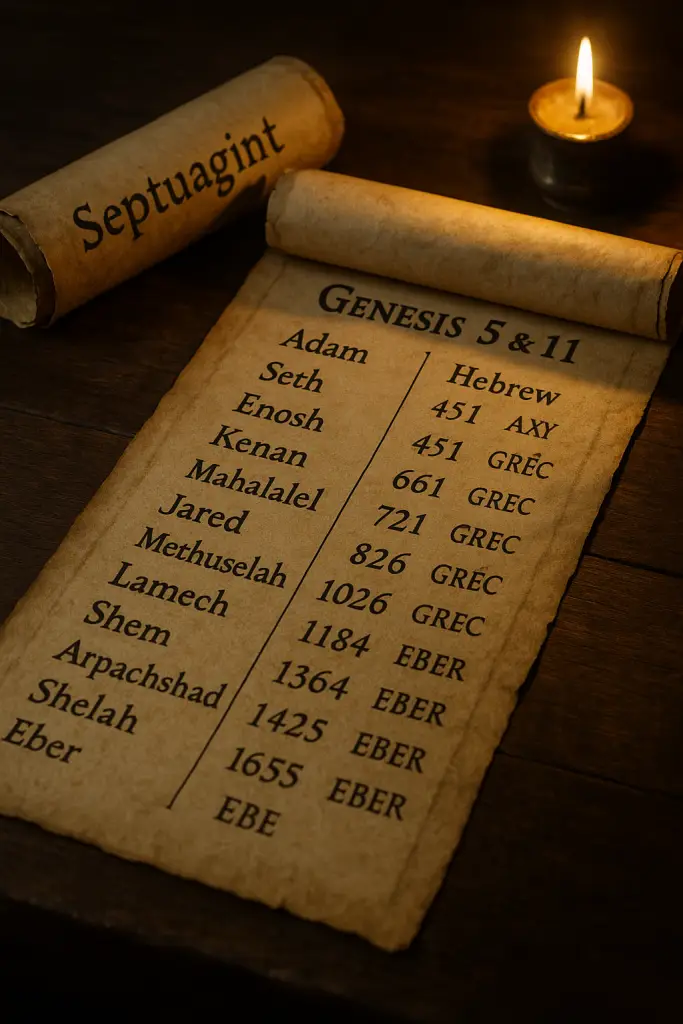
One of the most compelling reasons to question the reliability of the Septuagint is its catastrophic impact on biblical chronology. Far from being a faithful mirror of the Hebrew Scriptures, the Septuagint introduces errors so severe that they distort the biblical timeline and undermine the integrity of Scripture’s historical record.
1. Methuselah Survives the Flood?
According to the Septuagint’s timeline in Genesis 5, Methuselah lives 969 years — the same as in the Hebrew — but the ages of when the patriarchs begat sons are inflated by 100 years each. The result? Methuselah dies 14 years after the Flood begins (Genesis 5:25–27, LXX).
This directly contradicts Genesis 7:23, which says that all life outside the ark perished. The King James Bible, following the Hebrew Masoretic Text, shows Methuselah dying the same year as the Flood, preserving the integrity of God’s judgment.
2. The Genesis 5 and 11 Distortions
The Septuagint inflates the ages of patriarchs at the birth of their sons by 100 years across Genesis 5 and 11. This results in an additional 1,386 years inserted into the genealogy from Adam to Abraham.
This not only disrupts biblical chronology, but it also breaks typological patterns God placed into history — such as the roughly 2,000 years from Adam to Abraham, 2,000 to Christ, and 1,000 to the millennial rest.
3. Undermining Typology and Prophecy
The added years destroy the prophetic structure that reflects God’s plan across time. The typology of the ‘third day,’ the Sabbath millennium, and the foreshadowing of Christ’s first and second comings become confused under the Septuagint’s inflated timeline.
Biblical typology is not arbitrary. When chronology is altered, so too is the spiritual structure God designed. The King James Bible protects this structure by following the preserved Hebrew record.
4. A Pattern of Confusion, Not Preservation
These are not minor scribal errors — they represent a pattern. The Septuagint’s chronology distorts timelines, confuses doctrine, and invites modern scholars to distrust the very text Jesus affirmed (Luke 24:27, 44).
By contrast, the King James Bible offers consistency, prophetic integrity, and doctrinal clarity because it is based on the divinely preserved Masoretic Text.
Conclusion
When the foundations are shaken, the structure collapses. The Septuagint’s errors in chronology show it cannot be the bedrock of Christian doctrine. The King James Bible, anchored in the Hebrew Scriptures, preserves both the truth and the timeline of God’s redemptive plan.