Series: Hard Questions, Holy Answers — Post 42
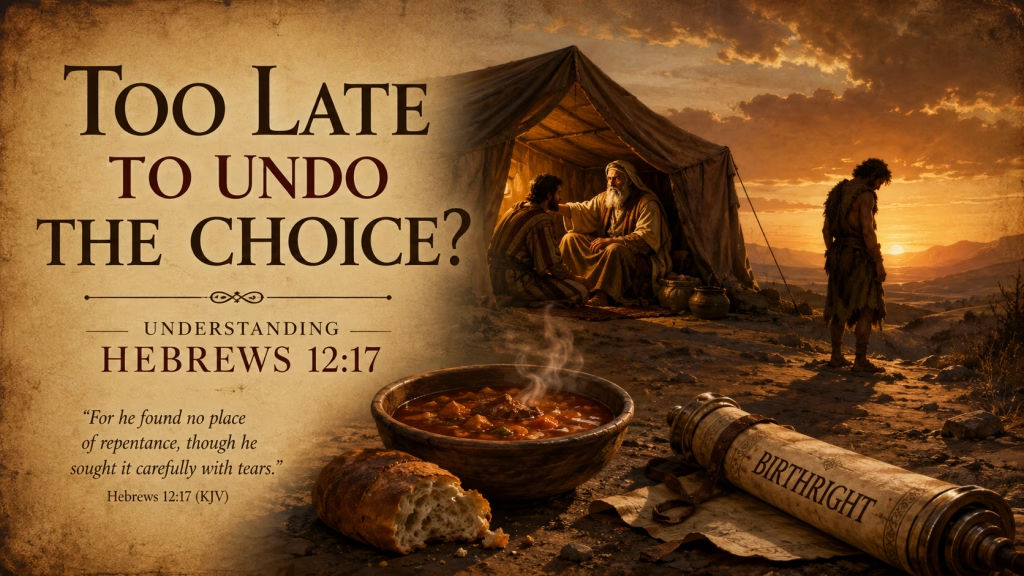
Understanding Hebrews 12:17
What Does “He Found No Place of Repentance” Mean?
“For ye know how that afterward, when he would have inherited the blessing, he was rejected: for he found no place of repentance, though he sought it carefully with tears.” (Hebrews 12:17)
At first glance, this verse can be unsettling. Did Esau sincerely repent only to have God refuse him?
Could someone seek God with tears and still be rejected?
Has Esau become an example of a man who wanted salvation but was denied?
Not at all.
A careful reading of both Hebrews and Genesis reveals a very different picture.
The Context Is Sonship, Not Salvation
Hebrews 12 opens with one of the clearest passages in Scripture about God’s fatherly discipline.
“For whom the Lord loveth he chasteneth…” (Heb. 12:6)
The entire chapter addresses God’s children. The writer encourages believers not to despise the Father’s correction but to receive it as evidence of His love. Then comes the warning:
“Looking diligently lest any man fail of the grace of God…” (v.15)
The subject is not how to become a child of God, it is how God’s children respond to His gracious dealings.
What Does “Fail of the Grace of God” Mean?
The expression does not mean “lose salvation.” It means to fall short of, or miss, what God’s grace intends to accomplish. Instead of responding to God’s discipline with faith, a believer may become bitter, resentful, or careless.
That is exactly why the writer immediately mentions:
- a root of bitterness,
- fornication,
- and Esau.
These are warnings about despising spiritual privilege.
Why Does Esau Become the Example?
Esau’s great tragedy was not that he committed an unusually terrible sin. His tragedy was that he treated something infinitely valuable as though it were worthless.
Genesis tells us:
“Thus Esau despised his birthright.” (Gen. 25:34)
For one satisfying meal he exchanged an inheritance that could never be recovered. The issue was never solely about food, the issue was what he valued.
What Did Esau Actually Lose?
Many assume Esau lost salvation but Genesis never says that. Hebrews never says that.
Instead, Esau lost:
- his birthright,
- his inheritance,
- and his father’s blessing.
These are privileges—not statements about his eternal destiny.
What Does “He Found No Place of Repentance” Mean?
This is where many readers become confused. Notice carefully what Hebrews actually says:
“…when he would have inherited the blessing…”
The subject is the blessing. Esau wanted his father to reverse what had already been done but Isaac could not undo it. The blessing had already been given to Jacob.
The phrase
“he found no place of repentance”
does not mean God refused to forgive Esau. It means there was no opportunity to reverse the decision.
No place remained for changing what had already occurred. The consequences could not be undone.
Whose Repentance?
The wording itself gives an important clue.
The text does not say,
“God refused Esau’s repentance.”
Instead it simply says:
“he found no place of repentance.”
Many commentators understand this to mean there was no possibility of changing the situation, no opportunity for Isaac to change his mind regarding the blessing once it had been bestowed.
That fits perfectly with Genesis 27.
Isaac trembled greatly and acknowledged:
“Yea, and he shall be blessed.”
The blessing stood. It could not simply be revoked because Esau was now sorrowful.
Tears Do Not Always Mean Repentance
Verse 17 says Esau sought it with tears. What was he seeking?
The text answers:
the blessing.
His tears were real and his sorrow was real, but he was grieving the loss of the blessing, not necessarily the despising of the birthright that caused the loss. Scripture often distinguishes between sorrow over consequences and genuine repentance toward God.
Esau wanted the inheritance back but that was impossible.
God’s Forgiveness Does Not Always Remove Consequences
This is one of Scripture’s consistent lessons.
David was forgiven, yet the sword never departed from his house.
Moses was forgiven, yet he did not enter Canaan.
Likewise, Esau could not recover what he had freely thrown away.
God’s grace forgives, but grace does not always erase the earthly consequences of our choices.
The Comfort of the Gospel
Some believers fear this passage because they wonder,
“What if I seek God and He refuses me?”
Jesus answers that fear directly:
“Him that cometh to me I will in no wise cast out.” (John 6:37)
The writer of Hebrews is not warning that God rejects sincere seekers, he is warning believers not to treat God’s gifts with the contempt Esau showed toward his birthright. Esau teaches us that some opportunities, once despised, cannot be recovered. But nowhere does Scripture teach that a sinner who comes to Christ in faith will be turned away.
Final Thoughts
Esau’s story is not the story of a sinner turned away by a reluctant God. It is the story of a son who despised a precious inheritance until it was gone. Hebrews 12 warns us that while our heavenly Father delights in forgiving His children, He also teaches us that some opportunities, once surrendered, cannot simply be reclaimed. The warning is meant to make us value His gifts more highly, not to make us doubt His grace. It is a solemn reminder that while God’s grace freely forgives, some earthly privileges and opportunities, once surrendered, cannot simply be reclaimed.
The invitation of the gospel remains unchanged:
“Come unto me…” (Matt. 11:28)
And the promise remains just as certain:
“Him that cometh to me I will in no wise cast out.” (John 6:37)