Series: Hard Questions, Holy Answers — Post 37
The Original Apostolic Office Cannot Be Repeated
There is much discussion today about apostles. Some deny that apostles exist at all. Others insist the Church still needs governing apostles with authority over doctrine and direction.
Both sides often miss something essential.
The New Testament itself makes a crucial distinction: there were apostles who laid the foundation of the Church — and that foundation was laid once. If we do not understand that, we will either weaken Scripture or attempt to relaunch what God has already completed.
Let us begin where Scripture begins.
Handpicked by Christ
The Twelve were not volunteers. They were not elected by a congregation. They were not the product of church succession. They were personally chosen by the Lord Jesus.
“And when it was day, he called unto him his disciples: and of them he chose twelve, whom also he named apostles.” (Luke 6:13)
The initiative was entirely Christ’s. Their authority did not grow out of maturity, experience, or institutional recognition. It flowed from direct appointment by the Son of God.
This already sets them apart from any later claim to apostleship.
Eyewitnesses of the Risen Christ
When Judas fell, Acts 1 makes something unmistakably clear. The replacement had to meet a strict qualification:
“Wherefore of these men which have companied with us all the time that the Lord Jesus went in and out among us, Beginning from the baptism of John, unto that same day that he was taken up from us, must one be ordained to be a witness with us of his resurrection.” (Acts 1:21–22)
The apostolic office required firsthand, bodily witness of the resurrected Lord. That qualification alone removes the possibility of ongoing foundational apostles. No one today can meet it. Even Paul — who was not among the original Twelve — anchors his apostleship in this same reality:
“Have I not seen Jesus Christ our Lord?” (1 Corinthians 9:1)
“Last of all he was seen of me also, as of one born out of due time.” (1 Corinthians 15:8)
Paul’s apostleship was extraordinary because it was rooted in a direct appearance of the risen Christ. He did not inherit an office. He was commissioned from heaven.
Without resurrection witness, there is no foundational apostleship.
The Foundation of the Church
The most decisive text is Ephesians 2:
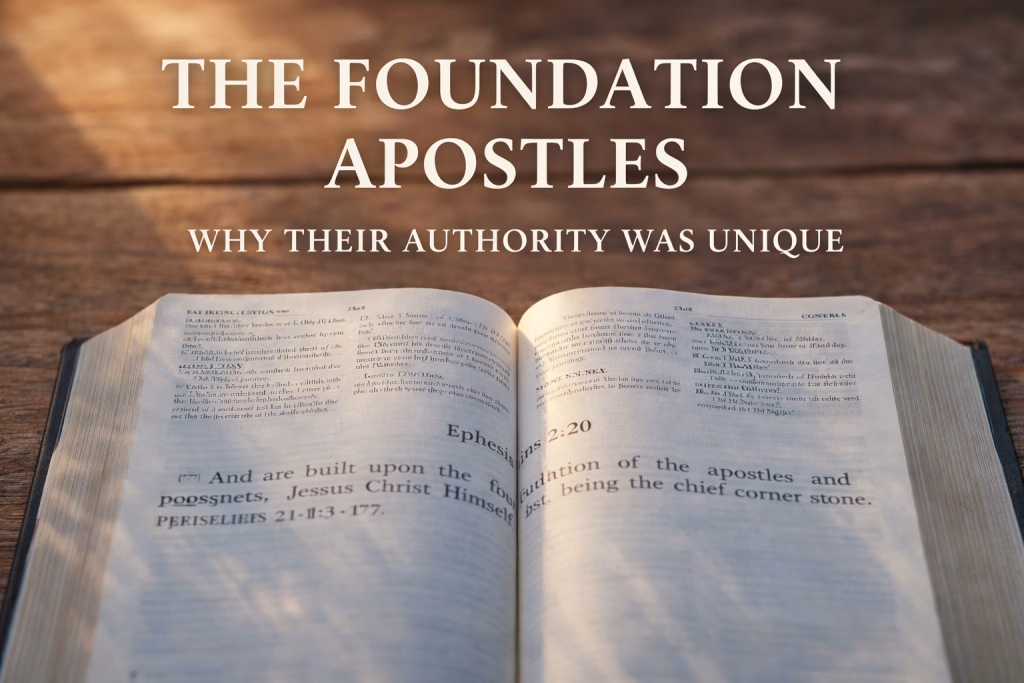
“And are built upon the foundation of the apostles and prophets, Jesus Christ himself being the chief corner stone.” (Ephesians 2:20)
A foundation is not continuously relaid. It is established once, and everything that follows rests upon it. The apostles did not merely lead churches. They laid the doctrinal bedrock upon which the Church stands.
Revelation confirms this imagery:
“And the wall of the city had twelve foundations, and in them the names of the twelve apostles of the Lamb.” (Revelation 21:14)
Twelve foundations. Not an expanding list. Not an ongoing line. A closed set. The symbolism is deliberate. The foundational apostles belong to the beginning of the Church’s structure, not to its ongoing construction.
Unique Authority and Inspiration
The foundational apostles were entrusted with more than pastoral oversight. They carried revelatory authority.
Paul writes:
“If any man think himself to be a prophet, or spiritual, let him acknowledge that the things that I write unto you are the commandments of the Lord.” (1 Corinthians 14:37)
That is not advisory language. That is divine authority.
Peter affirms the same:
“Even as our beloved brother Paul also according to the wisdom given unto him hath written unto you… which they that are unlearned and unstable wrest, as they do also the other scriptures.” (2 Peter 3:15–16)
Paul’s writings are placed alongside “the other scriptures.” That is canonical authority. This is what makes the foundational apostles unique. They were not merely Spirit-filled leaders. They were Spirit-inspired witnesses whose teaching became Scripture.
And Jude reminds us:
“The faith which was once delivered unto the saints.” (Jude 3)
Not gradually delivered, nor continually expanded, but ONCE delivered.
Confirmed by Signs
Scripture also speaks of “the signs of an apostle.”
“Truly the signs of an apostle were wrought among you… in signs, and wonders, and mighty deeds.” (2 Corinthians 12:12)
These were not occasional answers to prayer. They were confirming works establishing divine commission.
The apostles were authenticated by heaven because they were laying heaven’s foundation on earth.
Why This Is Important
If the foundation apostles still exist in the same sense today, then the Church’s foundation is still being laid. That would mean:
- Doctrine is still developing.
- Revelation is still being added.
- Authority is still expanding.
But Scripture does not present the Church as an unfinished doctrinal structure waiting for new apostles. It presents the Church as built upon a completed foundation, with Christ as the cornerstone. Everything that follows — pastors, teachers, evangelists, and Spirit-sent workers — builds upon what has already been laid.
The moment we blur that distinction, we risk either diminishing the authority of Scripture or elevating modern leaders beyond their proper place.
The Foundation Is Secure
The original apostles were:
- Personally commissioned by Christ
- Eyewitnesses of His resurrection
- Confirmed by divine signs
- Bearers of inspired revelation
- Named in the eternal foundations
Their role was unique, their authority was foundational and their commission was non-repeatable.
And that is good news.
It means the Church is not adrift, waiting for new revelation and we are not dependent on modern claimants to apostolic authority. It means the faith once delivered remains sufficient.
The foundation has been laid, Christ is the cornerstone.
And we build upon what He has already given.