(Truth in the Last Days — Post 3)
What Acts 1:6–7 and Pentecost Actually Changed
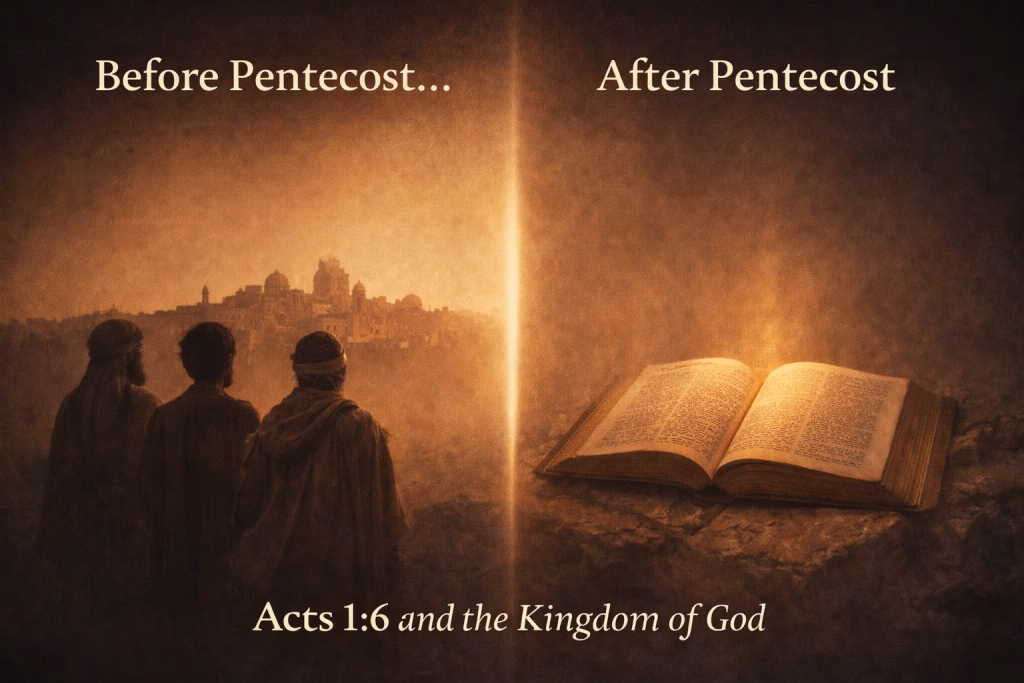
A difficult question has begun surfacing in many churches:
Can a genuine believer also hold to a Zionist understanding of prophecy?
We must answer that question carefully. A person is saved by faith in Jesus Christ, not by the correctness of every prophetic conclusion. Christians grow at different speeds, and sincere believers can carry inherited assumptions for years.
But that does not mean the issue is harmless.
Because the New Testament shows something profound happened to the apostles themselves — something that dramatically changed how they understood Israel, the kingdom, and the promises of God.
And Scripture lets us watch that change take place in real time.
The Question Before Pentecost
Immediately before the ascension, the disciples asked Jesus:
“Lord, wilt thou at this time restore again the kingdom to Israel?” (Acts 1:6)
This was not a strange question. It was the most natural question a first-century Jew could ask. For generations, Israel expected national restoration, visible rule, and earthly vindication. Even after walking with Jesus, the disciples still interpreted the prophets through that expectation.
Notice what Jesus did not do.
He did not give them a timetable.
He did not affirm a coming political restoration.
He redirected their attention.
“It is not for you to know the times or the seasons… But ye shall receive power, after that the Holy Ghost is come upon you: and ye shall be witnesses unto me.” (Acts 1:7–8)
Christ does not feed their national expectation. He prepares them for a coming illumination.
Something was about to happen that would change how they understood the kingdom entirely.
What Pentecost Changed
After Pentecost, we never again see the apostles preaching a national restoration of Israel as the hope of God’s people.
Instead, Peter stands and preaches that David’s promises are fulfilled in the resurrection and exaltation of Christ (Acts 2:29–36). The throne of David is no longer treated as a future earthly monarchy but as Christ’s present reign.
Soon afterward, the apostles begin declaring truths that would have been shocking under their earlier assumptions:
Believers — including Gentiles — are Abraham’s children:
“They which are of faith, the same are the children of Abraham.” (Galatians 3:7)
In Christ, the dividing distinction is removed:
“There is neither Jew nor Greek… for ye are all one in Christ Jesus.” (Galatians 3:28)
Not all who are ethnically Israel constitute the covenant people:
“They are not all Israel, which are of Israel.” (Romans 9:6)
The gathering place of God’s people is no longer earthly Jerusalem:
“Ye are come unto mount Sion… the heavenly Jerusalem.” (Hebrews 12:22)
The apostles did not abandon the Old Testament.
They understood it differently — through Christ.
The Hope of Israel
Late in his life, Paul explains why he is imprisoned:
“Because that for the hope of Israel I am bound with this chain.” (Acts 28:20)
What was the hope of Israel according to Paul?
He immediately explains in the same chapter: the preaching of “the kingdom of God” and “those things which concern the Lord Jesus Christ” (Acts 28:23,31).
The hope of Israel was not a restored state.
It was the risen Messiah.
This is why Paul could preach to Jews and Gentiles the same message. The promises were not cancelled — they had reached their fulfillment.
What Actually Changed in the Apostles
Before Pentecost, the disciples read the prophets with a national expectation.
After Pentecost, they read the prophets Christ-centeredly.
That is the real turning point.
Scripture says:
“The natural man receiveth not the things of the Spirit of God… they are spiritually discerned.” (1 Corinthians 2:14)
The difference was not intelligence.
It was illumination.
They no longer saw the promises as centered on a nation, but on a Person.
A Necessary Clarification
We must be careful here.
Holding a Zionist interpretation does not automatically prove a person is unsaved. Many believers inherit teaching long before they examine it carefully. Growth in understanding takes time.
But the New Testament does show this: the apostolic interpretation of prophecy moves consistently away from ethnic and territorial expectations and toward Christ and His people.
So the concern is not personal condemnation — it is doctrinal direction.
If a teaching continually re-centers the believer’s hope on geopolitics rather than the finished work of Christ, it is spiritually unhealthy and deeply confusing to the Church.
Why This Is Important
The question is not whether the Old Testament spoke about Israel. It certainly did, the question is how the apostles said those promises were fulfilled.
Before Pentecost, the disciples asked about national restoration.
After Pentecost, they preached:
- Christ reigning
- Christ as the temple
- believers as Abraham’s seed
- the heavenly Jerusalem
- one people of God
They did not stop believing the prophets, they understood them.
Word to the Overcomer
Every generation faces the same temptation: to look for God’s purposes primarily in history rather than in Christ. But the Holy Spirit was given for a reason — to lead believers into the truth about the Son of God.
The Scriptures ultimately speak about Him. When prophecy becomes centered on nations, borders, and timelines, the focus shifts from fulfillment back to expectation.
The apostles themselves once stood at that same place in Acts 1.
Pentecost changed them.
And it should shape how we read the promises as well.