(When Revelation Gives Way to Reconstruction — Post 13)
What Scripture Really Says: Why 72-Hour Charts Fail the Gospel Record
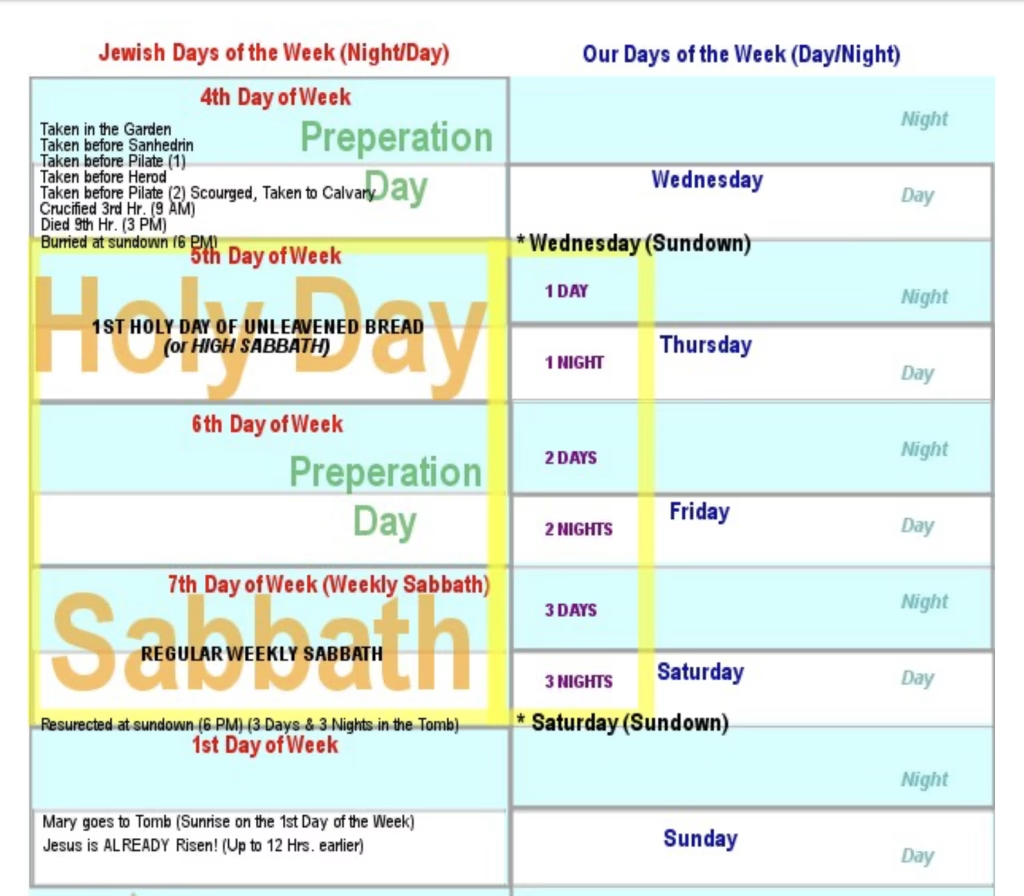
Over the years, increasingly complex charts have circulated online attempting to “correct” the traditional understanding of the crucifixion and resurrection of Christ. Most of these charts share a common goal: to prove that Jesus was in the tomb for exactly 72 hours—three full days and three full nights—usually by placing the crucifixion on a Wednesday or Thursday.
At first glance, such charts can look impressive. They are detailed, color-coded, and filled with references to Sabbaths, Passover dates, and astronomical calculations. But the real question is not whether a chart looks precise.
The question is: Does it agree with Scripture?
Let’s examine what these charts are trying to prove—and then allow the Word of God to interpret itself.
What These Charts Are Trying to Prove
The driving assumption behind 72-hour charts is this statement:
“If Jesus was not in the tomb for exactly 72 hours, then Matthew 12:40 was not fulfilled.”
Matthew 12:40 (KJV):
“For as Jonas was three days and three nights in the whale’s belly; so shall the Son of man be three days and three nights in the heart of the earth.”
From that single assumption, everything else in the chart follows:
- The crucifixion must be moved earlier than Friday
- Multiple Sabbaths must be inserted
- Jewish time reckoning must be redefined
- Clear Gospel statements must be reinterpreted
The chart is not asking, “What do the Gospels say?” It is asking, “How do we make 72 hours work?”
That is the fundamental problem.
How Scripture Actually Reckons Time
In Scripture, any part of a day is counted as a day and night. This is not speculation; it is demonstrated repeatedly.
Esther 4:16:
“Fast ye for me, and neither eat nor drink three days, night or day.”
Esther 5:1:
“Now it came to pass on the third day, that Esther put on her royal apparel…”
She did not wait 72 hours. She went in on the third day.
This is standard Hebrew idiom. The Bible itself defines how such language works. Once this is understood, the demand for a literal 72-hour entombment disappears entirely.
The Gospel Timeline Is Clear and Consistent
All four Gospels agree on the following fixed points:
1. Jesus died on the
Day of Preparation
Luke 23:54:
“And that day was the preparation, and the sabbath drew on.”
The Day of Preparation is consistently identified as the day before the Sabbath.
2. Jesus was buried
before sunset
He was placed in the tomb hurriedly because the Sabbath was about to begin.
3. The women rested on the Sabbath
Luke 23:56:
“…and rested the sabbath day according to the commandment.”
4. Jesus rose on
the first day of the week
Luke 24:1:
“Now upon the first day of the week, very early in the morning…”
The tomb was already empty.
This yields a straightforward sequence:
- Friday — Crucifixion and burial (Day 1)
- Saturday — Sabbath rest in the tomb (Day 2)
- Sunday — Resurrection (Day 3)
No gaps. No calendar gymnastics.
The Emmaus Road Statement Settles the Matter
Luke 24:21 records words spoken on Resurrection Sunday:
“To day is the third day since these things were done.”
Count backward:
- Sunday = third day
- Saturday = second day
- Friday = first day
If Jesus had been crucified on Wednesday or Thursday, this statement would be false. Scripture does not need to be corrected by charts.
The Problem with “High Sabbath” Arguments
Yes, Passover included high Sabbaths. But the charts rely on stacking Sabbaths to create artificial gaps that the text itself never indicates.
The Gospels speak plainly of:
- the Sabbath (singular)
- the first day of the week
They never describe a midweek crucifixion followed by multiple intervening Sabbaths.
The women’s actions—preparing spices, resting on the Sabbath, then visiting the tomb—only make sense in the traditional timeline.
Why These Charts Keep Appearing
These charts appeal to readers because they:
- sound more “exact”
- feel more “Hebraic”
- challenge tradition
- appear to defend Jesus’ words more carefully
Ironically, they end up overruling Jesus’ own apostles and the Gospel narratives they recorded. This is not reverence for Scripture, it is theory-driven interpretation.
Letting Scripture Interpret Scripture
The Bible itself tells us:
- Jesus would rise the third day
- He was crucified the day before the Sabbath
- He rose the first day of the week
When Scripture is allowed to speak plainly, the timeline is neither confusing nor controversial. Sometimes the simplest reading is the faithful one.
Final Word
These charts do not clarify Scripture, they attempt to correct it.
The resurrection of Christ does not rest on a 72-hour calculation. It rests on the faithful fulfillment of God’s Word, spoken in covenant language and fulfilled exactly as written.
Christ rose on the third day—just as the Scriptures said.