And Why They Crumble Under Scripture
Purpose:
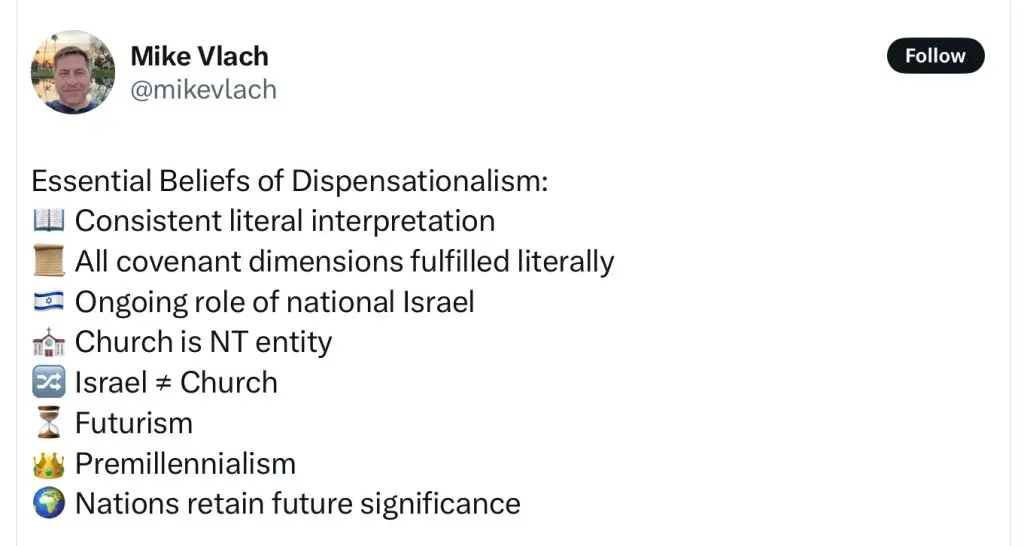
To biblically and clearly dismantle the core tenets listed in Mike Vlach’s post by showing how they contradict the New Testament revelation of Christ, the nature of the Church, and the fulfilled promises of God. His post here lays out the standard framework of Dispensational theology in compact form:
Summary of Vlach’s Post:
Brief One Liner of the Beliefs of Dispensationalism:
- 📖 Consistent literal interpretation — Interpreting prophecy and Scripture with a rigidly literal lens, even when the context may call for symbolic or spiritual understanding.
- 🏺 All covenant dimensions fulfilled literally — Especially the Abrahamic, Davidic, and Land covenants, believed to require physical fulfillment in national Israel.
- 🇮🇱 Ongoing role of national Israel — Israel remains distinct from the Church and will play a future role in God’s plan.
- 🏛️ Church is NT entity — The Church began at Pentecost, not before.
- 🔀 Israel ≠ Church — A firm separation; never to be conflated or seen typologically.
- ⏳ Futurism — Most prophecy is yet future, especially concerning Israel.
- 👑 Premillennialism — Christ will return to reign after the Tribulation.
- 🌍 Nations retain future significance — Ethnic/national distinctions persist into the Millennium and beyond.
Introduction:
Mike Vlach’s list has become the go-to summary for modern Dispensationalists. But when held up to the Word of God, these pillars collapse. Each belief may sound “literal,” but it actually undermines the spiritual, fulfilled reality found in Christ.
Consistent Literal Interpretation
Refuted:
Literalism sounds noble, but Scripture itself teaches that spiritual realities often lie beneath types, shadows, and parables. Jesus spoke in parables (Matthew 13:10–13), Paul revealed mysteries hidden from ages (Colossians 1:26), and Hebrews repeatedly affirms that the old covenant was a shadow (Hebrews 10:1).
“Which things are an allegory: for these are the two covenants…” — Galatians 4:24
All Covenant Dimensions Fulfilled Literally
Refuted:
Paul says the promises to Abraham were not ultimately about physical land or lineage, but Christ (Galatians 3:16). The inheritance is heavenly, not earthly (Hebrews 11:10–16).
“For all the promises of God in him are yea, and in him Amen…” — 2 Corinthians 1:20
Ongoing Role of National Israel
Refuted:
In Christ, there is no more Jew or Greek (Galatians 3:28). God’s people are now one new man (Ephesians 2:14–15). The physical nation has no redemptive distinction apart from Christ.
“For they are not all Israel, which are of Israel…” — Romans 9:6
Church is a New Testament Entity
Refuted:
Stephen called Israel “the church in the wilderness” (Acts 7:38). Hebrews 12:22–23 shows the Church as the heavenly Zion — the continuation, not a detour.
“One body… one hope… one faith…” — Ephesians 4:4–5
Israel ≠ Church
Refuted:
The true Israel is defined by faith in Christ (Romans 2:28–29, Philippians 3:3). The Church is the continuation of the faithful remnant — not a replacement, but a fulfillment.
“Ye are a chosen generation, a royal priesthood, an holy nation…” — 1 Peter 2:9
Futurism
Refuted:
Much prophecy has already been fulfilled in Christ’s first coming, the outpouring of the Spirit, and the destruction of Jerusalem in AD 70. Futurism often ignores fulfilled prophecy to keep a future Israel-centered system.
“This is that which was spoken by the prophet Joel…” — Acts 2:16
Premillennialism
Refuted:
Christ is reigning now (Acts 2:30–36, Revelation 1:5). The idea of a future earthly kingdom undermines the spiritual Kingdom Christ inaugurated. He is seated now on the throne of David.
“He must reign, till he hath put all enemies under his feet.” — 1 Corinthians 15:25
Nations Retain Future Significance
Refuted:
In the New Jerusalem, the Lamb is the light — not national identity. The gospel gathers people “out of every nation” (Revelation 5:9), but there is no spiritual advantage in being part of a physical nation anymore.
“The kingdoms of this world are become the kingdoms of our Lord…” — Revelation 11:15
Conclusion:
Dispensationalism offers a fragmented, future-based, nationalistic gospel. But the New Testament preaches a present, unified, spiritual Kingdom. The promises are fulfilled in Christ — and the Church is not a plan B. She is the Bride for whom He died.