How Dispensationalism Binds the Church to the World
Why “the spirits of just men made perfect” calls us upward, not backward.
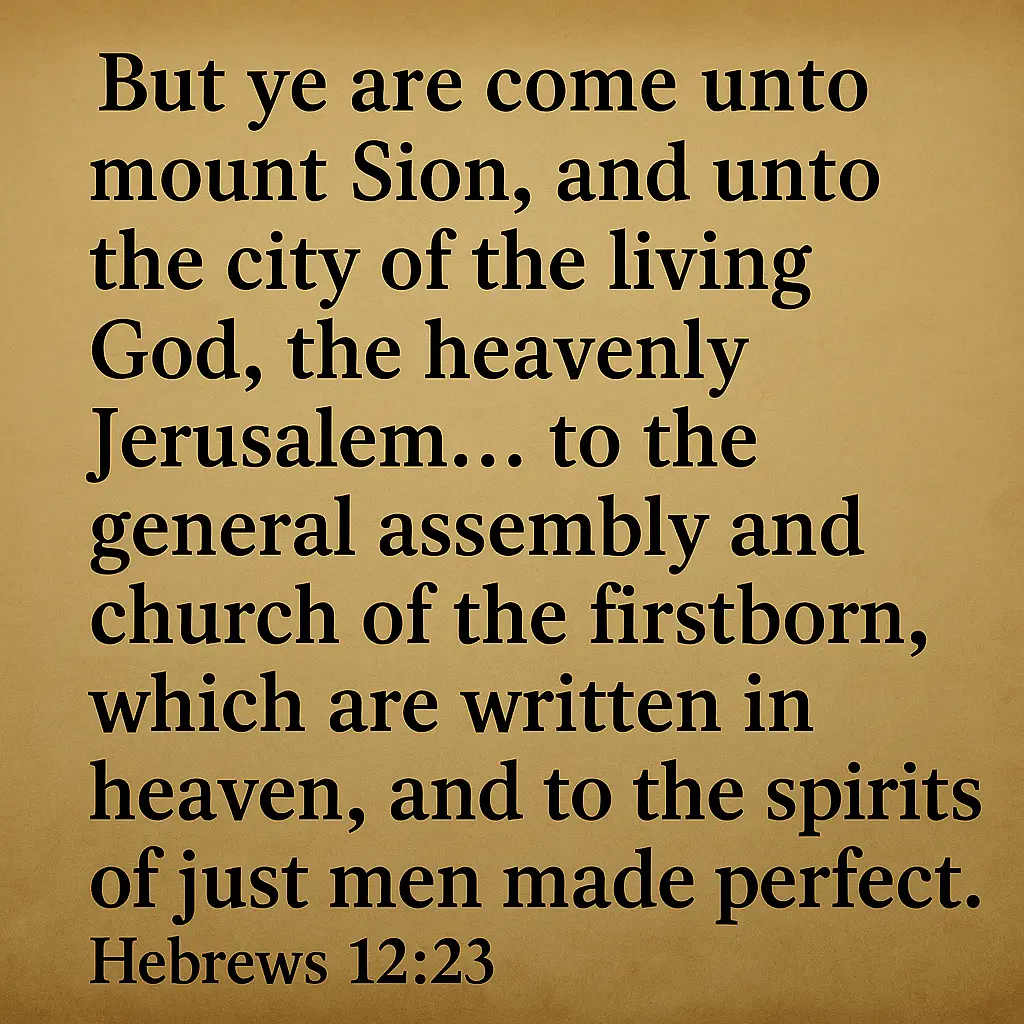
But ye are come unto mount Sion, and unto the city of the living God, the heavenly Jerusalem… to the general assembly and church of the firstborn, which are written in heaven, and to God the Judge of all, and to the spirits of just men made perfect. Hebrews 12:22–23
There’s a phrase in this passage that won’t let go of us: “the spirits of just men made perfect.” It doesn’t point us to a future millennial era. It doesn’t center our gaze on natural Israel, Jerusalem, or temple reconstruction. It calls us heavenward.
For those beginning to awaken from the grip of Dispensationalism, this verse lands like a stone thrown through the glass walls of an earthbound theology.
Because here’s the truth:
Dispensationalism doesn’t just divide the Bible. It divides the heart.
A Matter of Affection, Not Just Interpretation
For years, many of us parked Dispensationalism in the “secondary issue” garage — a harmless framework about end-times timelines and rapture charts. But its impact goes deeper.
It subtly reorients the Church’s affection toward:
- A geopolitical nation, rather than a spiritual people.
- A future temple, rather than the living Body of Christ.
- A natural Jerusalem, rather than the heavenly Jerusalem.
- A Messiah to come, rather than the reigning Christ already seated on the throne.
When you adopt this framework, your affections begin to drift toward the visible, the nationalistic, and the carnal — even while confessing the name of Jesus.
Set your affection on things above, not on things on the earth. Colossians 3:2
Dispensationalism makes that command difficult to obey.
The Spirits of Just Men Made Perfect
Hebrews 12 does not say we will come to this company. It says we are come.
This is the Church of the Firstborn — not a synagogue of natural lineage. It’s not defined by borders, bloodlines, or feasts. It is composed of every believer who has been born of the Spirit and joined to Christ, including:
- Abel, who offered by faith (Hebrews 11:4)
- Abraham, who saw Christ’s day and was glad (John 8:56)
- Moses, who chose Christ’s reproach over Pharaoh’s riches (Hebrews 11:26)
- David, who foresaw the resurrection (Acts 2:31)
- And every Old Testament saint who saw promises afar off, and embraced them by faith.
This is the cloud of witnesses we are surrounded by — not an earthly movement awaiting geopolitical restoration, but a heavenly family perfected in Christ.
Why This Matters Now
In the current climate, many Christians are discovering — sometimes painfully — that Dispensationalism is not neutral. It affects:
- Affection — drawing hearts to natural Israel instead of spiritual Zion.
- Allegiance — fostering political Zionism rather than Kingdom loyalty.
- Assurance — promoting an unfinished gospel that waits on Israel’s return to legitimacy.
- Application — distracting believers from the mission of the Church with geopolitical prophecy charts.
The Church has been “made perfect” not in stages or dispensations, but in Christ. To look for fulfillment elsewhere is to depart from the Head (Colossians 2:19).
A Righteous God, A Spiritual People
One final objection often arises: “Would God blind Israel, only to condemn them?”
Friend, the same Jesus who said, “Ye will not come to me, that ye might have life” (John 5:40), also wept over Jerusalem. Their blindness was both judgment and mercy. Judgment, because of persistent unbelief. Mercy, because it opened the door to the Gentiles — and to any Jew today who will receive Him.
But that door is Christ — not nationalism. Not Torah. Not genealogy.
“There is neither Jew nor Greek… for ye are all one in Christ Jesus.” — Galatians 3:28
There is neither Jew nor Greek… for ye are all one in Christ Jesus. Galatians 3:28
It’s time to come out from an age of shadowy affections and enter the glorious reality:
We are come to Mount Sion.