Series: Hard Questions, Holy Answers — Post 32
Using the Lord’s Prayer as Your Guide
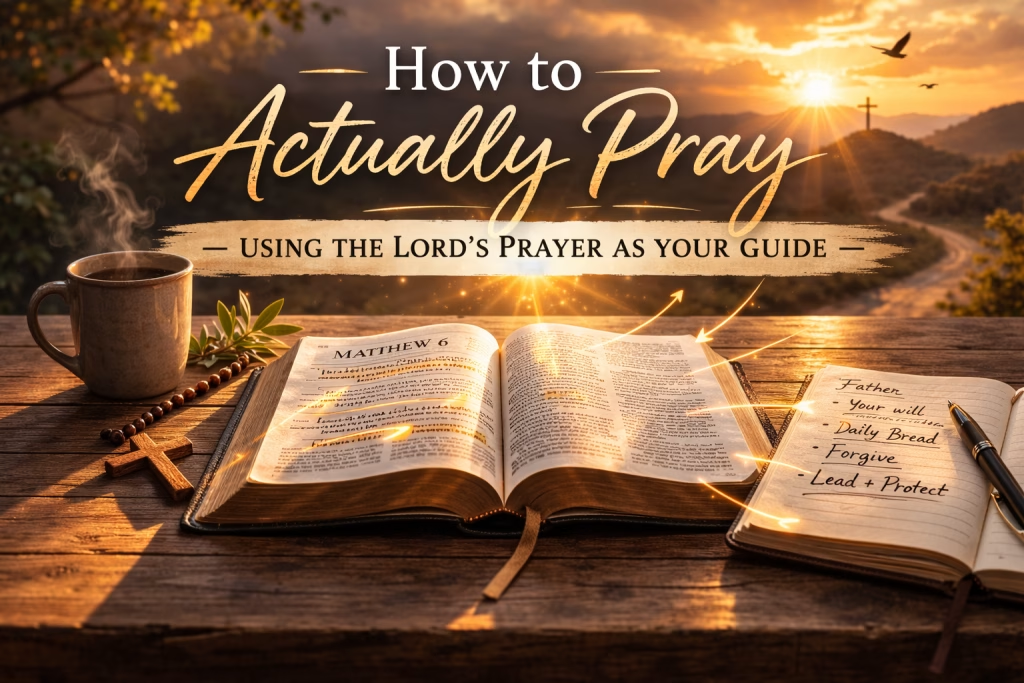
Many believers agree that Jesus gave us a pattern for prayer in Matthew 6 — but then quietly wonder:
“So what do I do when I actually sit down to pray?”
If the Lord’s Prayer is not merely a script to recite, how do we use it?
The answer is simple and freeing:
Each line is a doorway.
Instead of repeating the sentence and moving on, we pause, expand it, and let it shape real conversation with the Father.
Here is how that might look.
“Our Father which art in heaven…”
Start by slowing down.
You are not beginning a ritual. You are approaching a Person.
You might pray:
“Father, thank You that I belong to You. Thank You that I come not as a stranger, but as Your child. You are above all things — yet You invite me near.”
Let this settle your heart. Prayer begins with access, not anxiety.
“Hallowed be thy name.”
Turn your attention upward.
Instead of rushing into needs, worship first.
“Lord, Your name is holy. You are righteous, wise, faithful, and good. You do not change. You are worthy whether my circumstances feel stable or unstable.”
This realigns the soul. Many problems shrink when God grows in our sight.
“Thy kingdom come. Thy will be done…”
Now surrender your agenda.
“Father, in my home, in my work, in my church — let Your rule be seen. Where my desires conflict with Yours, change me. I want Your will, not just my comfort.”
Prayer is not persuading God. It is aligning with Him.
This may be the most transforming part of prayer.
“Give us this day our daily bread.”
Now bring your needs.
Be specific.
“Lord, I need wisdom for this decision. I need patience with this person. I need strength for today’s responsibilities. Provide what is necessary — not what feeds my fear.”
Notice: Jesus said daily bread.
We ask for what today requires, trusting tomorrow to God.
“Forgive us our debts…”
Confess honestly.
“Father, I was impatient. I was proud. I spoke carelessly. Cleanse me.”
Then pause and examine your heart toward others.
“Is there anyone I am holding in quiet resentment?”
If so:
“I release them to You. I choose forgiveness. I do not want bitterness to block fellowship with You.”
Prayer keeps the heart soft.
“Lead us not into temptation…”
End with watchfulness.
“Lord, guard my steps today. Protect me from situations that weaken me. Deliver me from the evil one. Keep me alert.”
Prayer is not only communion — it is protection.
A Simple 5–10 Minute Prayer Pattern
If you are new to this, here is a practical structure:
- 1–2 minutes: Acknowledge God as Father
- 1–2 minutes: Worship and magnify His name
- 1–2 minutes: Surrender your plans and ask for His will
- 2–3 minutes: Present your specific needs
- 1–2 minutes: Confession and forgiveness
- 1 minute: Ask for protection and spiritual alertness
This is not a formula — it is a framework.
Over time, your prayers will grow more natural, more honest, and more personal.
What Changes When You Pray This Way?
Prayer stops feeling repetitive.
It becomes relational.
You are no longer trying to “get through” a prayer. You are walking with your Father through the concerns of your heart.
The Lord’s Prayer was never meant to limit your words.
It was meant to shape your heart.
And when used as a guide, it becomes what Jesus intended — not a recital, but a way of living before God.
Final Encouragement
If you feel awkward at first, that is normal.
Relationship grows with use.
You do not need eloquence.
You do not need perfect wording.
You need honesty and trust.
The Father already knows what you need before you ask Him (Matthew 6:8).
Prayer is not informing Him.
It is walking with Him.