Series: Why I Trust the KJV — Post 2
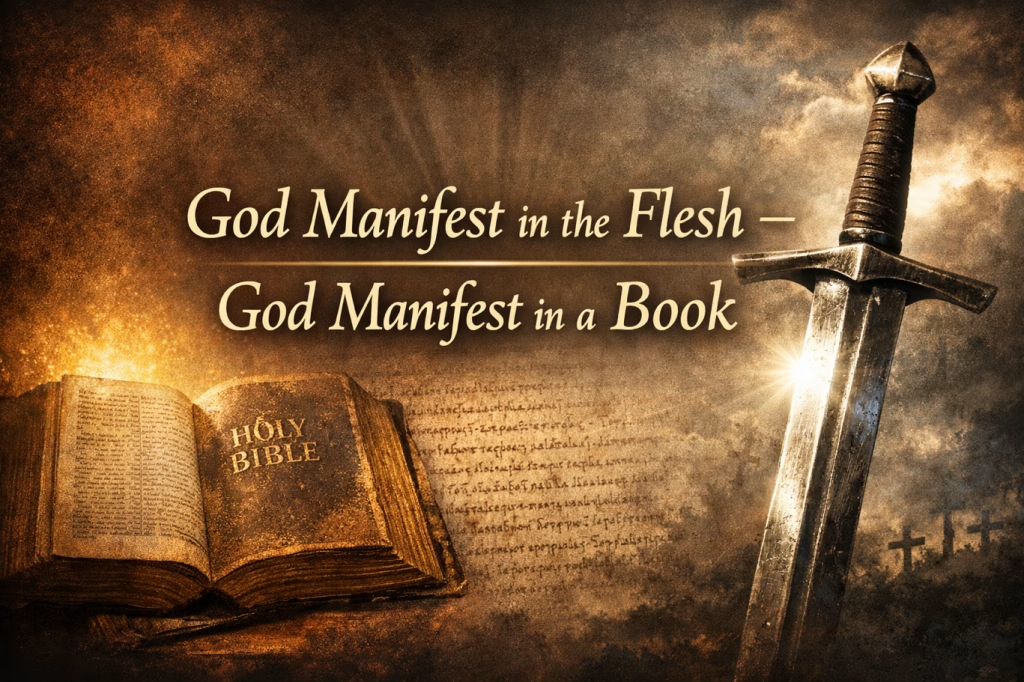
There is a reason the Bible never presents itself as a neutral religious artifact. Scripture does not ask to be evaluated before it is believed. It speaks as something already living, already authoritative, already judging the reader.
For the word of God is quick, and powerful, and sharper than any twoedged sword… (Heb. 4:12, KJV)
That verse is not poetic exaggeration. It is doctrinal reality. And it brings us to a truth many modern Christians have never been taught to face plainly:
You cannot separate Jesus Christ from His Word without diminishing both.
The Living Word and the Written Word
In Revelation 19, John sees the Lord Jesus Christ returning in power and judgment. He is clothed in white. His eyes burn with fire. A sharp sword proceeds from His mouth. And He bears a name above all names:
“And his name is called The Word of God.” (Rev. 19:13, KJV)
This is not metaphorical fluff. Scripture deliberately binds the identity of Christ to the identity of God’s Word. The same Bible that calls Jesus the Word also calls itself the word of God. That is not coincidence — it is revelation.
Jesus reveals the Father, scripture reveals the Son.
We do not know God by instinct, experience, or imagination. We know Him because He has spoken.
God Manifest in Flesh — God Manifest in a Book
The New Testament makes a staggering parallel that modern Christianity often softens.
- Jesus Christ is God manifest in the flesh (1 Tim. 3:16).
- Scripture is given by inspiration of God (2 Tim. 3:16).
One is divine truth clothed in humanity, the other is divine truth clothed in language.
Christ came through men without sin, scripture came through men without error.
This is not bibliolatry, this is consistency. If Christ had sinned once, He could not save. If Scripture errs once, it cannot judge.
That is why the issue of the Bible is never merely academic. It is Christological.
Revelation 19: Christ Described — The Word Reflected
When Revelation 19 describes Christ, it also quietly describes Scripture:
Heaven opened — the Word is revealed from heaven.
- White — the Word is pure.
- Faithful and True — the Word is faithful and true.
- Judging — the Word judges thoughts and intents.
- A sharp sword — the Word cuts, divides, exposes.
This is not clever symbolism. Scripture testifies of itself.
Jesus Himself said:
The word that I have spoken, the same shall judge him in the last day. (John 12:48, KJV)
If the Word judges, then the Word must be trustworthy.
Counterfeits Follow the Same Pattern
Scripture warns us of false Christs. It also warns us of corrupting the word of God (2 Cor. 2:17). These two warnings run in parallel for a reason.
Satan does not attack Christ directly anymore — he attacks how Christ is presented. He cannot erase Jesus from Bibles, but he can:
- soften His authority
- obscure His judgments
- blur His words
- multiply alternatives until certainty dies
Modern versions rarely deny Christ outright. They diminish Him subtly — just as false Christs do.
The Shared Titles, Attributes, and Works
Scripture does something remarkable: it gives the same titles, attributes, and works to Jesus Christ and to the Word itself.
Christ is called:
- Truth
- Light
- Holy
- Faithful
- Perfect
- Everlasting
- Powerful
The Word is called:
- Truth
- Light
- Holy
- Faithful
- Perfect
- Everlasting
- Powerful
- Christ saves.
- The Word saves.
- Christ sanctifies.
- The Word sanctifies.
- Christ judges.
- The Word judges.
To attack one is to attack the other.
Why This Matters for the KJV Question
This is where the issue sharpens.
The King James Bible does not merely contain truth. It speaks as truth. It does not apologize for authority. It does not hedge, qualify, or retreat. It exalts Christ plainly, fully, and consistently.
Modern versions introduce doubt where Scripture asserts certainty. They invite correction where Scripture declares judgment. They train readers to question words God says He magnified above His own name (Ps. 138:2).
If Christ is trustworthy, His Word must be trustworthy and if His Word is uncertain, Christ is diminished.
That is why I trust the King James Bible. Not because of nostalgia and not because of tradition, but because it speaks with the same voice, authority, and holiness Scripture claims for itself.
How We Should Respond
Scripture gives the response plainly:
- Believe God.
- Receive His Word.
- Glory in the Lord.
- Preach the Word.
A Bible you must continually correct will never correct you.
And a Christ softened by modern language will never conquer the heart.