Introduction
When the Bible speaks of the Holy Spirit, it speaks of abundance, power, and purpose. From Joel’s prophecy to the outpouring at Pentecost, the Word presents a vision of God’s people not only indwelt by the Spirit for salvation, but also empowered by the Spirit for witness, holiness, and spiritual gifts.
Joel 2:28-29 declared:
“And it shall come to pass afterward, that I will pour out my spirit upon all flesh… And also upon the servants and upon the handmaids in those days will I pour out my spirit.”
Peter confirms this at Pentecost (Acts 2:17-18), where the Spirit fell with power and they spoke in other tongues. But is this outpouring synonymous with salvation, or is it a further gifting of God?
Salvation brings the Spirit to dwell within us. Scripture is clear:
“That if thou shalt confess with thy mouth the Lord Jesus, and shalt believe in thine heart that God hath raised him from the dead, thou shalt be saved.” (Romans 10:9)
Upon believing, we are sealed with the Spirit (Ephesians 1:13). This is the new birth (John 3:5-6) — the Spirit within us, making us God’s own.
The Baptism in the Holy Spirit: The Spirit Upon
Yet, the book of Acts shows a pattern where the baptism in the Holy Spirit is a further gift — a distinct work where the Spirit comes upon believers for power, boldness, and spiritual gifts.
Jesus told His disciples:
“But ye shall receive power, after that the Holy Ghost is come upon you: and ye shall be witnesses unto me…” (Acts 1:8)
These disciples were already believers (John 20:22), yet were told to wait for this further empowering (Luke 24:49). Though they had believed, and even received the breath of life from Christ (John 20:22), the full outpouring of the Spirit was yet to come — for as Scripture says, “the Holy Ghost was not yet given; because that Jesus was not yet glorified” (John 7:39).
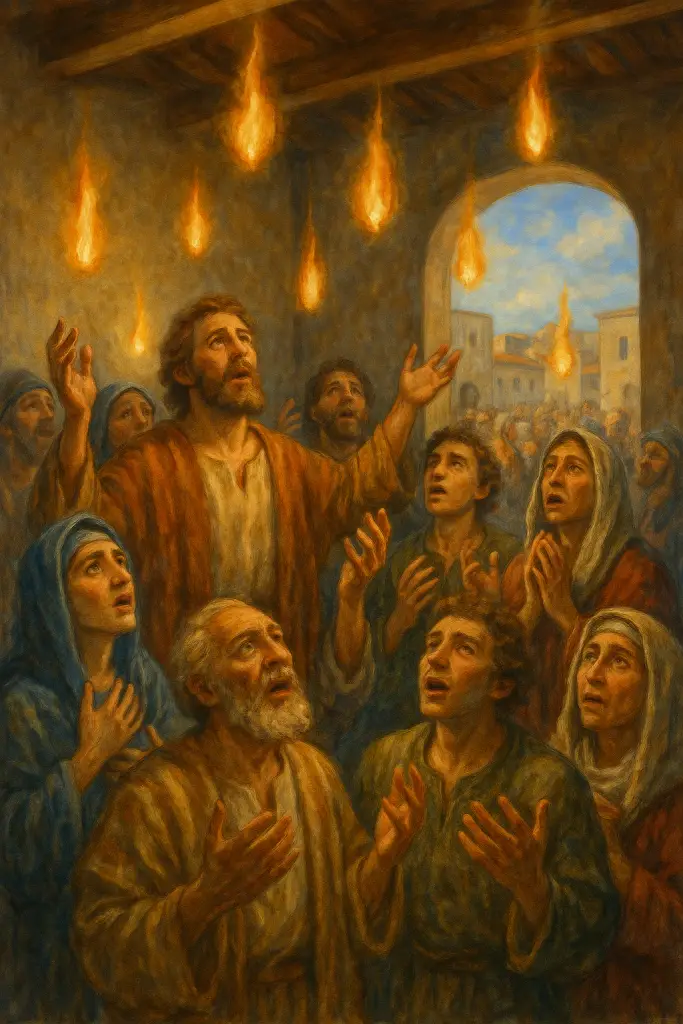
At Pentecost, they were all filled with the Holy Ghost and spoke with other tongues (Acts 2:1–4). The gift of tongues during this event was a sign of God’s presence and power — especially since men from many different countries heard the disciples glorifying God in their respective languages (Acts 2:11). But what many people miss is that the primary purpose of the Holy Spirit’s coming was to give them the power Jesus had promised — power to boldly witness for Him. Jesus had told them: ‘…tarry ye in the city of Jerusalem, until ye be endued with power from on high’ (Luke 24:49).
Less we miss more important outward signs…the outward sign of tongues was miraculous — but the inward result was supernatural boldness to preach Christ without fear. The fearful became fearless, the timid became bold, and the gospel spread like fire — not by human effort, but by divine power. And what compelled this boldness was not pride or defiance, but love — a Spirit-born love for their people, even for those who had rejected Christ. These disciples risked their lives because they longed for their countrymen to know the truth — that the promised Messiah had come, that the Scriptures were fulfilled, and that forgiveness was freely offered through His name.
The fearful became fearless, the timid became bold, and the gospel spread like fire — not by human effort, but by divine power.
Biblical Pattern: Receiving the Spirit After Belief
Acts 19:2 records Paul asking, “Have ye received the Holy Ghost since ye believed?” This question from Paul is highly significant and should not be misunderstood. Paul was not questioning whether these believers had received the Holy Spirit within them for salvation — for Scripture teaches clearly that all true believers receive the Spirit when they are born again (Romans 8:9; Ephesians 1:13). Rather, Paul was discerning whether they had experienced the further outpouring of the Spirit upon them for power, as was common in the early church following salvation.
Sadly, some modern translations, like the ESV, render this as, “Did you receive the Holy Spirit when you believed?” This confuses the issue, for of course Paul knew they were believers who possessed the Spirit within. His question points instead to the subsequent empowering of the Spirit upon believers for ministry and boldness.
Paul prayed for them, and they received the Holy Ghost, speaking with tongues and prophesying (Acts 19:5–6).
This same pattern is seen elsewhere in the book of Acts. In Samaria, believers received the word of God and were baptized — but only later did the Spirit fall upon them through the laying on of hands (Acts 8:14–17). Even Cornelius’ household received the Spirit while hearing the word, speaking in tongues as evidence of the Spirit’s outpouring (Acts 10:44–46).
Speaking in Tongues: A Common but Not Universal Sign
In the New Testament, speaking in tongues frequently accompanies the baptism in the Holy Spirit, but it is not presented as an invariable sign. Out of five recorded instances in Acts where individuals received the Holy Spirit, three explicitly mention speaking in tongues:
- Acts 2:4 — At Pentecost, all present were filled with the Holy Spirit and began to speak in other tongues.
- Acts 10:46 — In Cornelius’ household, the Gentile believers spoke in tongues, astonishing the Jewish believers.
- Acts 19:6 — In Ephesus, upon receiving the Holy Spirit, the disciples spoke in tongues and prophesied.
In the other two instances, speaking in tongues is not explicitly mentioned:
- Acts 8:17 — The Samaritans received the Holy Spirit, and while tongues are not mentioned, Simon the sorcerer observed something significant that led him to offer money for the ability to impart the Spirit, suggesting a visible manifestation.
- Acts 9:17-18 — Paul’s encounter includes being filled with the Holy Spirit, but tongues are not mentioned at that moment. However, Paul later states, “I thank God that I speak in tongues more than all of you” (1 Corinthians 14:18), indicating he did speak in tongues.
These accounts demonstrate that while speaking in tongues is a common outward sign of the baptism in the Holy Spirit, it is not an absolute requirement. The emphasis remains on the empowerment and transformation that the Holy Spirit brings.
Speaking in Tongues: Biblical Purpose
Speaking in tongues, biblically, serves multiple purposes:
- As a sign of the Spirit’s outpouring (Acts 2, Acts 10, Acts 19)
- For personal edification (1 Corinthians 14:2, 4)
- When interpreted, for the edification of the church (1 Corinthians 14:27-28)
Paul teaches order: tongues should not dominate public worship unless interpreted, but neither should they be despised (1 Corinthians 14:39).
Spirit Within vs. Spirit Upon
Salvation is the Spirit within us — securing us as God’s children (Romans 8:9). The baptism in the Holy Spirit is the Spirit upon us — equipping us for ministry, spiritual gifts, and boldness (Acts 1:8).
Both are works of grace. Both are essential. But Scripture shows they are not always simultaneous. God, in His wisdom, pours out His Spirit as He wills (John 3:8).
Seeking the Fullness of the Spirit
Believers are invited to seek the fullness of the Holy Spirit:
“If ye then, being evil, know how to give good gifts unto your children: how much more shall your heavenly Father give the Holy Spirit to them that ask him?” (Luke 11:13)
This is not about spiritual superiority, but about being fully surrendered vessels. It is about walking in power, holiness, discernment, and spiritual vitality.
Conclusion: Living in the Promise
Jesus declared to His disciples that it was essential — “Tarry ye in the city of Jerusalem, until ye be endued with power from on high” (Luke 24:49). They were not to go forth in their own strength, wisdom, or experience — but in the power of the Holy Spirit.
This baptism in the Holy Spirit is not an optional blessing for a few — it is the promised gift of the Father for all who believe and hunger for more of His presence and power. It is given not for self-glory, but to glorify Jesus Christ. It is power to witness, power to live holy , and power to love boldly in a world darkened by sin.
Salvation is the Spirit within us — sealing us as God’s children.
The baptism in the Spirit is the Spirit upon us — clothing us with power to live and speak for Christ.
Let us not be content with a form of godliness without power (2 Timothy 3:5). Let us not settle for knowledge without fire, or confession without fullness. Let us seek all that God has promised — not for our sake, but for His Name’s sake among the nations.
Even so, come, Holy Spirit. Fall afresh on Your people. Empower us to live, to love, and to labor for the glory of Jesus Christ.