Series: Freedom That Remains — Post 5
The Only Way Freedom Stays Free
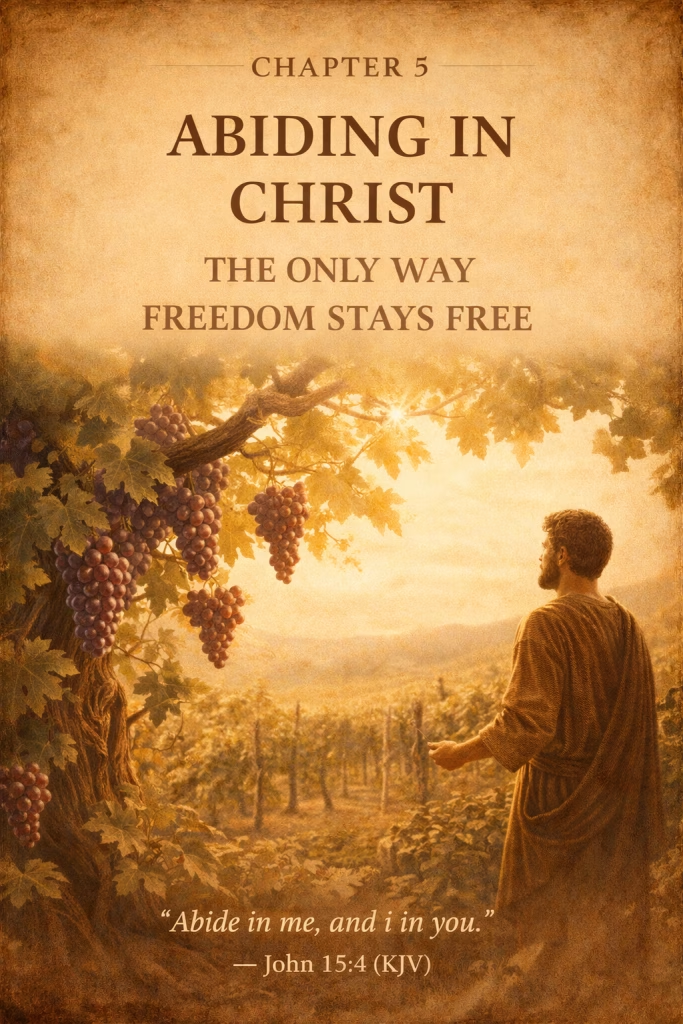
Deliverance confronts the enemy.
Discipleship trains the believer.
But abiding in Christ is what makes freedom endure.
Many believers are delivered but not free. Others are disciplined but not alive. Some are zealous but exhausted. The missing center is not another method, teaching, or ministry—it is abiding union with Christ Himself.
Freedom that remains does not come from fighting harder or managing sin better. It comes from remaining where victory already is.
“Abide in me, and I in you. As the branch cannot bear fruit of itself, except it abide in the vine; no more can ye, except ye abide in me.”
— John 15:4 (KJV)
Abiding Is Not Passivity — It Is Position
Abiding is often misunderstood as spiritual passivity: “Just rest. Just trust. Do nothing.”
Scripture teaches the opposite.
Abiding is active dependence, not inactivity.
It is ongoing union, not occasional surrender.
It is remaining, not visiting.
Jesus does not say, “Come to me once.”
He says, “Remain in me.”
A branch does not strive to produce fruit—it bears fruit because it stays connected. The moment it disconnects, fruitfulness ends. The same is true for freedom.
Deliverance can remove an intruder.
Discipleship can retrain habits.
But only abiding keeps the house occupied.
Why Freedom Collapses Without Abiding
Jesus gives a sober warning in Luke 11:24–26. When an unclean spirit leaves a man, it wanders and then returns to the house—swept, but empty.
The problem is not that deliverance failed.
The problem is that nothing took possession afterward.
An empty house invites re-entry.
A filled house resists invasion.
Abiding is how Christ fills the house.
When believers do not learn to live from Christ’s indwelling life, they attempt to maintain freedom through:
- vigilance without vitality
- discipline without affection
- warfare without worship
- obedience without intimacy
The result is exhaustion, relapse, or legalism.
Union With Christ Is the True Safeguard
The New Testament does not emphasize constant spiritual warfare as the believer’s primary posture. It emphasizes union.
“Christ in you, the hope of glory.”
— Colossians 1:27 (KJV)
“He that is joined unto the Lord is one spirit.”
— 1 Corinthians 6:17 (KJV)
The enemy does not fear Christians who know techniques.
He fears believers who know where they live.
Abiding anchors identity. Identity governs behavior. Behavior determines territory.
When believers forget who they are in Christ, they attempt to regain freedom by effort. When they remember who they are, obedience flows naturally.
Abiding Ends the Cycle of Striving
Much burnout in deliverance and discipleship ministry comes from trying to do for people what only Christ can do in them.
Abiding shifts the source of change:
- From self-management → to Spirit-life
- From willpower → to indwelling power
- From fear of relapse → to confidence in Christ
Paul captures this perfectly:
“I am crucified with Christ: nevertheless I live; yet not I, but Christ liveth in me…”
— Galatians 2:20 (KJV)
The Christian life is not Christ assisting you.
It is Christ expressing Himself through you.
Freedom remains when Christ is not merely believed in—but lived from.
Abiding Replaces Control With Communion
Many believers relapse not because demons return, but because control replaces communion.
They manage emotions instead of yielding them.
They suppress desires instead of surrendering them.
They monitor sin instead of magnifying Christ.
Abiding restores a relational center.
“Because thy lovingkindness is better than life, my lips shall praise thee.”
— Psalm 63:3 (KJV)
Love sustains what fear cannot.
Where love governs, fear loses authority.
Where Christ fills the heart, darkness finds no vacancy.
The End of the Cycle: Living From Rest
Hebrews speaks of a rest that must be entered—not earned.
“Let us labour therefore to enter into that rest…”
— Hebrews 4:11 (KJV)
This labor is not striving—it is faithful remaining.
Abiding is the posture of overcomers.
Not those who never face battles, but those who fight from victory, not for it.
Deliverance opens the door.
Possession secures the ground.
Abiding establishes the throne.
Christ is not only the Deliverer.
He is not only the Teacher.
He is the indwelling King.
And where the King reigns, freedom remains.
Transition to Conclusion
Freedom that lasts is not maintained by constant vigilance—but by continual fellowship.
Not by fear of falling—but by love of remaining.
The final chapter brings these threads together and calls the believer to a settled, mature life of victory:
deliverance accomplished, possession established, and abiding sustained.