And Why Jesus Gave a Two-Horizon Prophecy
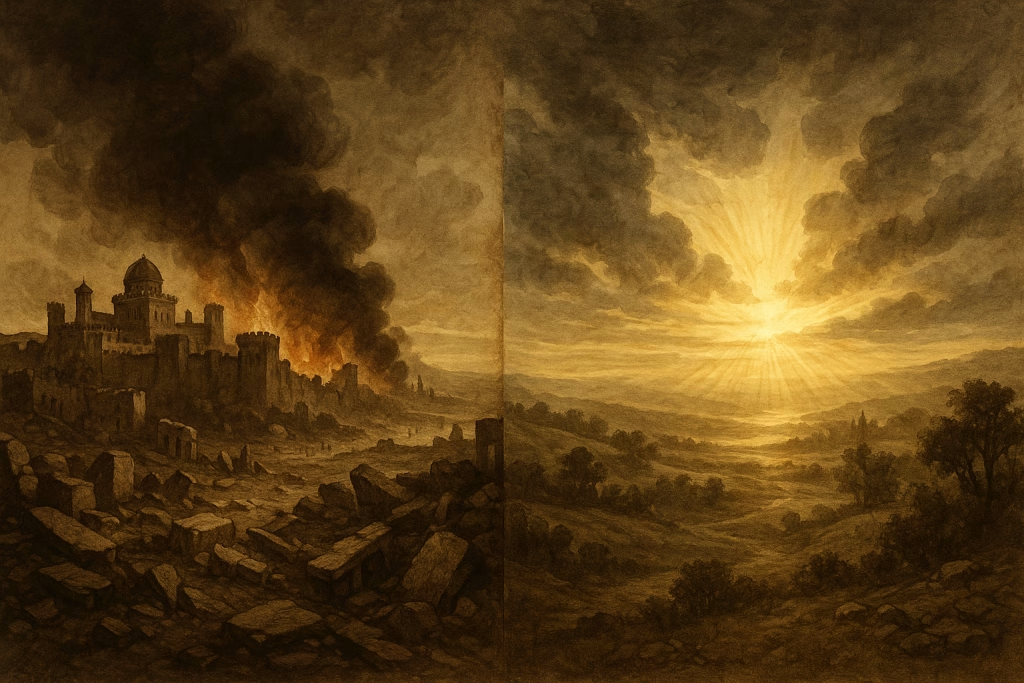
There is a growing trend — especially among hyper-preterists and some partial-preterists — to force all of Matthew 24 into a single past fulfillment in AD 70. And while AD 70 is very real, very biblical, and absolutely necessary to understand, it is not the end of the story.
To collapse the whole chapter into that single event is to do violence to the words of the Lord Jesus and to erase the consistent testimony of the apostles.
And we are living in a day where false prophetic systems are deceiving the simple — so we must return to what Scripture actually says.
This post will make one simple point:
Matthew 24 contains both a near judgment (AD 70) and the far, glorious appearing of Christ — because Jesus Himself made it so.
This is not a theory. This is not a system.
This is the Lord’s own teaching.
The Disciples Ask Two Questions — So Jesus Gives Two Answers
Matthew 24:3 is the key:
- “When shall these things be?” (destruction of the temple)
- “What shall be the sign of Thy coming, and of the end of the world?”
These are not the same event.
The disciples didn’t understand the gap — just like they didn’t understand the cross.
But Jesus understood it — and He answered both questions.
Every interpretation that forces Matthew 24 into one event is already off the rails before the chapter even begins.
AD 70 Was Real — But It Was Not the Coming of the Son of Man in Glory
Jesus absolutely came in judgment upon Jerusalem in AD 70.
He said He would.
And He did.
But AD 70 did not bring:
- “all the tribes of the earth mourning”
- “the Son of Man coming in the clouds of heaven with power and great glory”
- “His angels gathering His elect from the four winds”
- the universal, visible appearing of Christ
(See Matthew 24:29–31.)
These things simply did not happen in AD 70.
Not symbolically.
Not spiritually.
Not partially.
They did not happen.
To claim they did — or to reduce them to metaphors — is to deny Jesus’ own plain words.
Prophetic Telescoping: “Near and Far” Is Normal in Scripture
The prophets constantly merged near and far events into one prophetic picture.
Examples:
- Isaiah 61 — Jesus fulfills half at His first coming, leaves the other half for the end (Luke 4:21).
- Joel 2 — Pentecost fulfilled part, the cosmic signs remain future.
- Isaiah 13 — Babylon’s fall is described in Day-of-the-Lord language that also reaches to the last days.
Matthew 24 follows this exact prophetic pattern.
The Jews called this prophetic foreshortening.
Jesus uses it perfectly.
The Word “Immediately” (Matt. 24:29) Does Not Mean What Modern Readers Think
“Immediately after those days” is not a stopwatch.
Greek εὐθέως can mean:
- “the next event in the prophetic sequence”
- “theologically connected”
- “the next horizon in God’s plan”
It does not require the events to be back-to-back in history.
The prophets used “immediately” the same way.
The systems that say Matthew 24 must be only AD 70 ignore this.
Jesus Makes a Clear Shift in Verse 36
After describing the near judgment, Jesus abruptly says:
“But of THAT day and hour knoweth no man…” (Matt. 24:36)
“This generation” = near event.
“That day” = final event.
Jesus knew the difference.
He expected His disciples to see it.
And He placed a Holy Ghost-inspired dividing line right between the two horizons.
The Apostles Expected a Future, Visible Return — Not a Past One
Every apostolic writer — every one — says the appearing of Christ is still future:
- Paul: “all them that love His appearing” (2 Tim. 4:8)
- Peter: “when the chief Shepherd shall appear” (1 Pet. 5:4)
- John: “we shall see Him as He is” (1 John 3:2)
- Revelation: “every eye shall see Him” (Rev. 1:7)
If Matthew 24:30 happened in AD 70, then all the apostles were wrong.
Impossible.
The Final Coming of Christ Is Global — AD 70 Was Local
AD 70 judgment was real and biblical.
But it was local — in Judea, as Jesus said (Matt. 24:15–20).
By contrast, the Second Coming is:
- global
- visible
- glorious
- accompanied by resurrection
- the end of the age
Trying to merge the two destroys both.
Conclusion: Matthew 24 Is Not “Either/Or” — It Is “Both/And”
The near judgment (AD 70) validated Jesus as Prophet.
The final coming vindicates Him as King of kings.
Deny the near event?
You miss the severity of rejecting the Messiah.
Deny the far event?
You miss the blessed hope of His return.
Truth holds both horizons — exactly as Jesus taught.
And in these last days, when deception multiplies, we need the whole counsel of the Lord, not the systems of men.