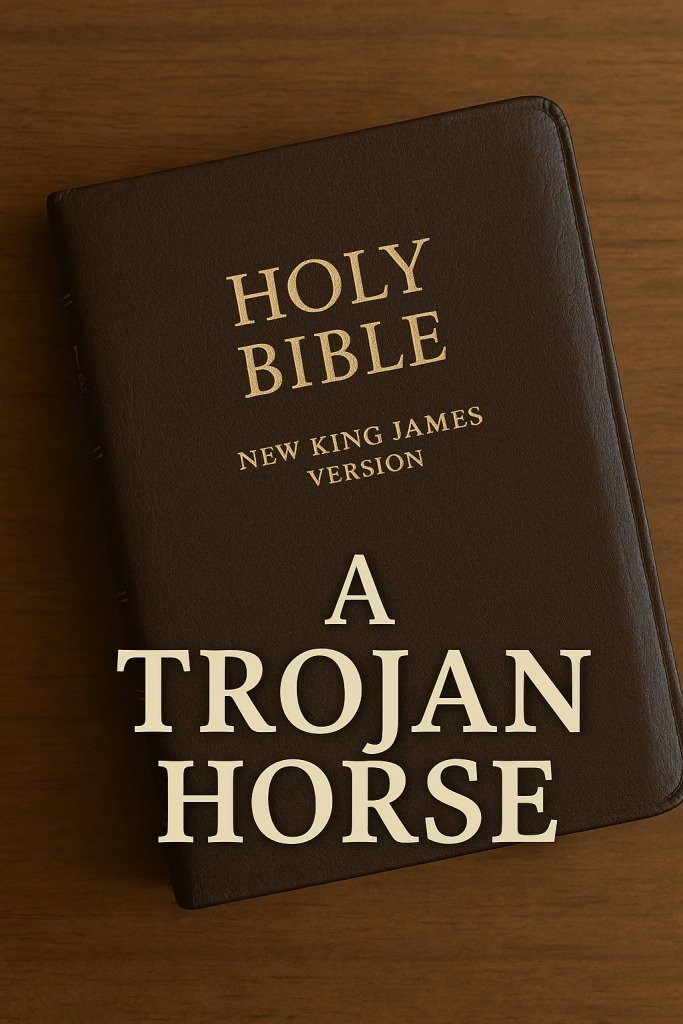
The most egregious deception of the NKJV is not its typography or its branding — but its pretense. It claims to be the same as the King James Bible, but it secretly makes the same doctrinal compromises as the ESV and NIV.
Unlike those versions, which openly use different Greek texts, the NKJV masquerades as a trustworthy alternative — when in truth, it undermines the very same foundations.
1. Same Doctrinal Attacks, Hidden Under Familiar Language
- “Repent” is replaced with soft, vague phrases like “be sorry” or “change your mind”
- “Hell” is changed to “Hades” or “Sheol” more than 20 times, dulling the warning of eternal judgment
- “Jehovah” — God’s covenant name — is completely removed (see Psalm 83:18)
- “Impute” becomes “credit” — reducing the spiritual doctrine of righteousness declared by God to a financial metaphor
2. The Word “Holy” Is Systematically Removed
From the AV Publications tract:
| KJV Phrase | NKJV Replacement | What’s Missing |
|---|---|---|
| “Holy men of God” (2 Pet 1:21) | “men” | Reverence for God’s vessels |
| “Holy scriptures” (Rom 1:2) | “Scriptures” | Sacredness of God’s Word |
| “Holy commandments” | “Commandments” | Authority of God’s law |
| “Holy temple” (Ps 138:2) | “temple” | Sanctity of His presence |
This is not modernization — it’s de-sanctification. The NKJV subtly removes the reverent adjectives that preserve the sense of awe, purity, and sacredness.
3. It’s Not Simpler — It’s Just Subtly Corrupted
Many assume the NKJV just updates hard words. But in truth, it often replaces simple KJV words with more complex ones, making reading harder, not easier.
| KJV Word | NKJV Replacement | Which is Easier? |
|---|---|---|
| “raiment” | “apparel” | More formal |
| “foolish” | “insensate” | Obscure |
| “ensample” | “example” | Same meaning, but KJV has spiritual nuance |
| “ghost” (Holy Ghost) | “Spirit” | Less personal, doctrinal downgrade |
4. The Copyright Trap
Because it is copyrighted, the NKJV is required to change thousands of words — even when no clarity is gained. Over 100,000 word changes exist between it and the KJV. These aren’t just updates — they are alterations done to create a new marketable text.
“A little leaven leaveneth the whole lump.”
— Galatians 5:9
5. A Trojan Horse in the Pulpit
The NKJV bears the King’s name, but not the King’s voice. It rides into homes and pulpits on familiar-sounding phrases, only to change the meaning from within. It is the most dangerous because it is the most trusted — and therefore, least examined.
If Satan cannot stop people from reading the Bible, his next move is to give them a version with just enough truth to be accepted — and just enough corruption to confuse.
“For we are not as many, which corrupt the word of God…”
— 2 Corinthians 2:17 (KJV)
From Reverence to Relatability: A God Brought Down to Human Level
Modern Bible versions don’t just change the words — they change the tone. The shift from holy reverence to emotional familiarity brings God down to man’s level. It emphasizes feelings over fear, sympathy over sovereignty, and empathy over holiness.
They shift from truth-centered language to feelings-based vocabulary.
The result? A God who sounds more like a therapist than a King.
| KJV Phrase | Modern Version | Spiritual Effect |
|---|---|---|
| “Fear of the LORD” | *“Reverence” or “Respect” | Downplays divine dread and awe |
| “Bowed his head and worshipped” | “Was overjoyed”, “felt thankful” | Replaces action with feeling |
| “God is angry with the wicked every day” (Ps. 7:11) | Softened or omitted | Removes God’s ongoing righteous anger |
| “Grieved” | “hurt”, “felt sad” | Makes God emotionally fragile |
| “It pleased the LORD to bruise him” (Isa. 53:10) | “The LORD was willing…” | Removes God’s active role in atonement |
| “Jesus wept” | Emphasized as “deeply moved in spirit” (John 11) | Over-interprets emotion to craft empathy narrative |
| “Be ye therefore perfect” | “mature,” “complete” | Waters down the call to holiness |
| “He is Lord of all” | “He is over all” | Changes authority to general leadership |
These changes reframe the majestic and terrible God of Scripture into a soft, sentimental deity — shaped more by modern emotions than eternal holiness.
This subtle shift reshapes God’s character. He becomes less holy, less authoritative, and more passive and permissive. The fear of the Lord — the beginning of wisdom — is traded for soft expressions of emotional warmth.
No wonder false doctrines flourish under this tone. If God is merely “disappointed,” who fears judgment? If sin merely “hurts His heart,” who trembles at His Word?