It’s Harder: Exposing the Myth
One of the primary selling points of the New King James Version (NKJV) is its supposed “readability.” Publishers claim it keeps the accuracy of the KJV while updating archaic words. But when you compare the two side by side, the results are shocking: the NKJV is often harder to read than the King James Bible.
Why? Because the KJV uses simple, Anglo-Saxon, one- or two-syllable words. The NKJV, in trying to copyright itself as a “new” work, replaces these with longer, Latinized terms that sound scholarly — but confuse the average reader.
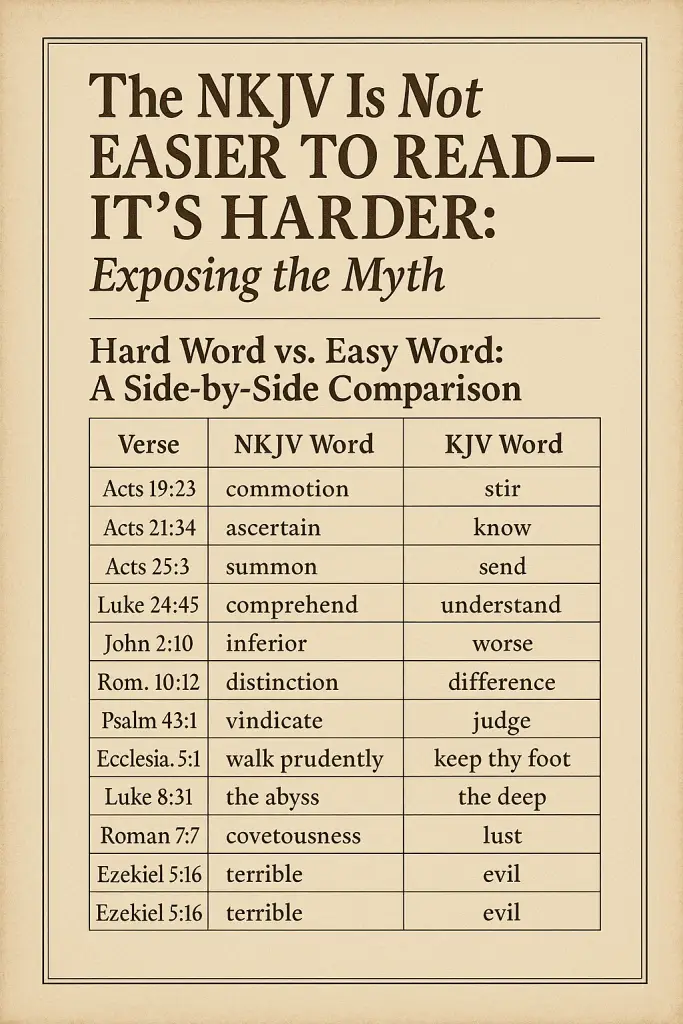
Hard Word vs. Easy Word: A Side-by-Side Comparison
Here are just a few examples from the AV Publications tract:
Why Does the NKJV Do This?
The answer is simple — and disturbing. According to U.S. copyright law, a Bible version must contain enough differences to be considered a new, copyrightable work. AV Publications explains:
“Making minor changes or additions of little substance to a pre-existing work will not qualify the work as a new version for copyright purposes.”
In other words, if the NKJV merely updated a few words, it wouldn’t be considered original — and therefore not profitable. So it had to change enough language to become a “new” Bible. The result? A so-called “easier” version that actually reads at a higher grade level than the KJV.
The KJV’s Built-in Simplicity
Gail Riplinger notes that the KJV reads at a 5th-grade level, making it ideal for teaching children and adults alike. It uses short, strong, time-tested English words — “lust” instead of “covetousness,” “know” instead of “ascertain,” “worse” instead of “inferior.”
This clarity isn’t just about readability. It reflects the spiritual simplicity and power of the original languages, which were given to common people — not scholars.
“The common people heard him gladly.” (Mark 12:37)
Why This Matters Spiritually
If the Word of God is to dwell richly in believers, it must first be understood. Every time a modern Bible makes language more complex, it creates distance between the reader and the truth.
God’s Word should not be shrouded in academic jargon. It should speak plainly, as the Spirit speaks:
“I have not spoken in secret, in a dark place of the earth…” (Isaiah 45:19)
And the King James Bible does just that — with unmatched clarity and beauty.
Conclusion: Stick With What’s Simple and True
When a Bible replaces “judge” with “vindicate,” or “send” with “summon,” it may sound more intellectual, but it loses connection. The power of Scripture is not in multisyllabic pomp — it’s in truth plainly spoken.
“The words of the LORD are pure words: as silver tried in a furnace of earth, purified seven times.” (Psalm 12:6)
There will never be a version “easier to read” than the King James Bible. It was built for the heart, the ear, and the soul — not the ivory tower.