“And in that day will I make Jerusalem a burdensome stone for all people: all that burden themselves with it shall be cut in pieces, though all the people of the earth be gathered together against it.” — Zechariah 12:3 (KJV)
This verse is often cited by Christian Zionists to argue that God will defend the modern nation-state of Israel against the nations of the world. But is that what the prophet meant? And how does the New Testament interpret this kind of imagery?
Let’s take a closer look.
Not a Political Endorsement, But a Prophetic Warning
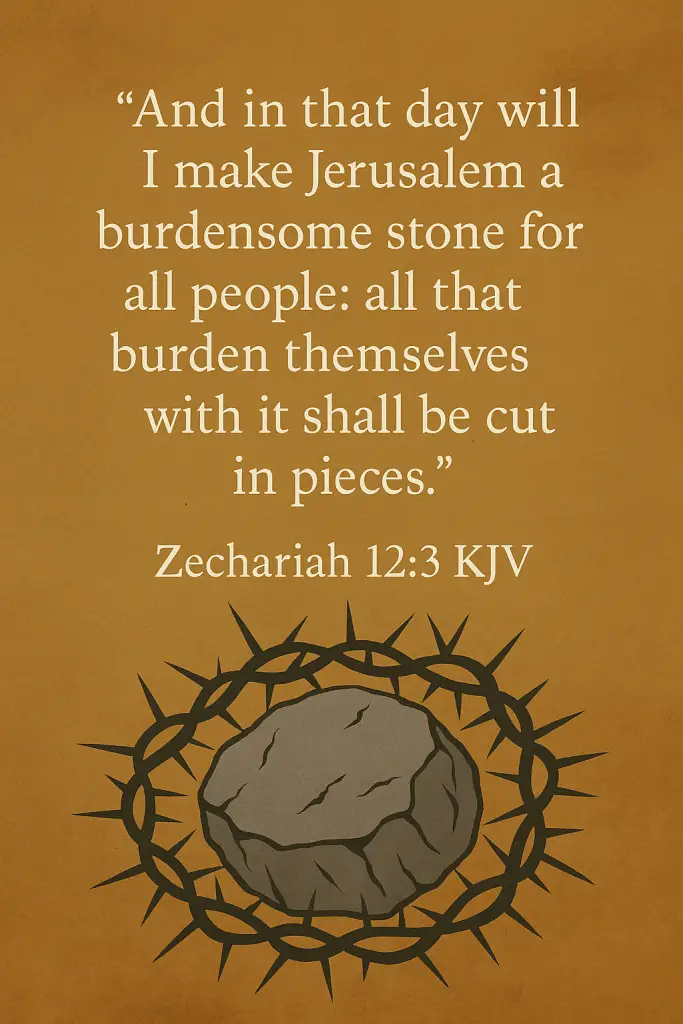
Zechariah’s language is vivid: Jerusalem as a stone so heavy that those who try to move it will injure themselves. But rather than a mandate to support geopolitical Israel, the verse carries a deeper, more enduring warning: don’t oppose the work of God.
In prophetic symbolism, Jerusalem is more than just a city. It represents God’s covenant people and His dwelling place. And in the New Testament, this meaning is elevated and spiritualized:
“But ye are come unto mount Sion, and unto the city of the living God, the heavenly Jerusalem…” — Hebrews 12:22
“But Jerusalem which is above is free, which is the mother of us all.” — Galatians 4:26
The Jerusalem that matters now is not the one in the Middle East, but the one composed of believers in Christ — the Church, the Body of Christ, the spiritual temple.
The Stumbling Stone
The “burdensome stone” in Zechariah 12:3 ultimately finds its fulfillment in Christ Himself:
“Behold, I lay in Sion a stumblingstone and rock of offence: and whosoever believeth on him shall not be ashamed.” — Romans 9:33
“And whosoever shall fall on this stone shall be broken: but on whomsoever it shall fall, it will grind him to powder.” — Matthew 21:44
He is the rock that breaks kingdoms (Daniel 2), the cornerstone rejected by the builders, and the one against whom the world still rebels. To oppose Christ and His Church is to pick up that stone and be cut.
The World Miscalculates the Church
In every generation, the Church appears weak, scattered, and easily dismissed. But she is the pillar and ground of the truth (1 Timothy 3:15). She carries the gospel, the only hope of salvation.
Those who “burden themselves” with Jerusalem today are not opposing a city in the Middle East — they are opposing God’s redemptive plan in Christ. They are resisting the Word of God, the reign of Christ, and the eternal kingdom that cannot be moved.
And the result? They will be “cut in pieces.”
Not because of foreign policy. Not because of national borders. But because they have opposed the King.
In Summary
Zechariah 12:3 is not a license to support a geopolitical agenda. It is a prophetic picture of the world’s resistance to Christ and His people — and the devastating consequences of that rebellion.
The King James Bible lets this verse speak with full prophetic thunder, unfiltered and unsoftened. And when we let Scripture interpret Scripture, the message is clear:
Christ is the stone. The Church is His dwelling. And those who oppose Him will fall.
So it’s okay in your view to annihilate this small nation called Israel? Your kind of view is what fuel antisemitic rhetoric and it’s dangerous, it’s what fueled Hitler to commit genocide against the jew, look like jews, smelled like jews, support jews!
The biblical verses that describe all nations being against Israel are found in the Book of Zechariah, specifically in Zechariah 12:2-3 and Zechariah 14:2. These verses depict a future event where the Lord will gather all nations against Jerusalem and Israel, though ultimately He will defend Jerusalem.
Zechariah 12:2-3 (NIV):
“On that day, when all the nations of the earth are gathered against her, I will make Jerusalem an immovable rock for all the nations. All who try to move it will injure themselves.”
Zechariah 14:2 (NIV):
“I will gather all the nations to Jerusalem to fight against it; the city will be captured, the houses ransacked, and the women raped. Half of the city will go into exile, but the rest of the people will not be taken from the city.”
These passages speak of a future time of great conflict where Jerusalem will be a focal point of opposition, but the verses also promise God’s intervention and defense of His people.
Key aspects of these passages:
Gathering of Nations: The verses describe God gathering all the surrounding nations to make war against Jerusalem.
Jerusalem’s Strength: Despite the attack, Jerusalem is described as an “immovable rock” that will cause the attackers to injure themselves.
Divine Intervention: The Lord will ultimately fight against these nations and defend Jerusalem.
Hello Zoila,
I appreciate you taking the time to comment, but I believe you have seriously misunderstood both the article and my position.
Rejecting Christian Zionism is not the same thing as hating Jewish people.
I do not support antisemitism, hatred toward Jews, violence against Jews, or genocide against anyone. Those accusations are extremely serious and should not be casually thrown at fellow Christians simply because they interpret prophecy differently.
My article was not calling for the annihilation of Israel. It was examining whether Zechariah 12 should automatically be interpreted through a modern geopolitical lens, or whether the New Testament gives us a Christ-centered fulfillment framework.
That is a theological discussion, not racial hatred.
Ironically, the very passage you quoted points to Christ Himself as the true stone:
“The stone which the builders refused is become the head stone of the corner.” (Psalm 118:22)
“The stone which the builders disallowed, the same is made the head of the corner.” (1 Peter 2:7)
Daniel 2 also speaks of the stone cut without hands that destroys the kingdoms of men and fills the whole earth — a kingdom fulfilled in Christ.
The issue is not whether God loves Jewish people. Of course He does. The Gospel itself came through the Jews, and the apostles were Jews. Salvation is offered freely to Jew and Gentile alike through Jesus Christ.
The issue is whether modern political Israel should automatically be equated with every prophetic promise in Scripture while ignoring how the New Testament repeatedly centers fulfillment in Christ and His body.
As for Zechariah 12 and 14, I would simply encourage you to read them alongside the New Testament rather than apart from it. The apostles consistently interpreted Old Testament prophecy through the lens of Christ’s death, resurrection, kingdom, and the inclusion of both Jew and Gentile into one new man.
That is not hatred toward Jews.
That is New Testament theology.
And respectfully, comparing fellow Christians to Hitler because they reject Christian Zionism only shuts down serious biblical discussion rather than helping it.