Post 8 of the Forensic Book Reviews
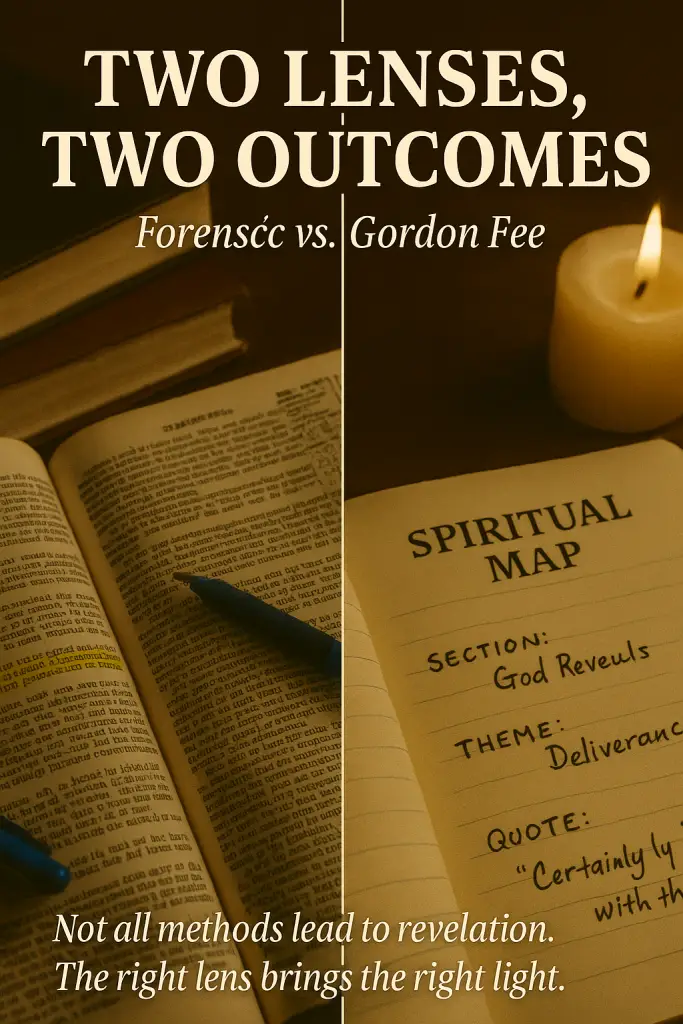
There are many methods for reading the Bible — but not all are equal in outcome. Some aim for literary understanding. Others seek spiritual revelation.
This post compares the widely taught method of Gordon Fee (How to Read the Bible for All Its Worth) with the Forensic Review approach.
Both aim to help believers interpret Scripture. But the lens is different — and so is the outcome.
📖 1. Gordon Fee’s Approach (Academic Lens)
Strengths:
- Emphasizes genre, grammar, and historical context
- Teaches respect for original audience and setting
- Warns against misapplication and taking verses out of context
Limitations:
- Often discourages typology unless explicitly confirmed in the NT
- Treats parables and prophecy mainly as literary devices
- Avoids devotional interpretation unless it aligns with scholarly consensus
- Relies heavily on external tools (commentaries, history, archaeology)
🧠 Result: Clearer understanding of the human authorship — but often at the cost of spiritual immediacy.
🔍 2. The Forensic Book Review Approach (Spiritual Lens)
Strengths:
- Starts with the belief that all Scripture is spiritually unified and God-breathed
- Embraces typology, spiritual patterns, and progressive revelation
- Seeks the heart of God in every passage — not just the mind of the human writer
- Focuses on application, transformation, and Christ-exalting truth
🕊 Result: Deeper discernment of the voice of the Spirit, not just the structure of the text
📊 Side-by-Side Comparison:
| Aspect | Gordon Fee | Forensic Approach |
|---|---|---|
| Lens | Historical/Grammatical | Spiritual/Revelatory |
| Main Goal | Understand the original meaning | Discern the present voice of God |
| Use of Typology | Limited, often discouraged | Embraced as divinely designed |
| Role of the Holy Spirit | Background interpreter | Primary teacher and revealer |
| Application Focus | Careful but secondary | Central and immediate |
| View of Scripture | Ancient text with divine origin | Living Word with unified spiritual message |
🛠 Example: Exodus 3 — The Call of Moses
- Fee’s Lens:
Emphasizes the historical call of Moses, the cultural context of “I AM,” and the deliverance of Israel from Egypt. - Forensic Lens:
Sees Moses’ call as a type of the believer’s calling. “I AM” becomes a timeless declaration of God’s sufficiency — not just for Moses, but for us. The burning bush becomes a symbol of divine fire that doesn’t consume but calls.
Same text. Different depth.
✍️ Why This Matters:
The method you choose shapes the message you hear.
If your lens reduces Scripture to history, you’ll miss its prophecy.
If it stays stuck in grammar, you’ll miss glory.
If it explains but doesn’t pierce, it may instruct but never transform.
Final Word:
Gordon Fee’s approach can be helpful for basic structure and context — but it must never replace spiritual discernment. The Forensic Review approach doesn’t reject clarity — it goes further.
Because the Bible isn’t just a book to study. It’s a sword to wield.
It’s not just history. It’s holy ground.
Choose your lens wisely.